How to Get Rid of Mice in Your House: A DIY Plan
To get rid of mice in your house, set snap traps in pairs along the walls where you find fresh droppings, seal every gap ¼ inch or wider with steel wool or copper mesh plus caulk, and store food in sealed containers. Skip repellents, mothballs and poison. When a week passes with no catches and no new droppings, you’re done.
Cost: about $57–71 in supplies. Difficulty: moderate. Call a pro if you’ve trapped steadily for 15 days and still find fresh droppings, mice are in spaces you can’t reach or clean safely, or they’ve gotten into your heating or cooling ducts.
This plan covers the signs, the three steps (trap, seal, clean), how to tell the mice are gone, which plan fits your home, and what it costs: about $57–71 in supplies, versus a $2,000 median across 53 pro trap-and-seal quotes homeowners shared on Reddit (see the quote table), or $150–$655 for a trap-and-bait visit in price guides. We haven’t tested these methods ourselves; this rests on CDC, university extension and National Pesticide Information Center guidance, plus store list prices.
Saw a mouse tonight? Put away any food left out, including pet food, and close the trash. Mice breed fast and are rarely seen, so treat one sighting as a reason to check for more. If you have snap traps, set a few along the wall where you saw it, out of kids’ and pets’ reach, and check them in the morning. Sealing can wait until tomorrow.
What Works and What Doesn’t Against Mice
Traps and metal sealing do the work; repellents, pets and poison don’t. Here is every common method side by side:
| Method | Works? | Cost | Main limitation |
|---|---|---|---|
| Snap traps, in pairs along walls | Yes, the core of the plan | $2.29 a two-pack | The trigger is exposed, so set them where kids and pets can’t reach. |
| Electronic traps | Yes | $24.99–$31.69 each, plus batteries | Far more per trap, and they still need a daily check. |
| Steel wool or copper mesh plus caulk | Yes, stops new mice | $28.80 for 20 ft of copper mesh | Doesn’t remove the mice already inside, so trap at the same time. |
| Food in sealed containers | Yes, as support | Containers you already have | Cuts the draw but won’t clear mice on its own. |
| Glue traps | No | — | The CDC advises against them at home, and adult mice often step around the glue. |
| Peppermint oil, dryer sheets, ultrasonic units | No | — | UC IPM says high-frequency devices aren’t effective against house mice; smell repellents don’t seal a gap either. |
| Mothballs | No | — | Made for clothes moths in closed containers; the NPIC says they have little or no effect as repellents. |
| A cat or dog | Rarely | n/a | Nebraska Extension says predators may kill mice but rarely control them, because mice live where pets can’t reach. |
| Poison | Not recommended | — | House mice stay within about 30 feet of their nest, so poisoned mice often die inside walls (the risks). |
Plug-in units get the most questions; whether ultrasonic repellers work covers the research.
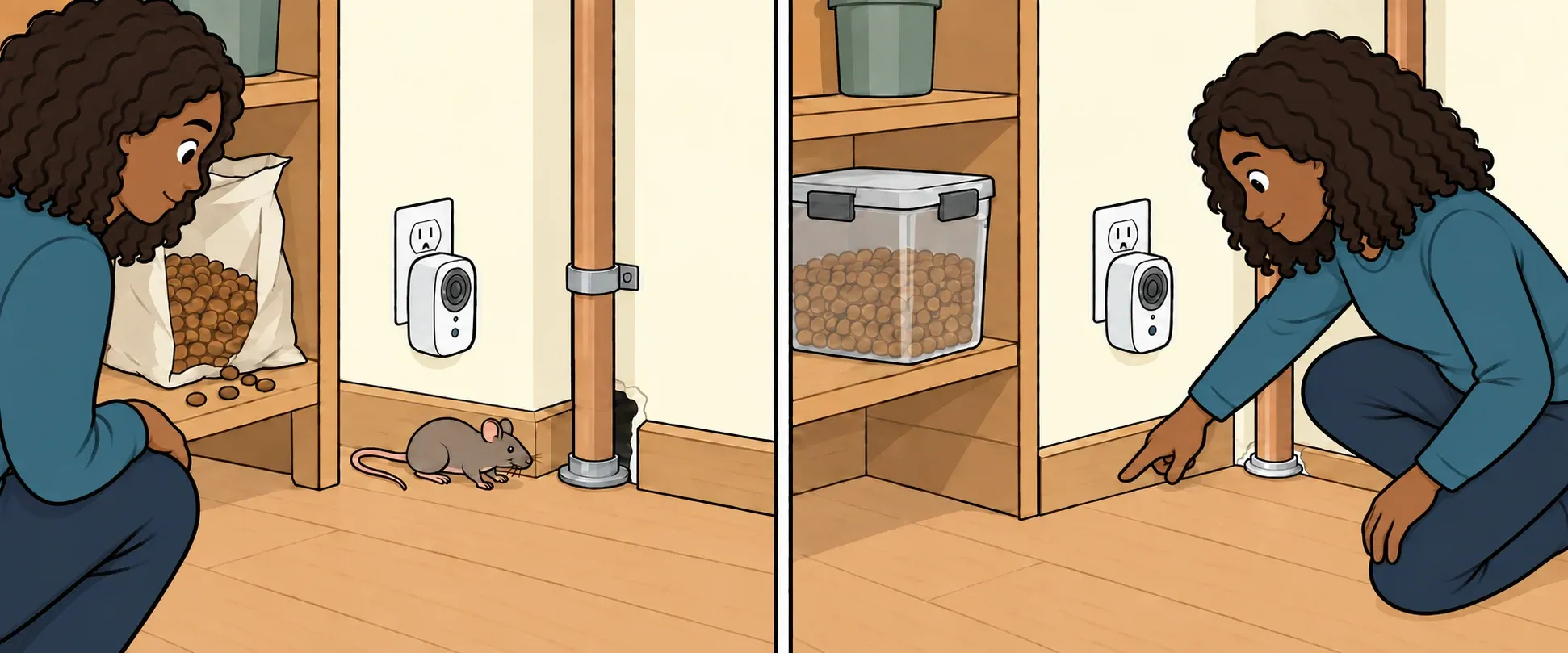
Illustration: a woman checks pantry food and a wall gap, with a plug-in repellent in the outlet nearby.
Signs of Mice in Your House
Most people find droppings long before they see a mouse. Nebraska Extension lists the signs to look for:
- Droppings: ⅛ to ¼ inch long and usually black, with one or both ends pointed. A mouse leaves 50 to 75 a day, scattered rather than in piles.
- Gnaw marks: tiny, about 1/32 inch wide, plus clean-cut holes about 1½ inches across in cardboard and food boxes.
- Nests: finely shredded paper or fabric, often near warmth: behind the fridge or oven, or by the water heater.
- Sounds: scratching and squeaking inside walls and ceilings, mostly before dawn and after dusk.
- Smell: a musky odor where mice have been living for a while.
Check along baseboards, inside cabinets, behind appliances and in sofa cushion creases, and note where signs appear. Those spots are where the traps go.
Droppings bigger than about ½ inch are rat droppings, not mouse droppings. If it’s rats, follow how to get rid of rats instead, because rats need bigger traps and tougher sealing.
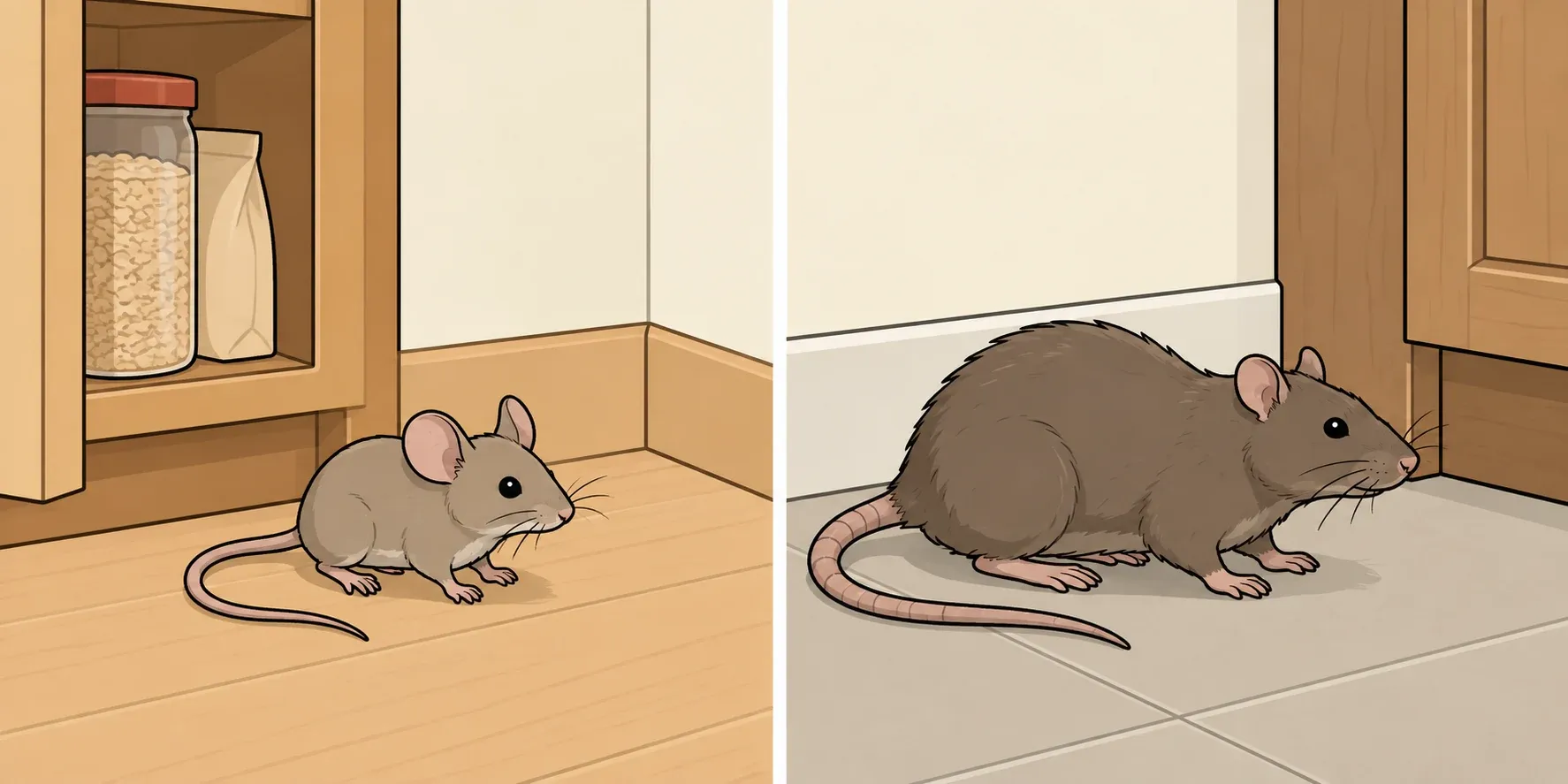
Illustration: a house mouse in a pantry (left) and a rat beside a wall (right).
Step 1: Trap the Mice Already Inside
Set snap traps where you see fresh activity, at a right angle to the wall with the baited end touching it, so the trap forms a T, as the CDC describes. Use mouse-size traps, not rat-size, and keep them out of reach of children and pets.
Use two dozen traps, not a handful. Nebraska Extension’s rough guide is two dozen snap traps for a new infestation in a 1,500-square-foot house.
Space them 10 feet apart at most, in pairs. UC IPM says pairs set 1 to 2 inches apart catch more of the mice that jump over a single trap.
Check every morning. The CDC advises a daily check, and mornings catch the night’s activity.
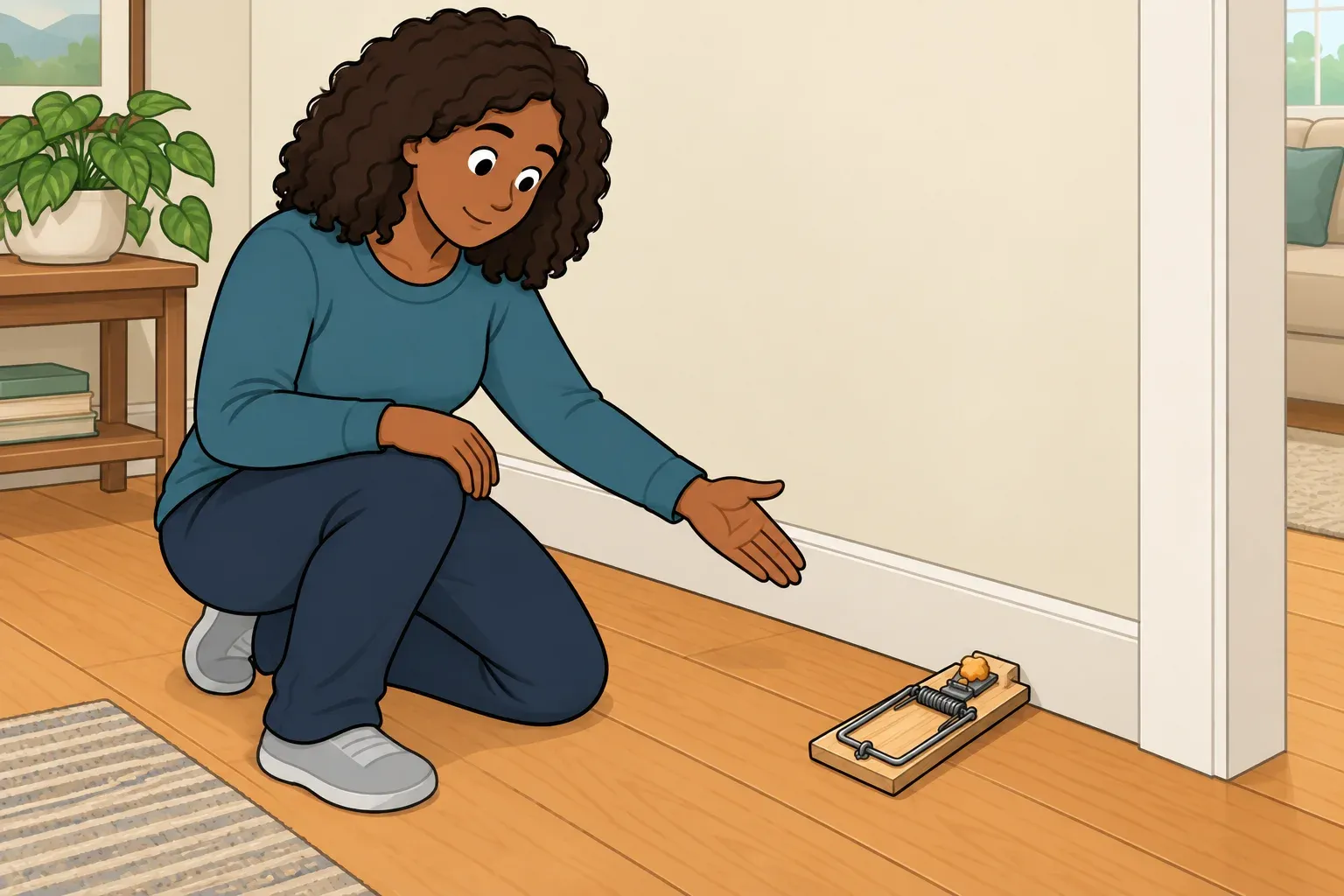
Illustration: a wooden snap trap set at a right angle to the wall, its baited end against the baseboard.
Setup details are in how to set a mouse trap, where to put mouse traps and the best bait for mouse traps. To weigh snap against electronic traps, see the main types of mouse traps.
Step 2: Seal the Gaps Mice Use to Get In
Seal every opening about ¼ inch (6 mm) wide or wider, inside and outside: the CDC says a mouse can fit through it. Look around pipes, doors, windows, vents, the foundation and utility lines, and keep trapping while you seal, since sealing only stops new mice.
Use metal, not foam. For small holes, the CDC suggests steel wool with caulk around it to hold it in place; for larger holes, metal, hardware cloth or cement. UC IPM cautions that expanding foam, plastic, rubber and wood are ineffective on their own. Copper mesh suits bigger gaps because it doesn’t rust; steel wool vs. copper mesh compares the two.
Check high, not just low. Mice climb any rough vertical surface, so look around vents, wiring holes and the tops of walls as well as the foundation.
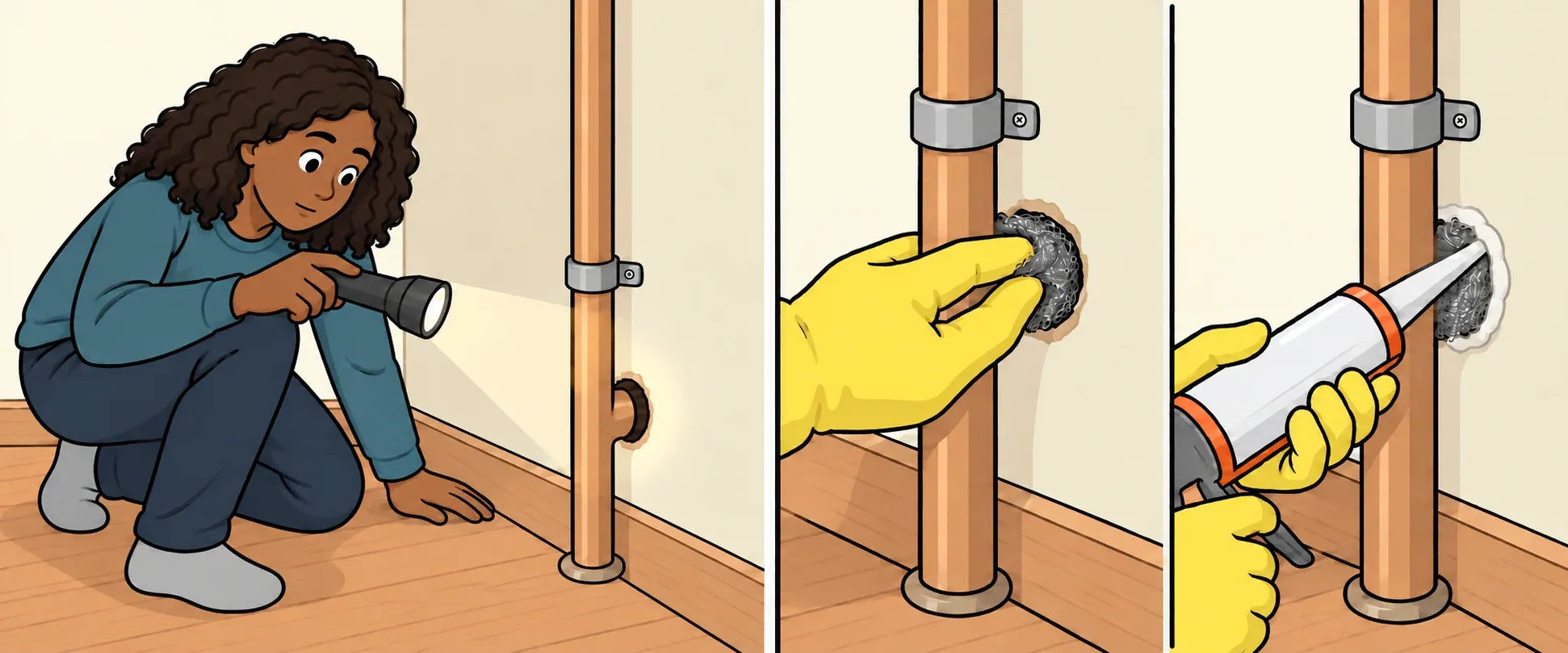
Illustration: a gap around a pipe, then gloved hands packing it with steel wool and sealant.
Step 3: Cut Off Food and Clean Up Safely
Store food and garbage in tightly closed containers of thick plastic, metal or glass, clean up spills, and put pet food away after meals; what mice eat lists the foods to lock up first. The CDC also advises keeping bird feeders and other outdoor food away from the home. For a fuller poison-free approach, see how to get rid of mice naturally.
Spray and wipe, never sweep. Mouse droppings, urine and saliva can carry diseases that mainly reach people through contaminated air. Wear rubber or plastic gloves, spray the material with disinfectant until very wet, let it soak 5 minutes or the time on the label, then wipe it up with paper towels, following the CDC’s clean-up instructions. Cleaning mouse droppings has the full routine.
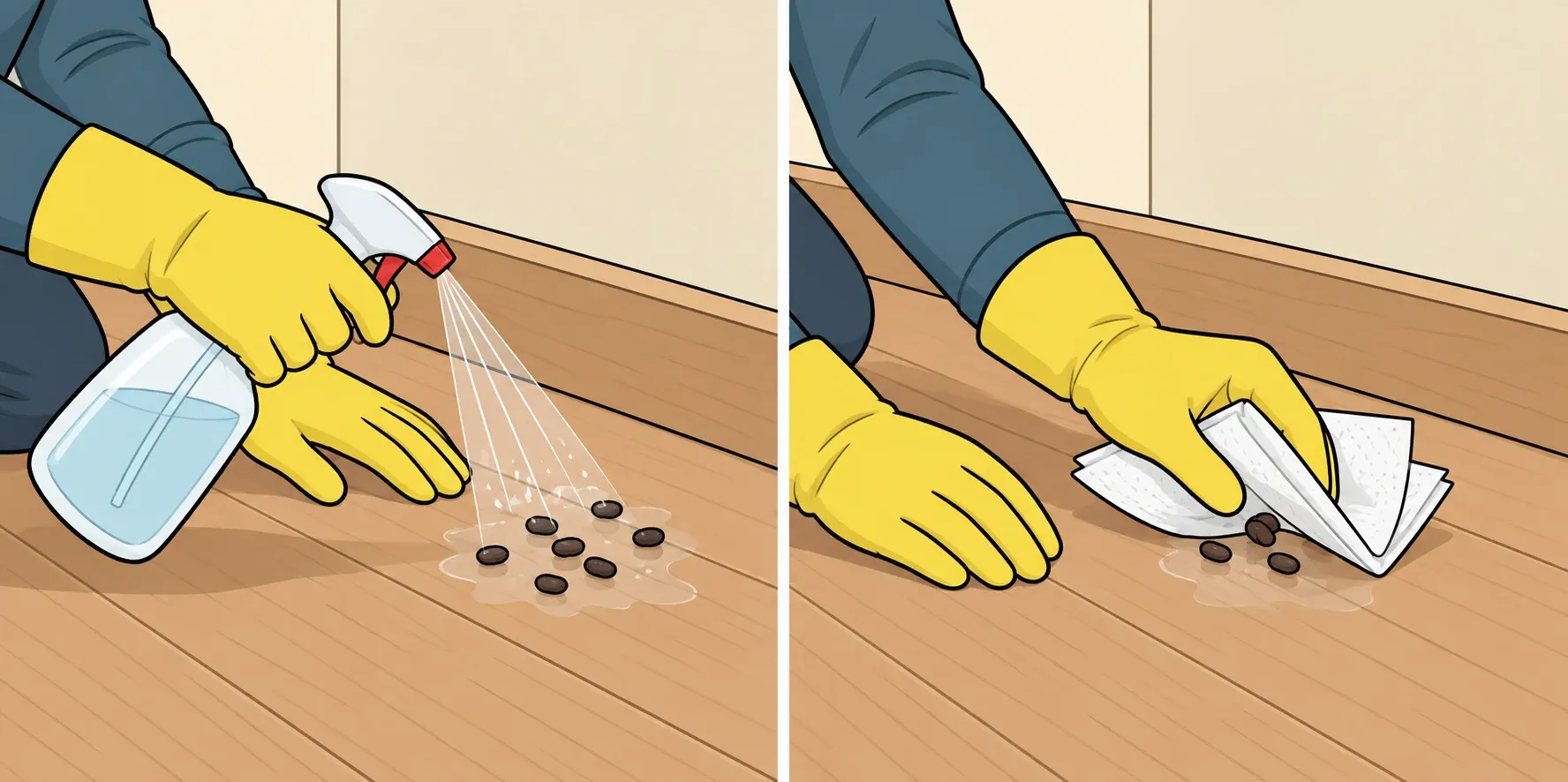
Illustration: gloved hands spray droppings with disinfectant, then wipe them up with paper towels.
How to Tell the Mice Are Gone
The CDC’s rule: if nothing is caught for a week and there are no new signs, the mice are gone. To make that check work:
- Clean up all old droppings first, so any new ones stand out.
- Keep a simple log of catches and where you find fresh signs.
- Leave a couple of traps set along the old routes after the week is up, and recheck the sealed gaps each fall.
A catch after a quiet stretch usually means a gap is still open. Go back to Step 2 and walk the outside again.
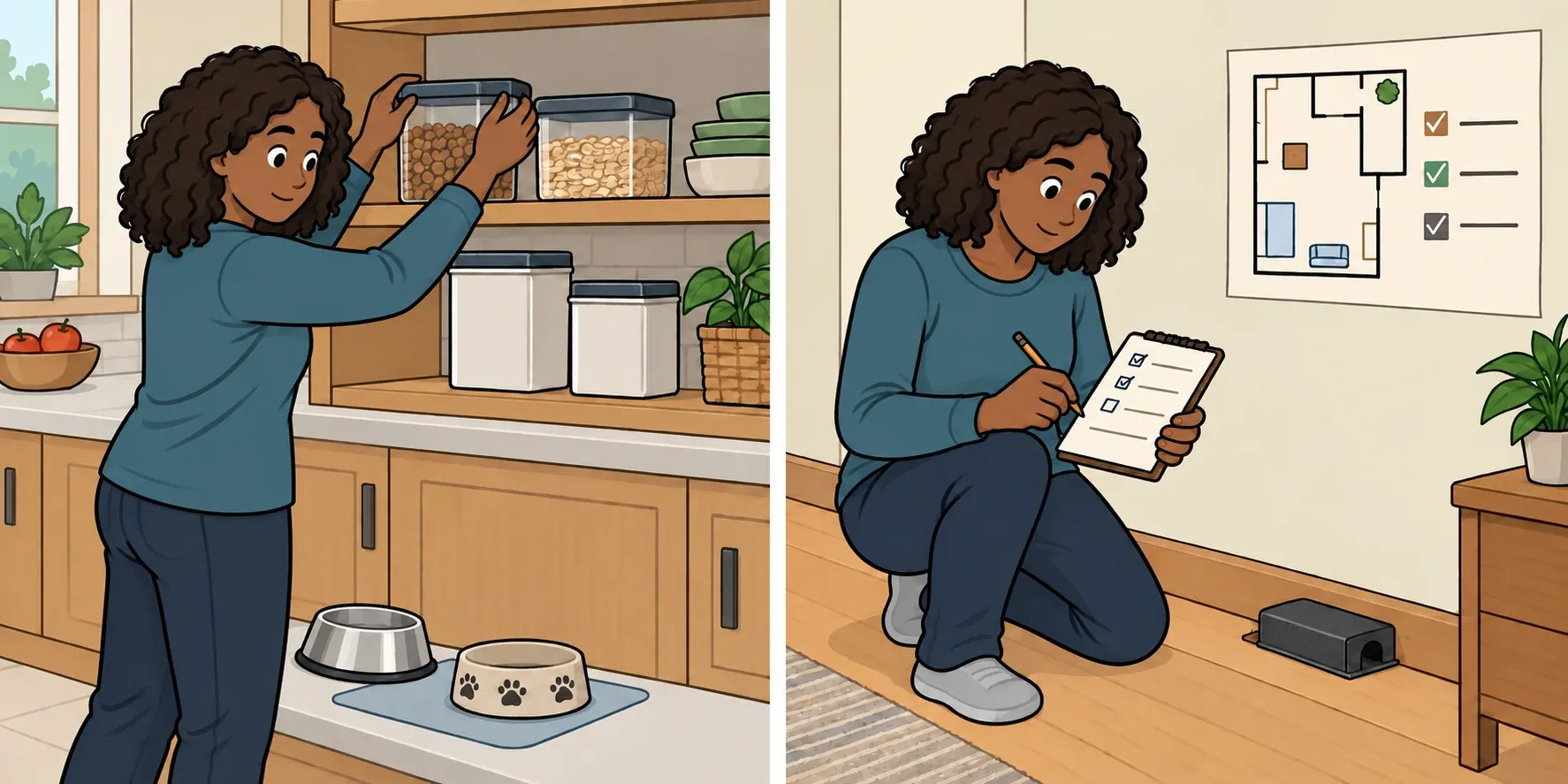
Illustration: a woman puts food in lidded containers and writes in a log beside a snap trap.
Which Plan Fits Your Situation
The three steps stay the same; where the mice are and who lives with you changes how you do them.
| Situation | What to do | Why |
|---|---|---|
| You rent | Trap, store food and clean inside your unit; tell the landlord in writing (mice in an apartment) | Outside sealing and wall repairs are usually the landlord’s job; check your lease. |
| Kids or pets at home | Snap traps behind appliances and furniture, never glue or poison | The CDC says to keep every trap and bait out of children’s and pets’ reach. |
| Scratching in a wall, no droppings in the room | Trap where the wall meets pipes, appliances and baseboards; see mice in walls | Mice travel the wall voids and come out to eat; don’t cut into the wall. |
| Noises overhead at night | Trap along the eaves and insulation trails; seal the roofline with metal (mice in the attic) | Mice run the same edges, and foam won’t hold at the roofline. |
| A mouse in the bedroom | Close the door at night, trap behind furniture, pull the bed a few inches off the wall | Keeps the mouse out of the bedding while traps work. |
| Droppings all over the house, or you can’t find the way in | Keep trapping, then get a pro quote | Heavy infestations need extra clean-up precautions, and hidden gaps need an inspection. |
What It Might Still Cost
| Item | Typical cost |
|---|---|
| DIY: 12–24 snap traps, 20 ft copper mesh, gloves, bleach | $57–71 |
| Pro trap-and-seal job, 53 shared quotes (middle half) | $1,400–$3,000 |
| Pro visit, price-guide range (usually no sealing) | $150–$655 |
| Pro attic insulation cleanup, if upsold | $7,500–$14,000 |
DIY: U.S. list prices on September 30, 2026, before tax and shipping. Pro: the middle half of 53 trap-and-seal quotes homeowners shared on Reddit (see the quote table). Price-guide range: This Old House for mice (April 2026) and HomeAdvisor for rats (June 2026); it usually covers a trap-and-bait visit, with sealing extra. Attic cleanup: the middle half of 35 shared quotes that included new insulation. The exterminator vs. DIY cost page breaks the kit down item by item.
Before You Start: A Quick Checklist
- Check the droppings: rice-grain size means mice, ½ inch or bigger means rats.
- Buy two dozen snap traps and set them in pairs, no more than 10 feet apart.
- Set each trap against the wall, baited end touching it, out of kids’ and pets’ reach.
- Seal every gap ¼ inch or wider with steel wool or copper mesh plus caulk, not foam.
- Move food into sealed containers, including pet food and birdseed.
- Clean droppings wet, with gloves and disinfectant, never a broom or vacuum.
- Log every catch and keep going until a full week passes with nothing new; five quiet days isn’t enough (see the 5-day mouse rule).
When to Call a Pro
Give DIY a fair run first. The CDC says to keep baited traps out for at least 15 days, checking the bait every week, and longer if you still see signs. If steady trapping doesn’t clear them, it suggests professional help. Call sooner if:
- mice are somewhere you can’t reach or clean safely, such as a crawl space;
- droppings are spread through the house, since heavy infestations need extra clean-up precautions;
- mice have gotten into heating or cooling ducts, which the CDC’s clean-up page says is a job for a professional;
- you’ve trapped and sealed but still can’t find how they get in.
Homeowners on Reddit have posted mouse-proofing quotes of $2,400 and more. Ask for an itemized quote that lists each gap to be sealed and the material, and get a second one before you sign.
Common questions
The bigger risk is what they leave behind. The CDC says rodents carry diseases that spread through their droppings, urine and saliva, through bites, and through air or food contaminated with their waste; they can also carry mites and fleas. Wash any bedding a mouse got into in hot water.
There’s no fixed number of days. House mice are less cautious than rats and may be trapped quickly, but the CDC says to keep baited traps out for at least 15 days.
Probably. Treat one sighting as a reason to check for more and set several traps: Nebraska Extension says a female house mouse can raise 5 to 10 litters a year.
Do both at once: traps catch the mice already inside, and sealing keeps new ones out. The CDC treats them as one plan.
The Bottom Line
Trap, seal and clean at the same time: two dozen snap traps along the walls, metal in every gap ¼ inch or wider, and food in sealed containers. That costs about $57–71 in supplies. Skip repellents, mothballs and poison, and call a pro if 15 days of steady trapping hasn’t cleared them.
Sources and further reading · 7
- CDC: Trap Up, Seal Up, Clean Up and Controlling Wild Rodent Infestations
- UC IPM: House Mouse
- Nebraska Extension: Controlling House Mice (G1105)
- University of Kentucky Entomology: Control of Mice (EF617)
- National Pesticide Information Center: Mothballs
- DIY prices: Victor, DoMyOwn and Target list prices, September 30, 2026
- Pro prices: This Old House, Mice Exterminator Cost, citing HomeGuide (April 2026); HomeAdvisor, Rodent Removal Cost (sealing, June 2026)