Mouse Poop vs. Rat Poop: How to Tell Droppings Apart
Rat poop is dark and capsule-shaped, about ½ to ¾ inch long: roof rat droppings are closer to ½ inch with pointed ends, Norway rat droppings about ¾ inch with blunt ends. Mouse poop averages about ¼ inch, like a grain of rice. Judge a group, not one pellet, and never sweep or vacuum them.
Call a pro if droppings show rodents have been in your heating or cooling ducts, or there are so many that cleanup calls for a respirator and coveralls, as the CDC advises for heavy infestations.
Mouse or rat changes which traps you buy and where they go. This guide compares the three droppings side by side, shows how to tell fresh from old and from look-alikes, and what to do next. We haven’t examined samples ourselves; it rests on ICWDM, Cornell, University of Nebraska–Lincoln, UC IPM and CDC guidance.
Mouse Poop vs. Rat Poop at a Glance
| Mouse | Roof rat | Norway rat | |
|---|---|---|---|
| Length | ⅛–¼ inch, some to ½ inch | About ½ inch | About ¾ inch, some to 1 inch |
| Shape | Thin; one or both ends pointed | Pointed ends | Thick capsule, blunt ends |
| Per day | About 50–75 | Not listed | About 40–50 |
| How they lie | Scattered | Along runways | Small clumps |
| Where | Drawers, shelves, counters | Attics, rafters, tops of cabinets | Basements, garages, ground-floor walls |
| Most like | A grain of rice | A large mouse dropping (some reach ½ inch) | About as long as a penny is wide |
What Does Rat Poop Look Like?
Rat droppings are dark brown to black, smooth, and noticeably thicker than a mouse’s, and the two rats you’re likely to find in a U.S. home leave different shapes.
Norway rats (brown rats) leave capsule-shaped droppings with blunt ends. The Internet Center for Wildlife Damage Management (ICWDM) puts them at up to ¾ inch long and ¼ inch thick; another university IPM guide says ¾ to 1 inch. A Norway rat leaves about 40 to 50 a day, usually in small clumps along its runways, near where it feeds and close to its shelter.
Roof rats (black rats) leave smaller droppings, about ½ inch long with pointed ends, according to the ICWDM. Because roof rats travel overhead, their droppings turn up in attics, along rafters and on top of cabinets more often than on the floor.
What Does Mouse Poop Look Like?
Mouse droppings are small and thin, averaging about ¼ inch long. Nebraska Extension describes them as ⅛ to ¼ inch long with one or both ends narrowing to a point, and says a mouse leaves about 50 to 75 a day, usually scattered rather than in piles. Its IPM for Rats and Mice manual adds that some can reach ½ inch, which is where confusion with young rats starts. That trail is why mouse poop seems to be everywhere: one mouse can leave it through drawers, shelves and counters.
Rat Poop vs. Mouse Poop: 4 Ways to Tell Them Apart
Size is the most reliable difference. A dropping about the size of a grain of rice is almost certainly from a mouse. Rat droppings are two to three times that long and much thicker.

Infographic: mouse, roof rat and Norway rat droppings drawn to the same scale beside a U.S. penny, with daily counts and how they age. Sources: Nebraska Extension, UNL, UC IPM, Cornell.
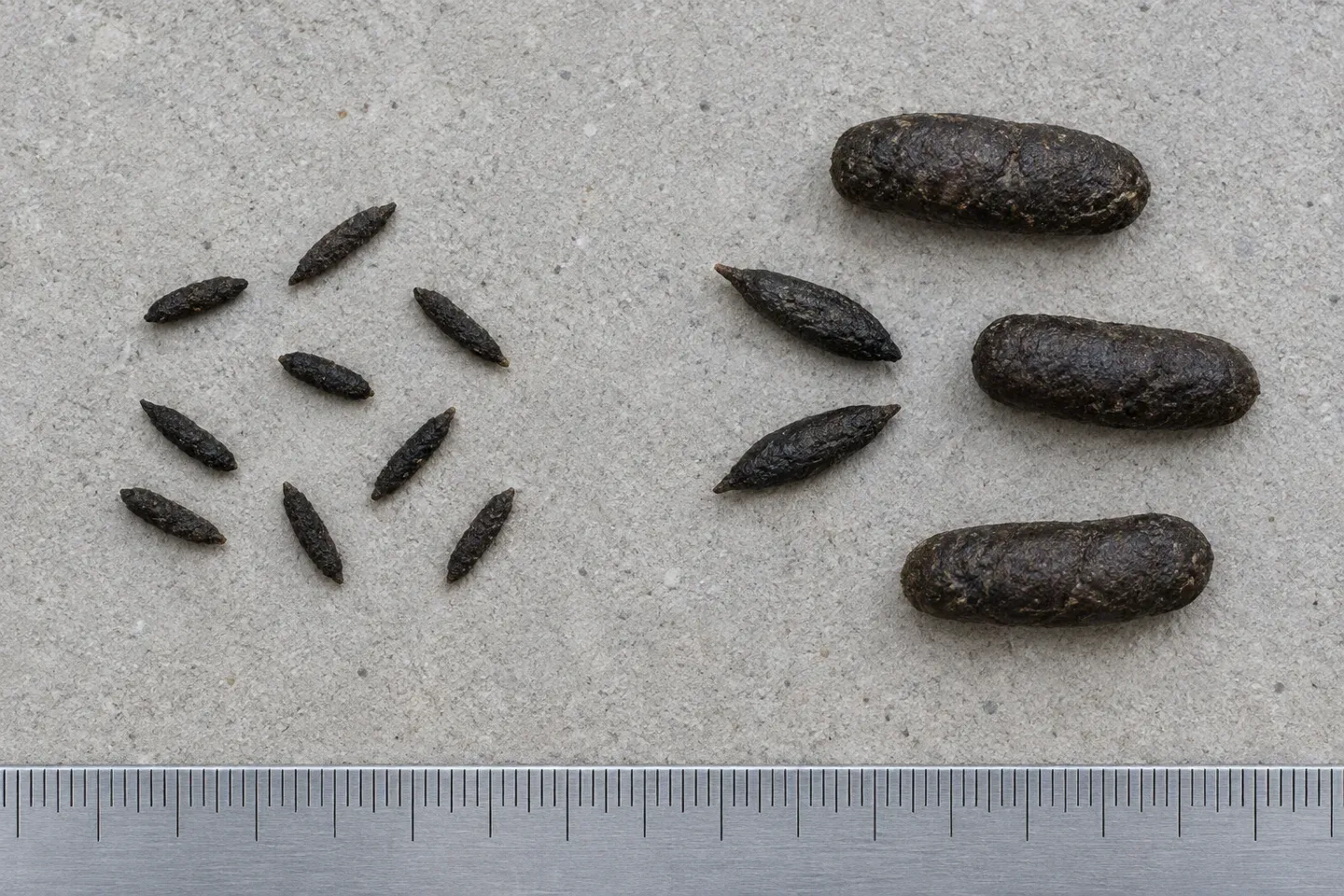
Mouse droppings on the left, roof rat droppings in the middle and Norway rat droppings on the right, beside a ruler for scale.
Shape: check the ends of several, not one. Pointed ends suggest a roof rat. Blunt, rounded ends and a thick, capsule-like body suggest a Norway rat.
Spread: clumps mean Norway rats, a scattered trail means mice. One pile of big droppings in a corner of the garage and a trail of tiny ones through the kitchen drawers can mean you have both.
Height: up high points to roof rats or mice, down low to Norway rats or mice. Droppings on attic insulation, rafters or cabinet tops suggest roof rats or mice; basement, garage and ground-floor walls suggest Norway rats or mice. Size settles which one.
Don’t decide from a single pellet: a large mouse and a young rat can leave droppings of similar size. Cornell also notes that very small and much larger droppings of the same shape side by side can mean young and adults are both present.
Fresh vs. Old Droppings: Are Rodents Still Active?
Older droppings tell you rodents were there; fresh ones tell you they still are. The UNL manual describes how they change:
| Age | What they look like |
|---|---|
| Fresh | Black or nearly black, soft, moist and glistening |
| A few days to a week | Dry, hard and dull; in warm, dry air they can lose their shine within hours |
| A few weeks | Rat droppings gray, dusty and crumbly; mouse droppings hard, dry and dull or whitish |
Very old droppings can look new again if they get wet, but they’ll still crumble instead of squashing.
Odd colors are a clue too. Rodent baits contain a dye, and Cornell notes that green or red droppings may mean a rodent has been eating rodenticide bait, possibly put out by a neighbor or a previous owner.
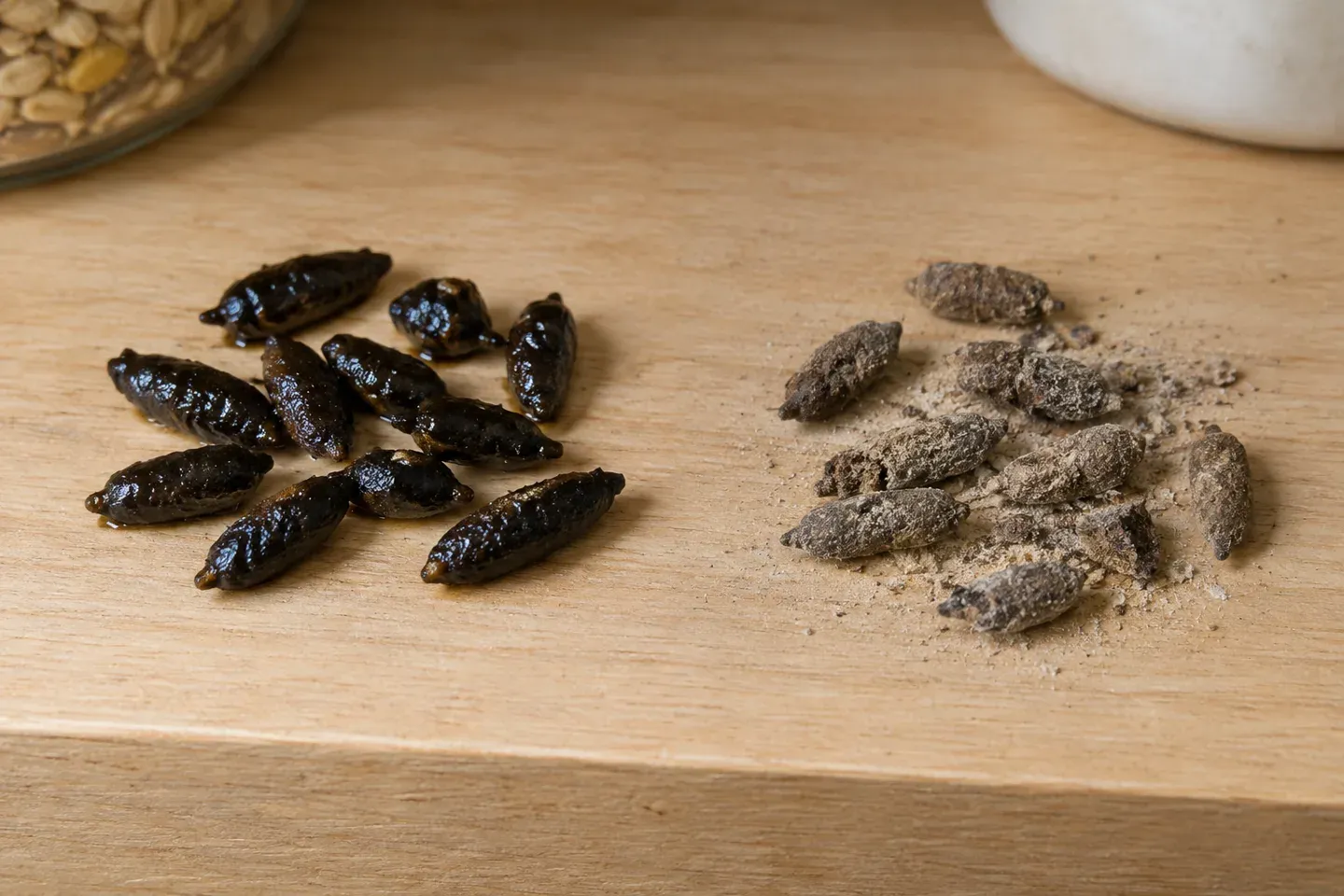
Fresh droppings (left) look dark and shiny; old ones (right) are dull, gray and crumble easily.
Rodent Poop or Something Else? Check for Ridges and Shine
Rodent droppings are smooth, and one animal’s droppings look much alike. A few things get mistaken for them:
| Look-alike | How to tell |
|---|---|
| Cockroach droppings | Ridges running along their length |
| Bat droppings | Crumble easily; tiny shiny insect fragments under a magnifier; piled below a roost |
| Squirrel droppings | Turn up in attics, easy to mistake for rat droppings; judge a group and the location |
| Seeds, soil, coffee grounds | Vary in size and shape |
Think you’ve found bat droppings in an attic? Don’t seal the openings until you know bats are gone; bats are protected in many states. Contact your state wildlife agency or a licensed wildlife control operator.
How to Confirm Rodents Are Still There
Clean up every dropping you find, using the wet method below, so new ones stand out.
Check the same spots over the next few mornings; anything that appears after the clean-up is new.
Read the pattern. A line along a baseboard is a runway, where traps go. A heavy pile in one spot means a feeding area or nest nearby, so check behind appliances, cabinets and stored boxes, and in storage areas such as the pantry, garage shelves and attic. A single dropping on a bed or counter means an animal passed through.
Look up. Droppings on attic insulation or rafters mean animals living overhead; check for gaps at the roofline, vents and where pipes or wires enter.
The CDC treats fresh droppings, urine or gnawing that keep showing up after a week of trapping as a sign of an ongoing infestation.
What to Do Next
Don’t sweep or vacuum; that puts dust from droppings into the air. The CDC’s clean-up is to air the room 30 minutes, put on gloves, spray with disinfectant or 1 part bleach to 9 parts water until very wet, soak 5 minutes or as the label says, then wipe up with paper towels. Full steps, including nests and dead mice, are on those pages. Wash bedding or clothes the mice got into in hot water with detergent.
Droppings can spread disease, which is why the method matters. The CDC says hantavirus can get into the air when fresh urine, droppings or nesting material from an infected rodent are stirred up, and that wild rats naturally carry hantaviruses. Leptospirosis spreads through the urine of infected animals, and house mice can carry lymphocytic choriomeningitis virus (LCM). If you get sick after a cleanup, tell your healthcare provider about the rodent exposure.
Call a professional if rodents have been in your heating or cooling ducts, or for a heavy infestation, which calls for coveralls, goggles and a HEPA-filter respirator.
- Measure a group of droppings, not one.
- Note where they are: high, low, clumped or scattered.
- Wet them with disinfectant and wipe up; never sweep or vacuum.
- Recheck the spots each morning for new ones.
- Start the right plan: mouse-sized means how to get rid of mice; rat-sized means how to get rid of rats in your house.
- Compare both animals on the mouse vs. rat page if you’re still unsure.
Common questions
It can be either; roof rats and mice both live in attics. Measure a few: around ¼ inch points to mice, around ½ inch with pointed ends to roof rats.
It means a rodent was there at some point. Clean it up and check the same spot over the next few days. Found it on your bed? Wet it with disinfectant before wiping it up, wash the bedding in hot water, and set traps along the bedroom walls.
Switch to the wet method for the rest, and bag soaked droppings along with any used traps.
Sources and further reading · 8
- ICWDM: Norway Rats and Roof Rats — dropping size, shape and daily numbers.
- Cornell NYS IPM: Mouse and Rat Biology and Behavior — dropping sizes for mice, Norway rats and roof rats, and how rodent droppings differ from cockroach droppings.
- Cornell NYS IPM: Managing Mice and Rats — using droppings to monitor activity, and dyed droppings from bait.
- University of Nebraska–Lincoln: IPM for Rats and Mice (hosted by Utah State University Extension) — how droppings age, and bat and cockroach look-alikes.
- University of Nebraska–Lincoln Extension: Controlling House Mice (G1105) — mouse dropping size, shape and daily numbers.
- UC IPM: House Mouse — LCM and how people catch it.
- CDC: How to Clean Up After Rodents — step-by-step clean-up, dead rodents and nests, bedding, air ducts and heavy infestations.
- CDC: Hantavirus Prevention and About Leptospirosis — how rodent-borne diseases spread.