What Do Mice Eat? And How Long Can They Go Without Food?
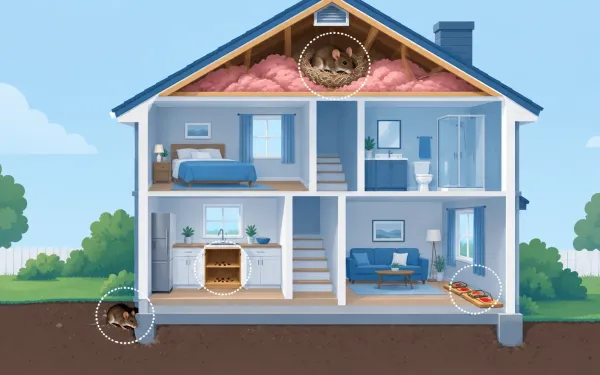
Mice eat mostly five kinds of food: grains and cereal, seeds (including birdseed), nuts and peanut butter, dry pet food, and crumbs and food scraps. Grains and seeds are their favorite, but house mice will eat almost anything, even insects. An adult needs only about 1/10 ounce a day, so you can’t starve them out. Store food in lidded glass, metal or thick plastic, and trap until a week brings no new droppings.
Cost: about $14–27 in supplies. Difficulty: easy. Call a pro if mice are in places you can’t reach to clean, or droppings and chewed packages keep appearing after 15 days of steady trapping.
Foods in Your Home That Attract Mice Most
| Food | Where mice find it | How to store it |
|---|---|---|
| Flour, rice, oats, pasta, cereal | Pantry shelves, in paper bags and boxes | Glass, metal or thick plastic with a lid |
| Dry pet food | Open bags in the garage or laundry room | A metal or hard plastic bin with a tight lid |
| Birdseed and grass seed | Garage and shed | A metal can with a lid |
| Nuts, seeds, peanut butter | Snack drawers and pantry | Sealed jars |
| Crumbs and food scraps | Under the toaster and stove, behind the fridge | Wipe up and vacuum; use a trash can with a lid |
Paper, cardboard and thin plastic bags don’t stop a mouse; see food storage below.
This guide covers what wild mice eat indoors and out, the best bait, how long they last without food, what rats eat, and what to do with food they got into. We haven’t tested this ourselves; it rests on UC IPM, Nebraska Extension, ICWDM, CDC and FDA guidance plus list prices.
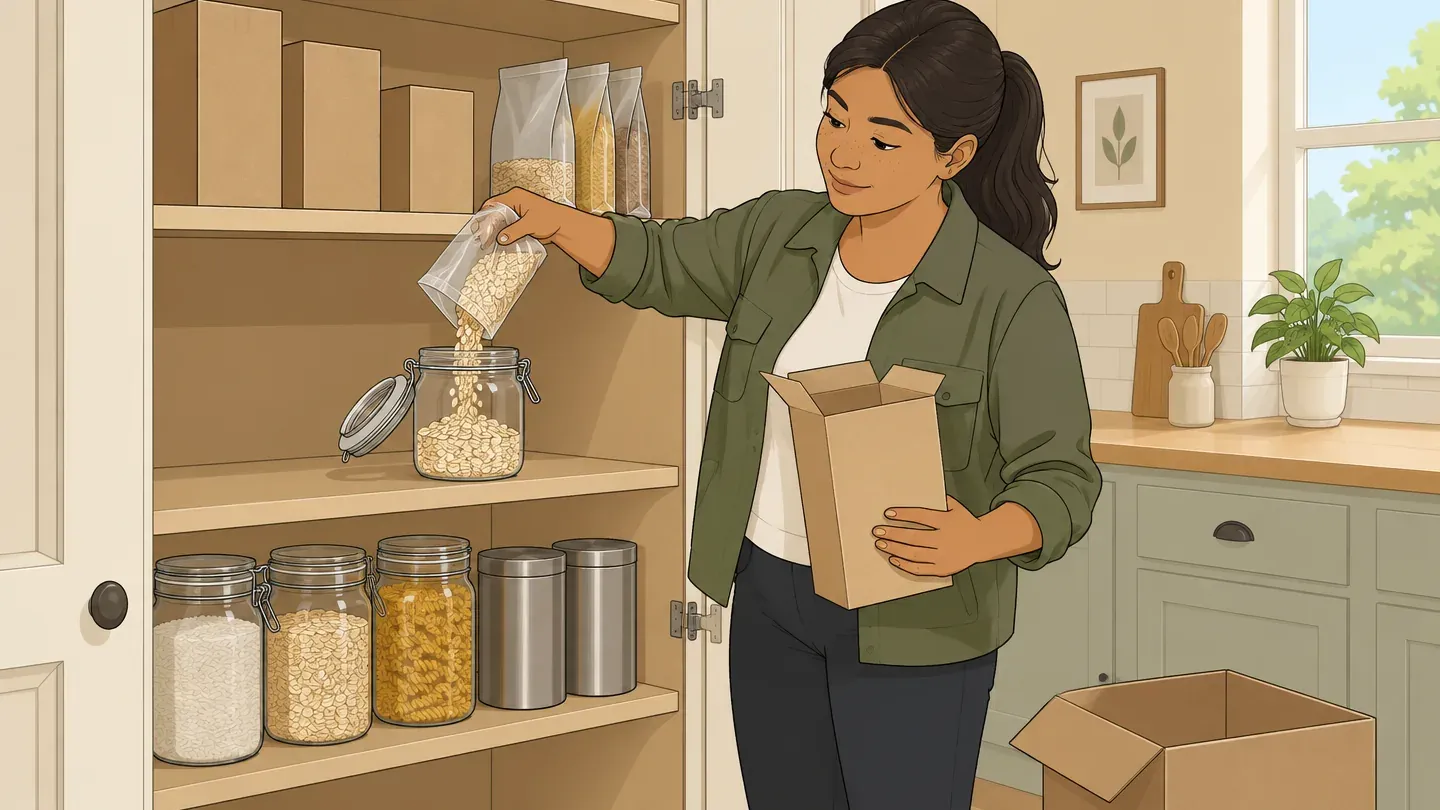
Illustration: rice, oats and crackers move from paper boxes and thin bags into glass jars and metal canisters with tight lids.
Mice vs. Rats: What They Eat at a Glance
| House mouse | Norway rat | Roof rat | |
|---|---|---|---|
| Favorite food | Cereals and grains | Cereal grains, meats, fish, nuts | Fruits, tree nuts, berries, slugs and snails |
| How much | About 1/10 ounce a day | Roughly 20–40 pounds a year | Not listed |
| Water | Doesn’t need to drink | About ½–1 ounce a day on dry food | Not listed |
| Also eats | Crumbs, pet food, insect larvae | Food waste around dumpsters | Oranges, hollowed out on the tree |
What Do Mice Eat in the House?
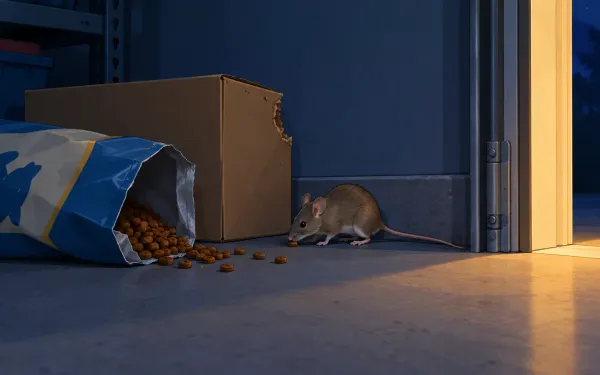
UC IPM calls house mice omnivores that eat whatever food is available, with cereals and grains as their favorite. In a typical home that means flour, rice, oats, pasta and cereal; bird seed and grass seed in the garage; dry kibble; crumbs under the toaster; and insect larvae.
They don’t travel far for it: usually 10 to 25 feet from the nest, and just a few feet when there’s plenty to eat (University of Kentucky). Chewed packages usually mean a nest close by, so that’s where the traps go.
What Do Field Mice Eat?
Out in fields and woods, the common mouse is the deer mouse, which UC IPM calls the most abundant mammal in North America. It mostly eats seeds, plus fruits, invertebrates, fungi and some green plants, and stashes acorns, seeds and nuts near the nest, especially in autumn. Outdoors, house mice eat much the same: cereals, grasses, roots, seeds and insect larvae.
Is it the hantavirus mouse? In a city or suburb, probably not. Deer mice spread hantavirus, but UC IPM says they aren’t common in urban and residential areas unless large parks or fields are nearby. The easiest tell is the tail, dark on top and white underneath on a deer mouse.
Hantavirus isn’t associated with house mice, says the Internet Center for Wildlife Damage Management (ICWDM), but mouse droppings and urine can carry other germs. So clean up after any mouse the same way: gloves, bleach solution, a 5-minute soak, never a broom (CDC).
What Food Do Mice Like Most? (Best Bait)
Mice like grains, seeds and fatty, high-protein foods most, so a dab of peanut butter or a few seeds beats cheese on a trap.
Do mice eat cheese? They’ll eat it, because house mice eat almost anything, but it isn’t their first choice. Extension guides describe a grain-and-seed eater that also likes fatty, high-protein food such as nuts, bacon and butter, and the ICWDM’s trap bait list doesn’t include cheese at all.
For a trap, the CDC’s pick is a small amount of chunky peanut butter. Our guide to mouse trap bait compares it with the other options.
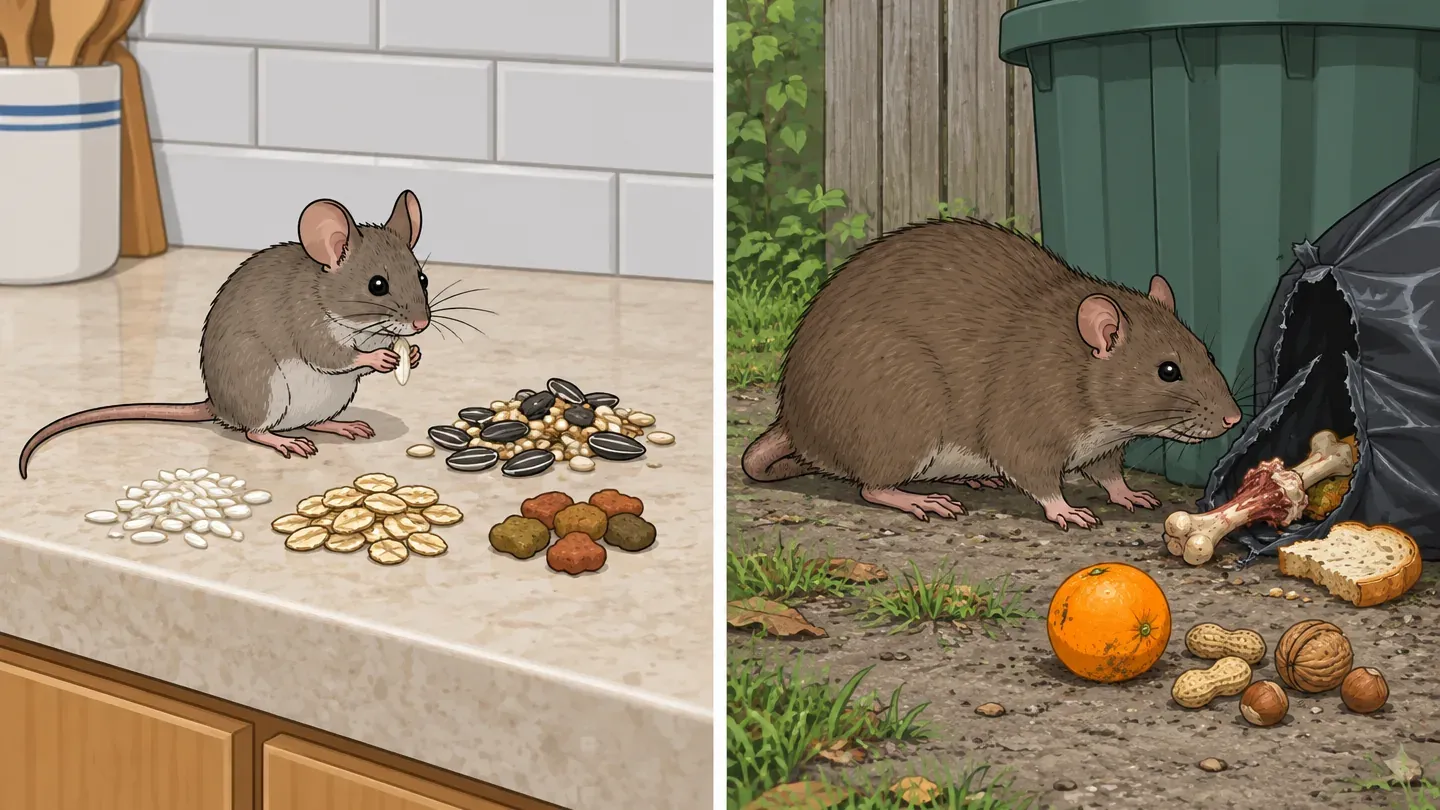
Illustration: a house mouse beside grains, seeds and pet kibble (left), and a Norway rat beside meat scraps, fruit and a torn garbage bag (right).
How Much Do Mice Eat?
Very little, all night long: about 1/10 ounce a day for an adult (Nebraska Extension), spread over about 200 tiny meals a night (UC IPM). They eat at the source or carry food off to a hidden spot. House mice don’t need to drink; they get enough moisture from food, but look for liquids in hot, dry conditions.
How Long Can a Mouse Go Without Food?
Not long, but none of the extension or health agency guides we checked gives a number of days, and the “2 to 4 days” seen online cites no source. The closest data is a 2007 lab study: mice given water but no food lost about 30% of their body weight in three days.
Either way, you can’t starve them out. Nebraska Extension says eliminating mice through sanitation alone is almost impossible, because they survive on limited food, shelter and no water. A house nearly always has a little food somewhere: a crumb under the fridge, seed in the garage, food a mouse stashed last week. Cutting off food doesn’t end an infestation; it makes the traps work.
What Do Rats Eat?
More, and more variety, as the table shows: Norway rats accept whatever is abundant, and roof rats lean to fruit, nuts, slugs and snails (UC IPM). Unlike a house mouse, a rat needs water (ICWDM). Los Angeles County’s rodent guide adds snails, garden vegetables and even dog droppings. Our plan for getting rid of rats covers trapping them, and rat trap bait covers what to put on the trap.
Food Storage: Glass, Metal or Thick Plastic, Not Cardboard
The CDC’s rule is simple: keep food in thick plastic, metal or glass containers with tight lids. Glass jars you already own work if the lids close tight.
Cardboard and thin bags don’t qualify, and that includes Ziploc bags. Mice gnaw clean holes about 1½ inches across in cardboard (Nebraska Extension), and they chew even storage containers meant to keep them out.
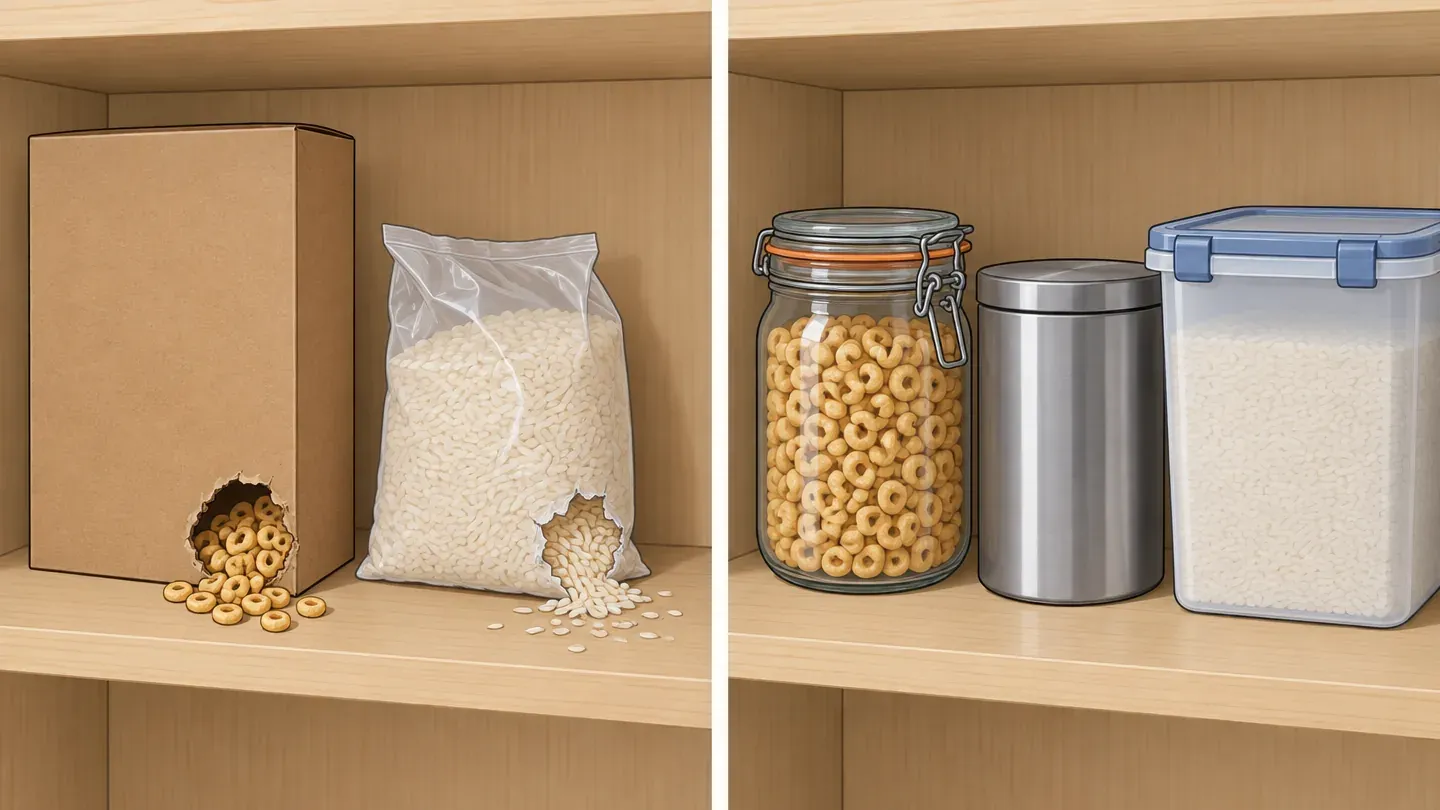
Illustration: a gnawed cereal box and a torn thin bag (left), and the same food in a glass jar, a metal canister and a thick plastic bin (right).
Pantry staples, nuts and snacks go into lidded jars or canisters; bulk kibble into a lidded metal bin; bird seed, grass seed and animal feed in the garage or shed into lidded metal or thick plastic cans. Spills, garbage, bird feeders and the ¼-inch gaps mice squeeze through are covered in what attracts mice.
Food Mice Got Into: Toss Anything in Paper or Plastic
Throw out any food in paper or plastic packaging that mice could have reached, the FDA says, including pet food and bird seed. Undamaged, sealed cans and jars can be cleaned and kept; throw out any with dents, bulges, cracks or a broken seal. Put discarded food in a trash can with a secure lid.
Then clean where they walked. The CDC says to mop or sponge floors, counters, cabinets and drawers with a disinfectant after the droppings are wiped up; cleaning mouse droppings goes surface by surface.
How to Confirm Mice Are Eating Your Food
Look for gnawed holes in cardboard boxes and torn thin bags.
Check for droppings near the chewed packages and behind the stove.
Search 10 to 25 feet around the damage for the nest.
Set two or three snap traps where you found the damage; a catch settles it.
What to Do Next
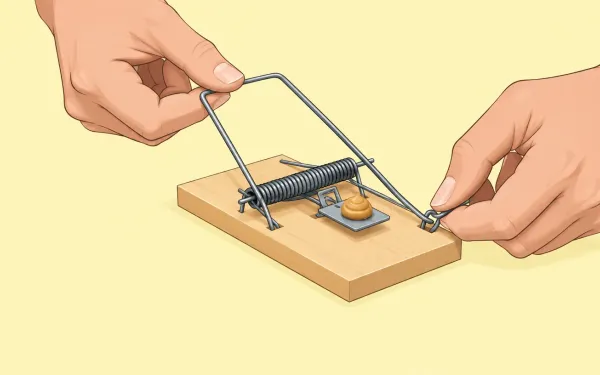
Sanitation never removes every mouse, the ICWDM says, but it makes traps work better by removing competing food: a mouse that can’t reach the oats is more likely to take the bait. Set traps against the wall with the baited end next to it, near the chewed packages, as in setting a mouse trap; the full plan is in how to get rid of mice.
- Move open food into lidded jars or the fridge tonight.
- Close up the pet food and pick up bowls overnight.
- Throw out packaged food mice could have reached.
- Start with two or three traps, adding more no more than about 10 feet apart if droppings show up elsewhere; Nebraska Extension’s ballpark is about 24 for a new infestation in 1,500 square feet.
- Keep traps out of reach of kids and pets, behind appliances or deep in cabinets (CDC).
- Trap at least 15 days (CDC), until a full week brings no catches and no fresh droppings or gnawing.
Cost: wooden snap traps list for about $2.29 a two-pack, so 12 to 24 cost about $14–27 before tax (our math). Price guides list $150–$550 for a pro mouse visit, but jobs that also seal the gaps had a $2,000 median across 53 quotes homeowners shared on Reddit (see the quote table).
Common questions
Mostly seeds. The deer mouse, the common mouse of fields and woods, also eats fruits, invertebrates, fungi and some green plants, and stashes acorns and seeds for later (UC IPM). See what field mice eat.
They can. House mice eat insects and insect larvae (UC IPM), so a roach is fair game, but a mouse won’t clear a roach problem. Roaches live on many of the same crumbs; see what cockroaches eat.
Whatever is left. A house rarely runs completely dry: crumbs under appliances, pet food, birdseed in the garage, and insects all keep a mouse going, and house mice eat insects and their larvae (UC IPM). Nebraska Extension says mice survive on very little, so cutting off food makes traps work better rather than starving them out. See how long a mouse can go without food.
Yes, and they like it. Nebraska Extension lists chocolate among mouse trap baits, next to peanut butter and caramel. A sealed candy stash belongs in a jar like any other pantry food.
Spray foam, yes: UC IPM lists expanding foam among materials that don’t stop mice. Coarse steel wool, packed tight with caulk around it, is the low-cost fix for small holes, though it can rust over time.
Sources and further reading · 9
- UC IPM: House Mouse, Deer Mouse and Rats: diet, meals, water, deer mice and hantavirus, rat diets.
- Nebraska Extension: Controlling House Mice (G1105): daily intake, sanitation, trap numbers.
- Internet Center for Wildlife Damage Management (ICWDM): House Mouse Control, Norway Rat Control and Norway Rat Biology.
- University of Kentucky: Control of Mice (ENTFACT-617).
- CDC: Seal Up, Trap Up and Clean Up.
- Los Angeles County Public Health: Are You Attracting Rats and Mice to Your Yard?
- FDA: How to Handle Food Products That Have Been Exposed to Filth.
- Sokolović et al., BMC Genomics (2007): Fasting induces a biphasic adaptive metabolic response in murine small intestine.
- This Old House: Mice Exterminator Cost (April 2026). Trap prices: U.S. list prices, September 30, 2026.