Humane Mouse Traps: How to Choose and Use a Live Trap
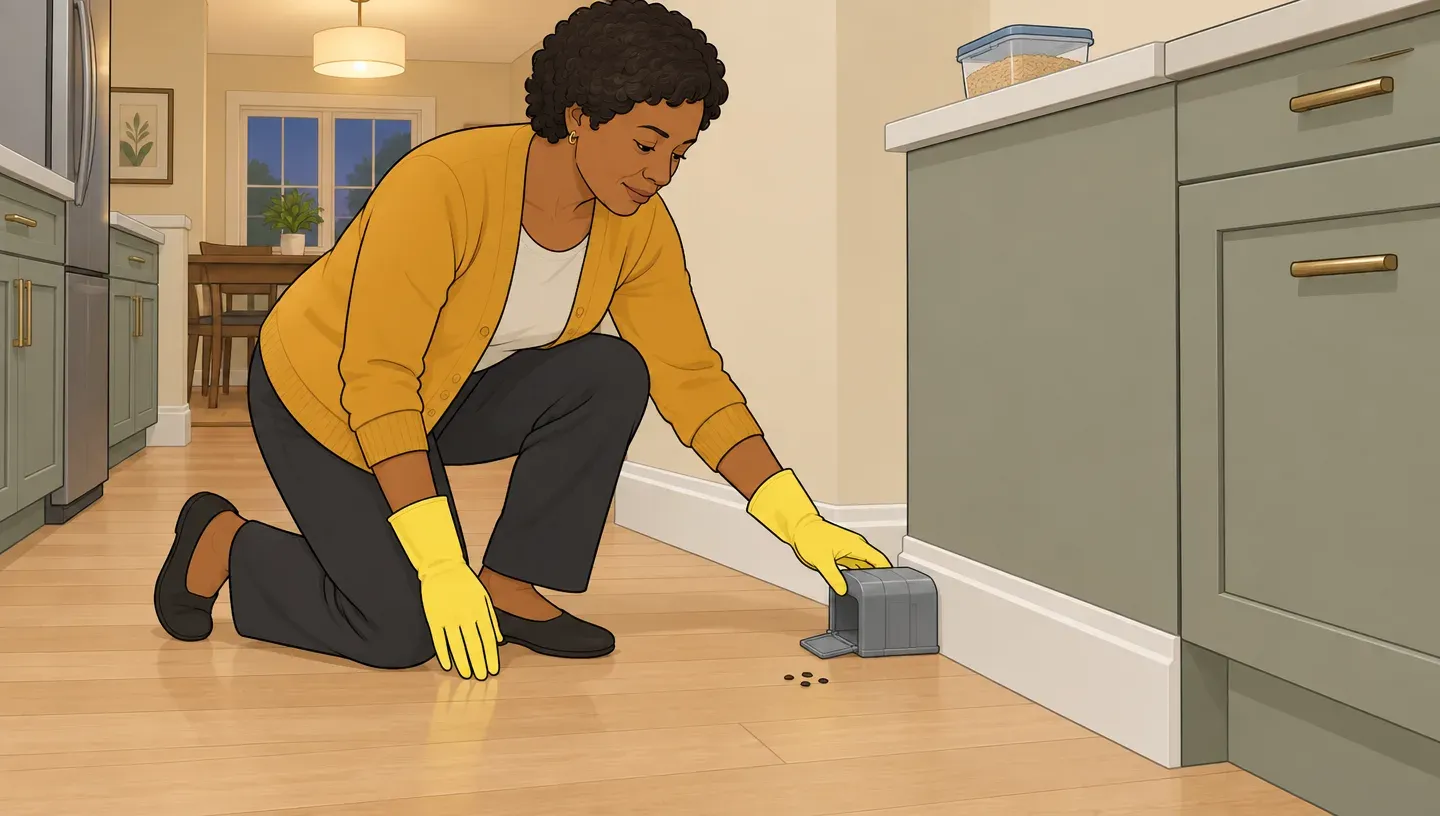
Illustration: a covered live trap set flat against the baseboard, a few droppings nearby.
The best humane mouse trap is a covered, single-catch live trap, $10–30, checked at least every 12 hours. Buy one only if you know what you’ll do with the mouse: released house mice often find their way back or die outdoors, and some states ban moving them. Without a plan, a well-set snap trap is the kinder choice.
Cost: about $10–30 per live trap in supplies. Difficulty: moderate. Call a pro if you catch mice or rats alive and can’t end it quickly and humanely yourself, you’re dealing with rats, or you’ve trapped steadily for 15 days and still find fresh droppings.
This guide compares live traps with the kill traps welfare groups rank against them, then covers setting one, handling a live catch and what it costs. We haven’t tested these traps ourselves. It rests on CDC, UC IPM and university extension guidance, two animal-welfare groups, and published price ranges.
Saw a mouse tonight? You don’t need a trap yet. Put on gloves and clean up droppings the CDC way: spray them with bleach solution (1.5 cups of bleach per gallon of water), wait 5 minutes and wipe up with paper towels. Don’t sweep or vacuum.
How We Compared These Traps
We rated each trap on five things:
- Welfare: how UFAW, Humane World for Animals and a 2023 expert panel rate it.
- Health risk: what the CDC says about handling the catch.
- What happens next: whether you’re left with a live animal to deal with.
- Effort: how often it needs checking.
- Price per trap: published ranges from April 2026 and a September 2026 list price.
Sources are listed at the end.
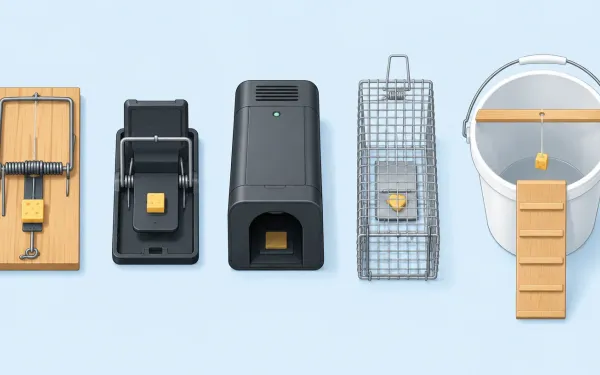
Humane Mouse Traps at a Glance
| Trap | Price | Best for and main drawback |
|---|---|---|
| Covered single-catch live trap | $10–$30 | People with a plan for the mouse. Needs a check at least every 12 hours. |
| Multiple-catch live box | Not priced | Not recommended by UFAW: its welfare impact hasn’t been measured. |
| Wire cage live trap | Not priced | Rat-size. UC IPM doesn’t recommend live-trapping rats for nonprofessionals. |
| Wooden snap trap | About $1.15 | Most homes. UFAW rates a good one as likely the most humane way to kill a mouse. |
| Glue trap | Not priced | Nothing. Humane World for Animals and UFAW both oppose them. |
Live trap range: This Old House, from store listings (April 2026). Snap trap: a $2.29 two-pack split in half, our math.
Do Live Mouse Traps Work?
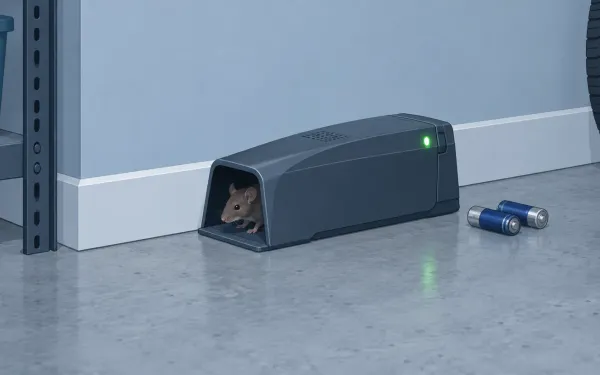
Yes, they catch mice. A live trap, also sold as a catch and release, no kill or ethical mouse trap, works like a snap trap without the snap, and house mice are less wary of traps than rats. The hard part is what comes after.
- Health. The CDC advises against live traps, because a frightened mouse may urinate, which raises your chance of getting sick.
- Hantavirus, in perspective. University of Arizona Extension calls house mice unlikely hantavirus carriers. The main U.S. carrier is the deer mouse, found mostly in rural and wooded areas, with a two-tone tail.
- Numbers. Removing a few mice doesn’t end an infestation if the gaps stay open; our plan to get rid of mice pairs trapping with sealing.
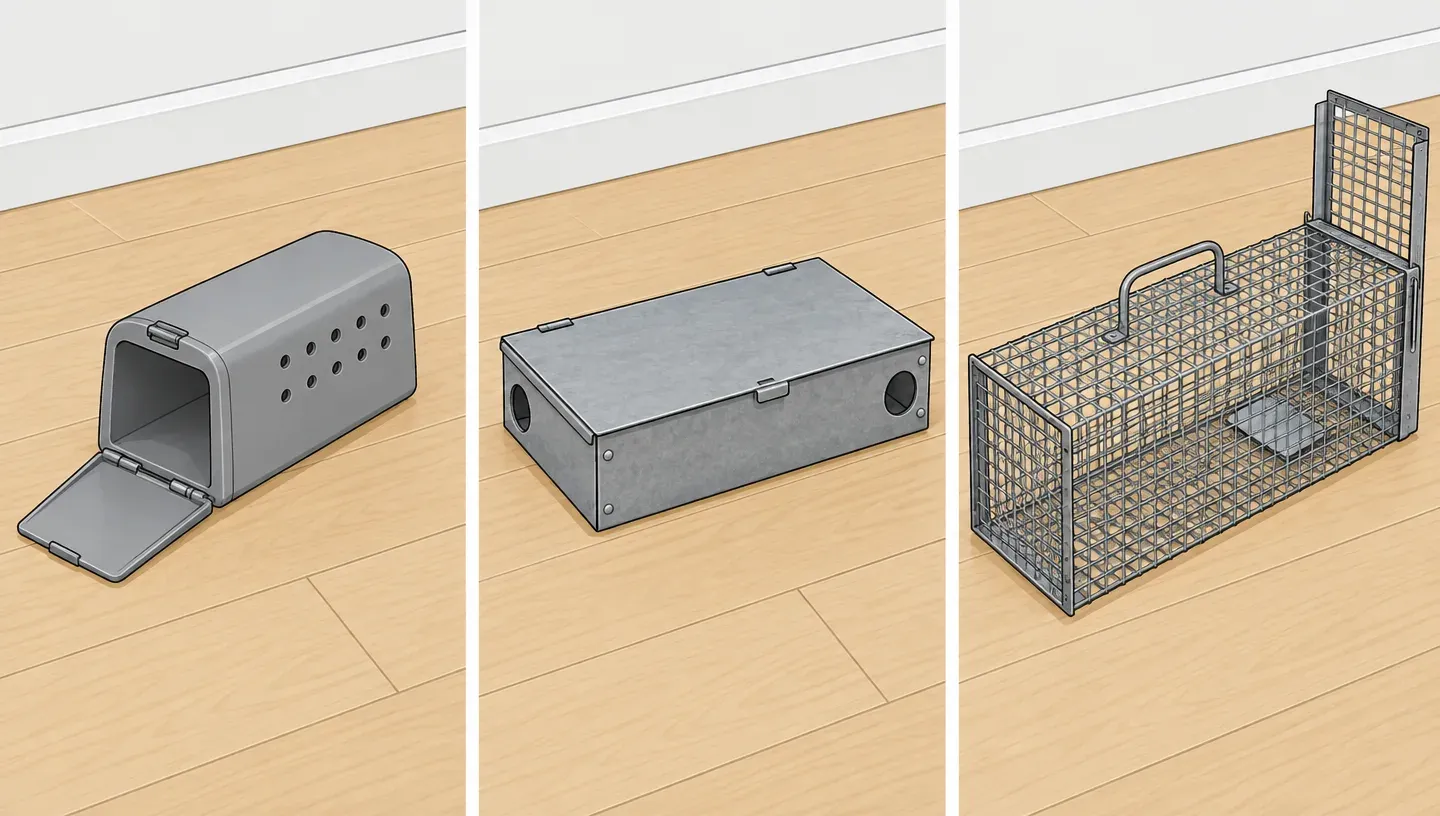
Illustration: a covered single-catch tunnel trap for mice, a metal multiple-catch box and a larger wire cage for rats.
Covered Single-Catch Traps: The Best Live Trap
Choose a trap sized for mice, covered with solid sides rather than open mesh, and built for one mouse. Science for Animal Welfare (UFAW), a UK welfare science charity, says covered traps may reduce deaths inside live traps, and that bedding and water inside reduce chilling and dehydration.
Best for: a home where someone can check traps morning and night and has a plan for the catch.
Main limitation: each catch needs a decision, a trip and a clean trap.
Multiple-Catch Live Traps: Welfare Unmeasured
A multiple-catch box holds several mice at once, which sounds efficient. UFAW doesn’t recommend multiple-catch mouse traps, because their welfare impact hasn’t been measured.
Best for: no home use we can recommend from the sources.
Main limitation: several stressed mice in one box, and no welfare data.
Wire Cage Traps: For Rats, and Rarely Then
Wire cages are rat-size, and live rat traps are a harder call. UC IPM doesn’t recommend live-trapping rats for nonprofessionals, because a trapped rat legally has to be humanely euthanized or released right where it was caught. Neither Norway rats nor roof rats are native to the U.S.
Best for: professionals, not homeowners.
Main limitation: release isn’t a legal option; see how to get rid of rats in the house for the snap-trap approach.
Snap Traps: Often the Kinder Choice
UFAW rates a good snap trap as likely the most humane way to kill a mouse, and live trapping plus release as likely less humane. A 2023 expert panel also rated electrocution among the least harmful methods, as our look at whether electric mouse traps are humane explains. Our guide to types of mouse traps compares them all.
Best for: anyone without a plan for a live mouse.
Main limitation: you handle a dead mouse, and the trigger must sit out of reach of kids and pets.
How to Use a Humane Mouse Trap
Step 1: Set traps where mice run. Place each one flat against a wall, near droppings or gnaw marks. With kids or pets, the CDC suggests closed spots behind the stove and refrigerator, or at the back of cabinets.
Step 2: Use enough traps. House mice seldom travel more than 30 feet from their nest, so UC IPM spaces traps no more than about 10 feet apart. Droppings along one 20-foot kitchen wall means about three traps.
Step 3: Bait small. Use a small dab of peanut butter or a few seeds, not a heap; too much lets a mouse eat without triggering the trap, UC IPM notes. A small ball of cotton wool also works, since nesting females collect it, and it doubles as bedding. More options are in the best bait for mouse traps.
Step 4: Check at least every 12 hours. This step makes or breaks a “humane” trap: UFAW says trapped mice may suffer, injure themselves trying to escape, or starve. Set traps in the evening, check before bed and at dawn, and close them if you’re away overnight.
Step 5: Handle the catch with gloves. Never touch the mouse bare-handed. Once the trap is empty, soak it for 5 minutes in fresh bleach solution (1.5 cups per gallon), the CDC’s method for reusing a trap.
Found it dead? Spray the mouse and trap with disinfectant and wait 5 minutes. Bag the mouse, knot the bag, put it in a second bag and throw it in a covered trash can.
What to Do With a Live Mouse You Caught
Pick one of these before you set the trap:
- Hand it to a pro. A pest control or wildlife control operator can take the catch and find the gaps. Ask the price for a single visit when you call.
- Humane killing. Oregon State University Extension’s advice for a live-caught mouse is a quick, strong blow to the head. If you can’t do that, skip this option.
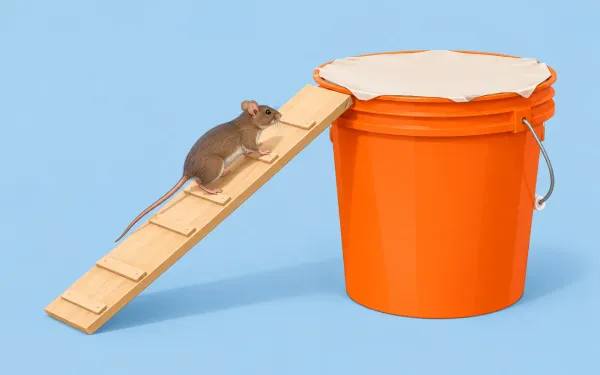
Don’t drown it, including in a water-filled DIY bucket trap. UC IPM says drowning isn’t considered humane, even though some trap makers suggest it.
Where to Release a Mouse
Ideally, nowhere. UC IPM puts it plainly: “Relocation is also ineffective.” House mice moved as far as half a mile can navigate back, and released mice “are likely to experience aggressive behavior from other mice, be attacked and killed by a predator, or die from exposure.” One Reddit poster caught six mice in six days in a garage live trap and suspected the same one kept coming back.
- They’re not native. House mice are invasive, which is why Nebraska Extension says not to release them alive in that state.
- It may be illegal. California bans moving live house mice off the property without a state permit, and some states forbid moving wildlife at all, according to the ICWDM.
Even Humane World for Animals, which favors live traps, says mice that have lived their whole lives in buildings have a slim chance of surviving outdoors.
Which Trap Fits Your Situation
| Situation | What to use | Why |
|---|---|---|
| You can check traps twice a day and have a plan | Covered single-catch live trap | It fits UFAW’s 12-hour rule; covered traps may cut deaths. |
| You can’t kill a mouse and can’t pay a pro | Snap traps set out of reach | A live catch would leave you with no next step. |
| You travel or work overnight shifts | Snap traps | A live trap can’t go unchecked for more than 12 hours. |
| Rural home or cabin, deer mouse signs | Call a pro | Deer mice are the main U.S. hantavirus carrier. |
| Rats, not mice | Rat-size snap traps | UC IPM doesn’t recommend live-trapping rats for homeowners. |
| You rent | Any trap, plus a written sealing request | Gaps outside and behind appliances are usually the landlord’s. |
What It Might Still Cost
| Item | Typical cost |
|---|---|
| Live trap, per trap | $10–$30 |
| Wooden snap trap, per trap | about $1.15 |
| Copper mesh for sealing, 20 ft | $28.80 |
| Nitrile gloves, 50 count | $8.49 |
| Bleach for cleanup, 81 oz | $6.39 |
| Pro trap-and-seal job, 53 shared quotes (middle half) | $1,400–$3,000 |
| Pro visit, price-guide range (usually no sealing) | $150–$655 |
Live traps: This Old House, from Lowe’s and Home Depot listings (April 2026). Pro: the middle half of 53 trap-and-seal quotes homeowners shared on Reddit (see the quote table). Price-guide range: This Old House for mice (April 2026) and HomeAdvisor for rats (June 2026); it usually covers a trap-and-bait visit, with sealing extra. Snap trap: maker’s list price for a two-pack, $2.29 (September 30, 2026). Supply prices match our exterminator vs. DIY cost breakdown. One live trap costs as much as 9 to 26 wooden snap traps, before counting the checks (our math).
The Most Humane Way to Get Rid of Mice
The kindest plan is the one that catches the fewest mice. UC IPM ranks keeping mice out as the most lasting fix: plug every gap wider than ¼ inch with metal, such as steel wool or copper mesh, starting around pipes, vents and cables. Then store food in lidded containers and trap the mice already inside with a method you can finish.
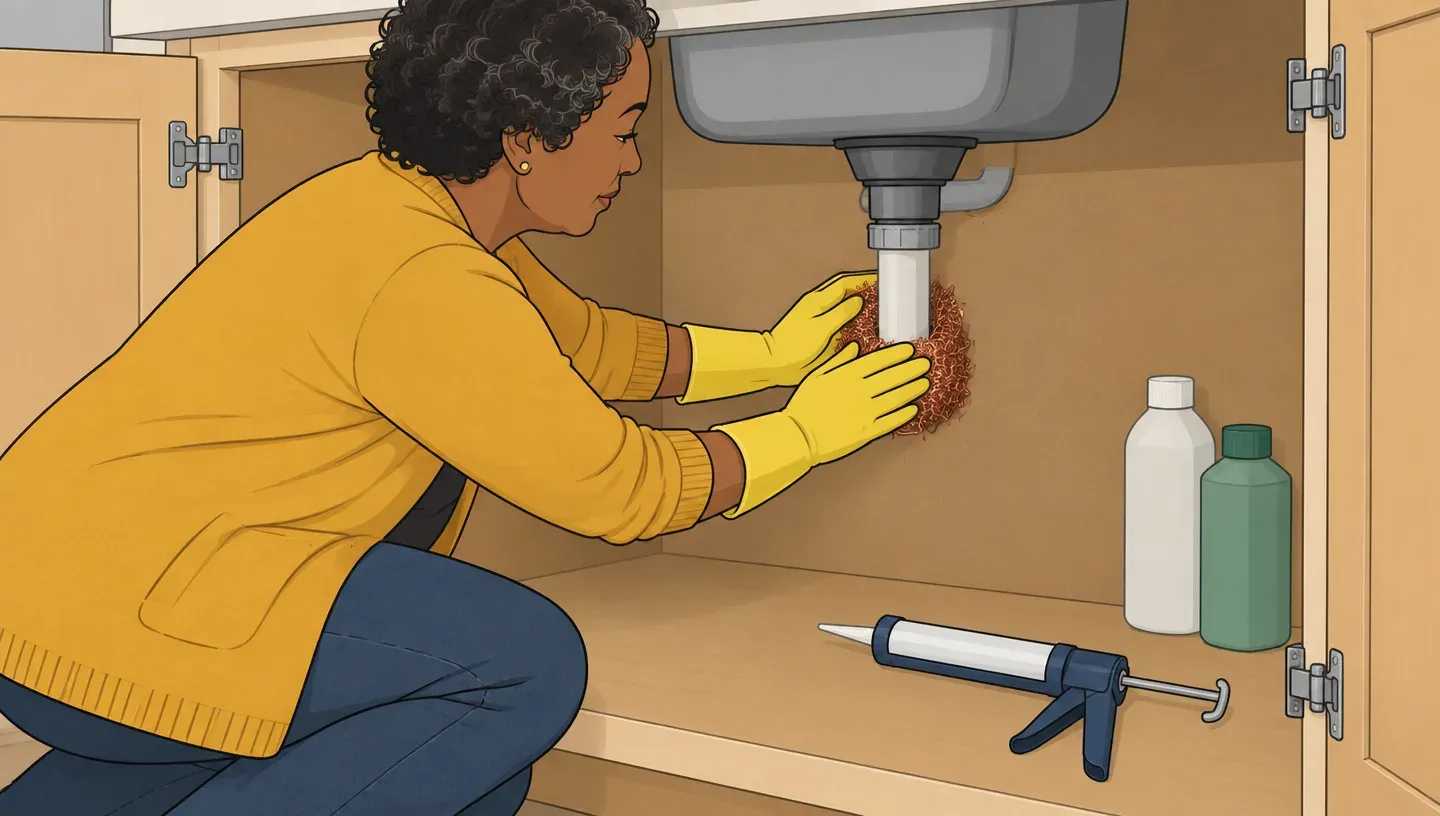
Illustration: copper mesh pressed into the gap around a pipe under the sink, with a caulk gun ready.
Before You Set a Live Trap: A Quick Checklist
- Decide what you’ll do with a live mouse before you buy.
- Choose a covered, single-catch trap sized for mice.
- Seal gaps wider than ¼ inch so new mice can’t replace the ones you catch.
- Bait a small dab and add cotton wool for bedding.
- Check every trap before bed and at dawn, at least every 12 hours.
- Wear gloves for every catch and soak the trap in bleach solution.
- Stop after a week with no catches and no new signs, the CDC’s rule.
When to Call a Pro
Call one if you’ve caught mice alive and can’t end it quickly and humanely, if the animal is a rat, if you see deer mouse signs in a rural home, or if you’ve trapped steadily for 15 days and still find fresh droppings. Ask how they handle live catches and what they’ll seal.
Common questions
Experts disagree. Humane World for Animals calls live traps the only humane option and snap, glue and electric traps cruel. UFAW rates a good snap trap as likely the most humane way to kill a mouse. The split is over what happens after the door shuts; both groups oppose glue traps for mice.
UFAW doesn’t give a survival time. It says to check at least every 12 hours, because trapped mice may otherwise suffer or starve.
The Bottom Line
A covered, single-catch humane mouse trap works, but only if you check it at least every 12 hours and know in advance what happens to the mouse. Release rarely ends well for a house mouse and may be illegal, so without a plan, a snap trap set out of reach is the kinder route. Either way, seal the gaps first.
Sources and further reading · 9
- CDC: Trap Up, Clean Up and About Hantavirus.
- UC IPM: House Mouse, Deer Mouse and Rats.
- University of Arizona Extension: Hantavirus and Disease Prevention.
- Nebraska Extension G1105: Controlling House Mice.
- ICWDM (Internet Center for Wildlife Damage Management): Moving Problem Wildlife.
- Oregon State University Extension: Mice.
- Science for Animal Welfare (UFAW): Humane Rodent Control, Detailed Advice.
- Humane World for Animals: What to Do About Wild Mice.
- Costs: This Old House: Mice Exterminator Cost.