How to Get Rid of Carpet Beetles: Find the Source First
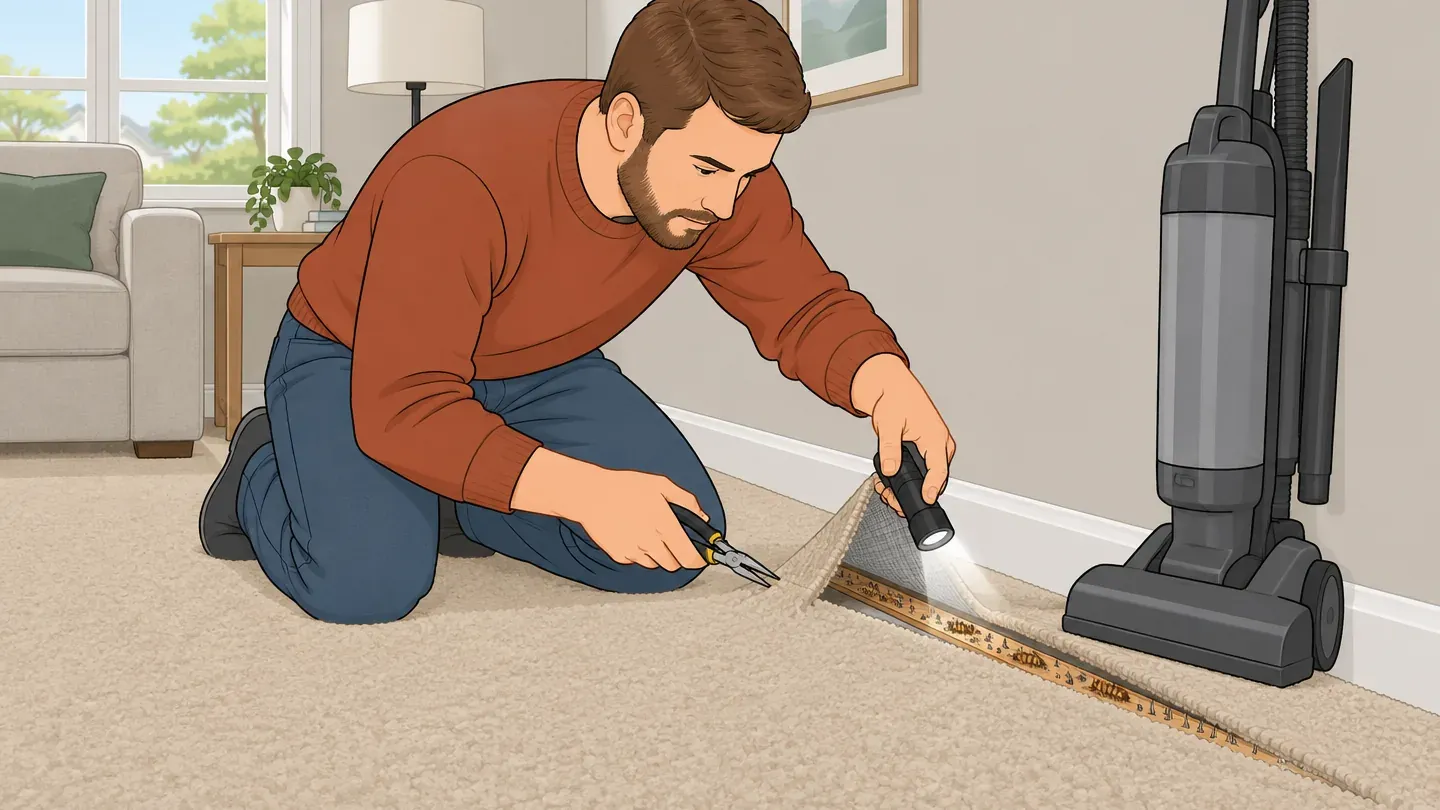
Illustration: checking under a carpet edge for larvae.
To get rid of carpet beetles, find where the larvae are feeding (wool, pet hair, lint or dead insects) and vacuum those spots. Then hot-wash, dry-clean or freeze infested items and store them sealed. Spray only edges and cracks you can’t clean. It’s working when no new larvae or shed skins turn up where you cleaned. The same plan works for the most common kind, the varied carpet beetle, and it’s how you exterminate carpet beetles without a pro in most homes.
Saw a carpet beetle tonight? One adult on a windowsill is no emergency, and they don’t bite. Vacuum it, then check the nearest closet and rug edge for fuzzy larvae or shed skins. Bag any wool with larvae until you can wash or freeze it. Found carpet beetle larvae in bed? Hot-wash the bedding and vacuum under the bed.
Cost: about $13 in supplies. Difficulty: moderate. Call a pro if larvae are inside a mattress, pillow or upholstered furniture stuffed with hair or feathers, or you can’t find the source after checking closets, carpet edges, vents and the attic.
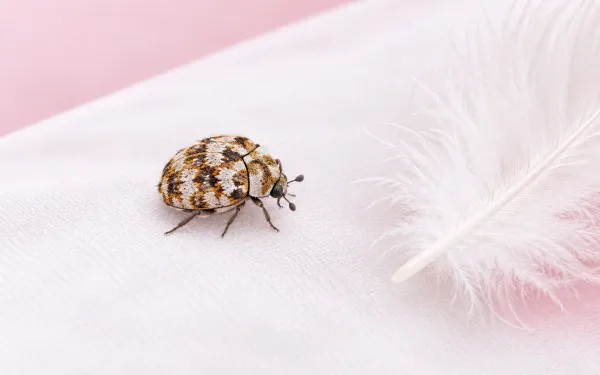
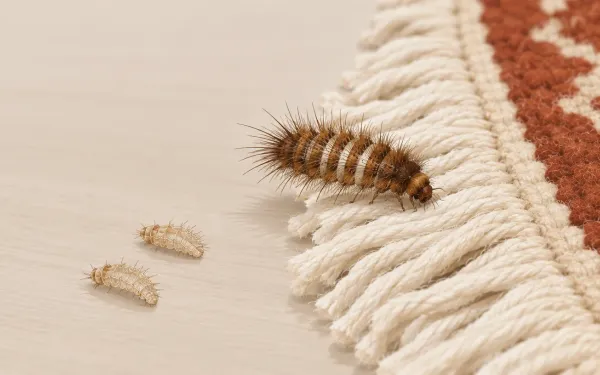
Little round beetles on a windowsill in spring (some people call them carpet bugs) are usually the first clue. The adults eat pollen, not fabric; the fuzzy larvae do the damage, somewhere dark. Not sure? Here’s what carpet beetles look like as adults, larvae and shed skins.
This guide covers carpet beetles in closets, rugs, beds and cars. Steps 1–3 (find, vacuum, wash or freeze) come first; Step 4 is only for spots you can’t clean. It won’t promise a fast finish: larvae can feed for months, so plan on rechecking for about a year.
What Works and What Doesn’t Against Carpet Beetles
| Method | Works? | Cost | Main limitation |
|---|---|---|---|
| Finding where larvae feed | Yes, the core fix | Free | Nests, vents and attics get missed |
| Vacuuming edges, vents, under furniture | Yes | Free | Won’t reach larvae inside a wool coat |
| Hot wash, hot dryer, dry cleaning | Yes, kills all stages | Laundry or cleaner’s bill | Only for items that can take it |
| Freezing two weeks in a sealed bag | Yes | $5.29 for 10 bags | Let it warm 24 hours before opening |
| Spot spray labeled for carpet beetles | Only where you can’t clean | $7.49 | Never on clothing or bedding |
| Bug bombs, cedar, kitchen remedies | No | — | Don’t reach larvae in materials |
Is It Really Carpet Beetles?
| What you find | Most likely |
|---|---|
| Small round beetles about ⅛ inch long, black or mottled white, brown and yellow, near windows | Adult carpet beetles |
| Slow, hairy, tan-to-brown larvae ⅛ to ¼ inch long | Carpet beetle larvae |
| Brown, bristly shed skins; pellets the size of a grain of salt | Carpet beetle larvae |
| One larger chewed patch on a garment or rug, no webbing | Carpet beetles |
| Scattered holes with silk webbing or cases | Clothes moths |
Silk webbing points to moths, which need their own cleanout in how to get rid of clothes moths. Shed skins, salt-grain pellets and chewed patches are the main signs of carpet beetles.
The University of California’s pest management program (UC IPM) says a few adults indoors aren’t cause for alarm; act once you find larvae developing.
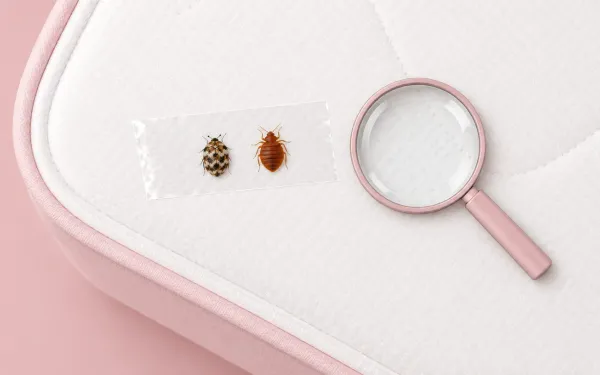
Are carpet beetles dangerous? They don’t bite, though larval hairs can leave itchy, bite-like bumps, according to a review in the journal Cutis. A rash that lingers is worth a doctor’s visit. Bed bugs feed on blood and leave dark spots along mattress seams, which is how to tell carpet beetles from bed bugs.
Step 1: Find Where the Carpet Beetles Are Breeding
The University of Kentucky says you must locate every infested item to eliminate carpet beetles. Larvae like dark, undisturbed places. With a flashlight, check:
- Closets and storage: wool sweaters, scarves, felt hats, furs, down pillows and blankets stored for months. Look in seams, folds, cuffs and collars. Cotton and polyester are rarely eaten unless blended with wool or heavily stained with food or body oils.
- Carpet edges and under heavy furniture. To see under wall-to-wall carpet, lift the edge off the tack strip with needle-nose pliers. Renting, or rather not? Vacuum hard along the edge instead.
- Lint and pet hair under baseboards, inside floor vents and ducts, and in upholstered furniture.
- Dead insects collected in light fixtures, window wells, attics and wall voids.
- Nests: old bird, rodent, bee and wasp nests and spider webs.
- Food: some species infest cereal, pet food and birdseed. Throw out infested packages.
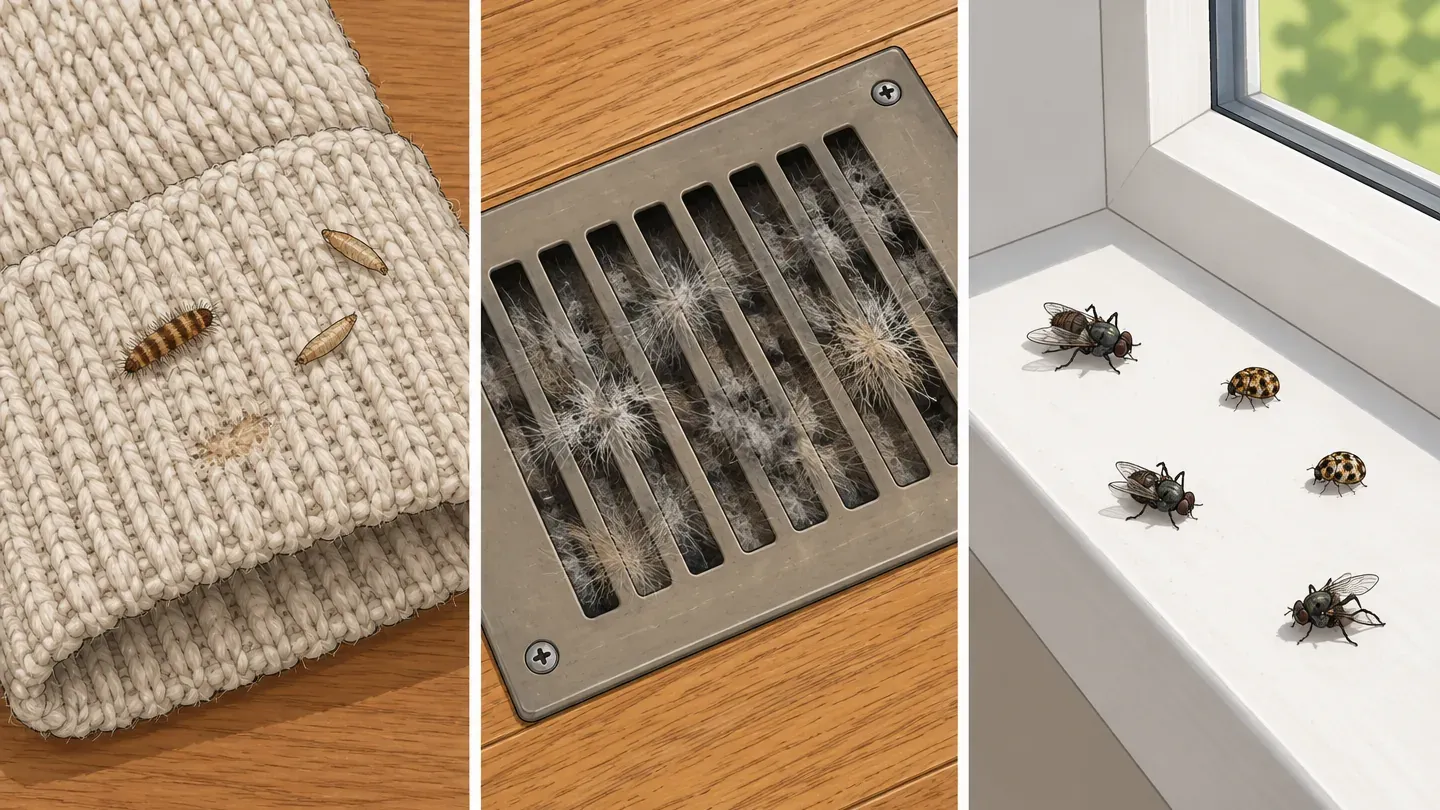
Illustration: a larva on a wool cuff, a lint-clogged vent and beetles on a windowsill.
Step 2: Vacuum Carpet Beetle Larvae and Their Food
Thorough vacuuming removes eggs, larvae and adults, plus the lint and hair they eat.
- Where: along and under carpet edges, baseboards, under furniture, closets, heating vents, draperies and upholstered furniture.
- Afterward: empty the bag or canister outdoors right away; larvae can keep developing in the debris.
Can you get rid of carpet beetles just by vacuuming? Not usually: larvae inside a wool coat need Step 3. For wall-to-wall carpet, vacuuming plus a spot treatment at the edges (Step 4) is the fix.
Step 3: Wash, Dry-Clean or Freeze Infested Items
This is how to kill carpet beetles in fabric. UC IPM calls hot-water laundering or dry cleaning the most important method for washable items, because it kills all stages.
- Washable items: wash on hot, then run a hot dryer. Dryer heat alone also works.
- Wool or anything labeled “no hot water”: freeze it or dry-clean it.
- Badly infested items: bag them and throw them out.
To freeze an item:
- Seal it in a plastic bag to keep frost off.
- Leave it in the freezer for 2 weeks. UC IPM says 2 weeks below 18°F kills carpet beetles, and a home freezer at 0°F is far colder.
- Not sure your freezer is at 0°F? That’s the FDA’s recommended setting for food; an inexpensive appliance thermometer will tell you.
- Let the bag warm up about 24 hours before opening, so moisture doesn’t condense on the item. Check first that fragile items can take the cold.
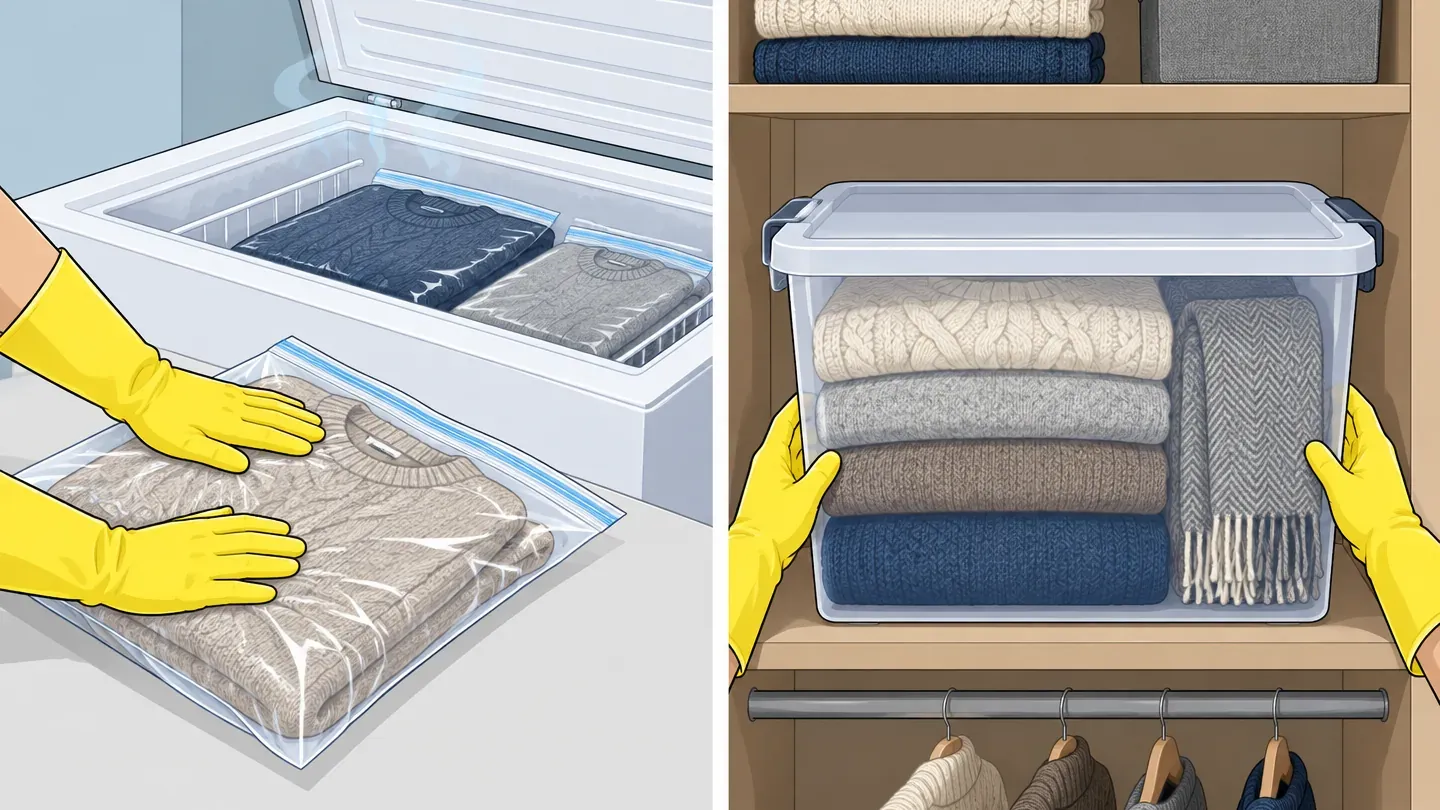
Illustration: sealing a sweater for the freezer, then storing woolens in a latched tote.
Step 4: Use Carpet Beetle Spray Only Where You Can’t Clean
UC IPM says insecticides may not be necessary if food sources are removed and areas kept clean. If larvae still turn up where you can’t clean:
- Use a spray whose label lists carpet beetles or fabric insects, and follow the label.
- Spot-treat only: carpet edges, under rugs and furniture, closet floors and walls, storage shelves, and cracks where lint gathers.
- Never spray clothing or bedding.
- Kids and pets: keep them off treated spots until the spray dries, as the label of the spray priced below directs.
- Attics and wall voids: use an insecticidal dust labeled for carpet beetles, and avoid breathing it in.
- Diatomaceous earth is a dust too. NPIC (the National Pesticide Information Center) says breathing it can irritate your nose; keep the bag away from kids and pets.
Step 5: Store and Seal to Keep Carpet Beetles Out
- Clean before storing. Food and sweat stains attract carpet beetles.
- Store in airtight containers, such as tight-fitting plastic bags inside totes or trunks.
- Mothballs only inside an airtight container, at the label’s dose and away from food, never loose in a closet where kids or pets can reach. NPIC says vapor leaking from containers that aren’t airtight can cause health problems.
- Keep adults out: fix screens, seal gaps around windows, doors and vents, and check cut flowers before bringing them in. Renting? Ask your landlord in writing to repair screens and seal gaps.
- Monitor: plain sticky traps on windowsills catch adults flying to the light. Check them once or twice a week.
How to Get Rid of Carpet Beetles Naturally (No Spray)
Most infestations clear without any pesticide. Steps 1–3 and 5 are the natural method: find the source, vacuum, hot-wash, dry or freeze what they touched, and store it sealed. UC IPM also suggests airing stored woolens in the sun once a year and brushing them thoroughly. Skip Step 4 unless larvae keep turning up in cracks you can’t clean.
Why Do Carpet Beetles Keep Coming Back?
Adults live on flowers outdoors and fly in through windows, so a few will keep showing up each spring. A few adults are normal; larvae are not. What you can stop is breeding inside.
Already sprayed and still seeing them? Kentucky says sprays are often of limited use because larvae sit inside materials where spray can’t reach. Treat the source instead.
What doesn’t work on its own:
- Killing the adults on the windowsill. The larvae doing damage are somewhere else.
- Bug bombs. Colorado State says they won’t be effective.
- Cedar chests and closets. Kentucky says they seldom seal tightly enough.
- Kitchen remedies. None of the four university guides in Sources lists vinegar, borax or baking soda as a treatment.
When larvae keep appearing, usually:
- A source was missed: a wool rug in the basement, a bird nest or dead insects in the attic or walls, pet hair in a vent.
- Larvae moved. Colorado State says they can survive several weeks without food and wander far.
- Cleaned items went back unsealed into an open closet.
Widen the Step 1 search.
How to Get Rid of Varied Carpet Beetles
The varied carpet beetle is the one most people find. The adult is round, about 1/10 inch, and black with a mottled pattern of white, brown and yellow scales (UC IPM). The larva is the one doing damage: carrot-shaped, hairy, with light and dark bands and tufts of hair at the back end.
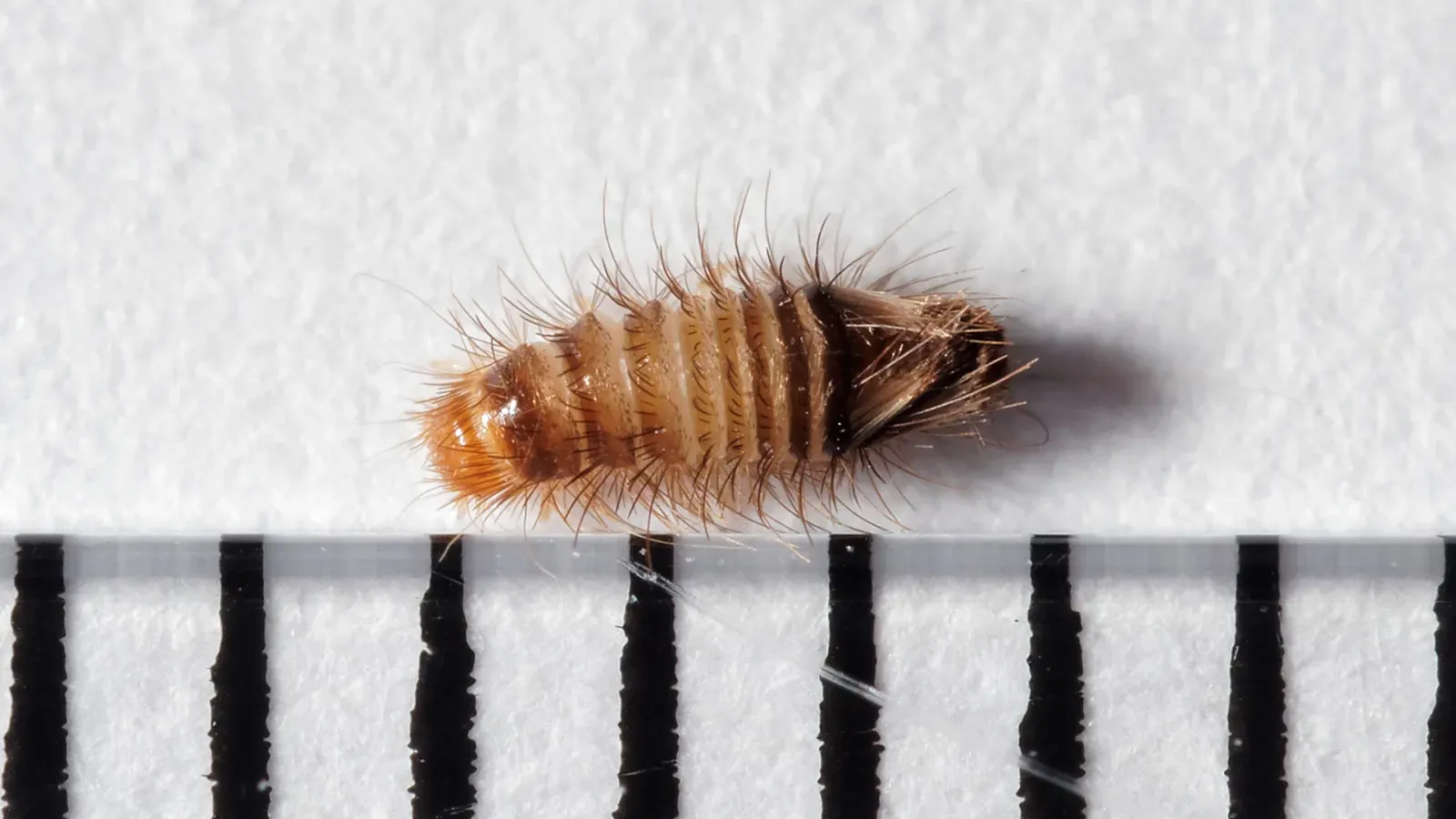
A varied carpet beetle larva next to a millimeter scale. Photo: Arnoldius (CC BY-SA 4.0), via Wikimedia Commons.
The five steps above work, with two places to look harder:
- Windowsills in spring. Adults feed on flowers outdoors and fly in through windows, so spotted beetles on a sill in spring are common. Vacuum them up, then look for larvae nearby.
- Dead insects and old nests. Varied carpet beetle larvae feed on dead insects in light fixtures, window wells, attics and wall voids, and on old bird and wasp nests. Clear those out, or the larvae keep coming back to the same rooms.
UC IPM says eggs hatch in about 2 weeks and larvae can feed for months, so keep vacuuming carpet edges and closets for a few months after the first cleanup.
How to Get Rid of Black Carpet Beetles
The black carpet beetle is a bit bigger and looks different at every stage. The adult is oval, about 1/8 to 3/16 inch, and plain shiny black or very dark brown. The larva is smooth and golden to dark brown, up to about 1/2 inch, with a long tuft of hairs at the tail end.
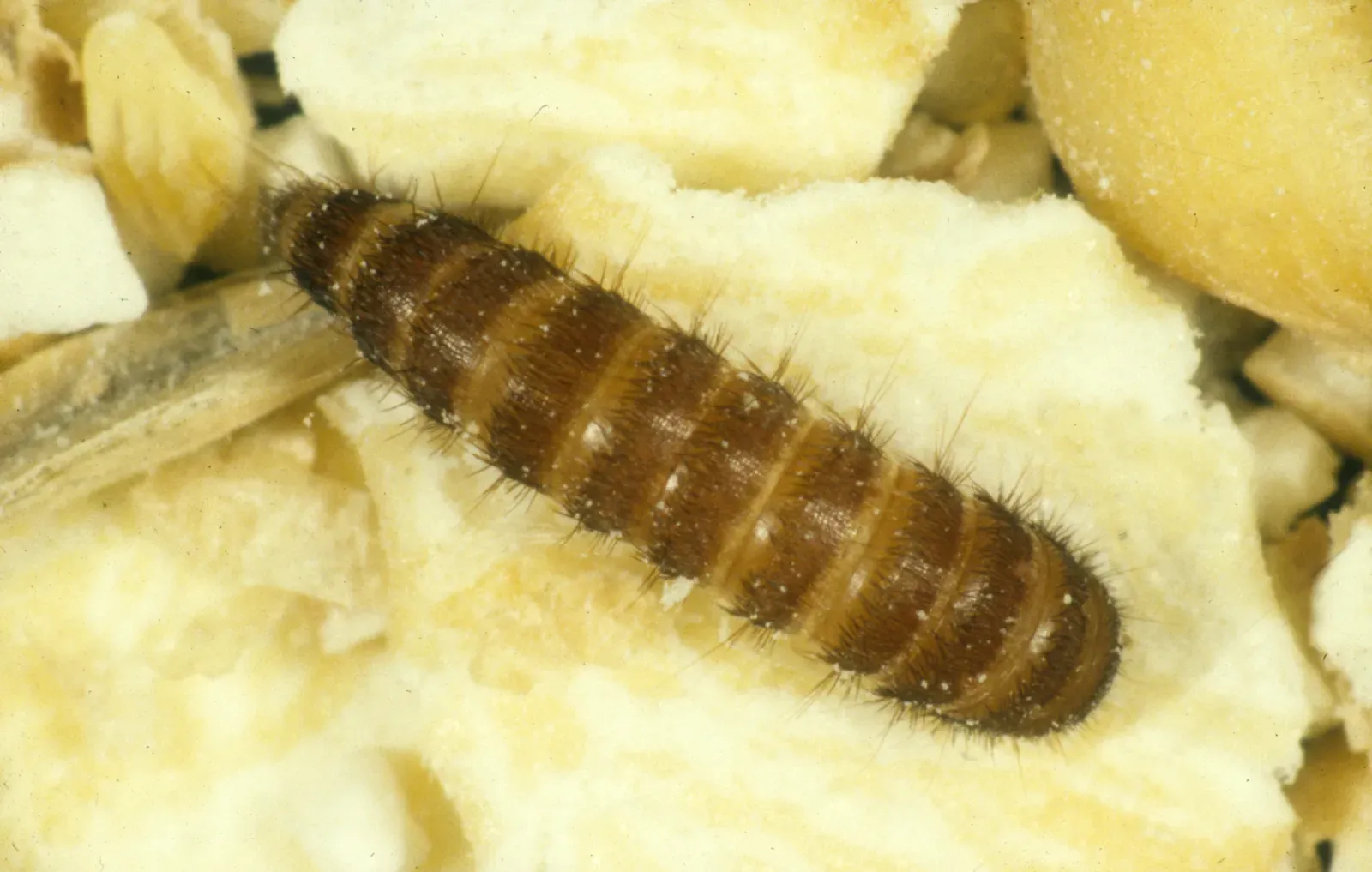
A black carpet beetle larva on grain. Photo: CSIRO (CC BY 3.0), via Wikimedia Commons.
Treat it with the same five steps, plus one more place to check: the pantry. Black carpet beetle larvae eat flour, cereal and pet food as well as wool, fur and feathers. If you find larvae in a closet, go through the dry food too, throw out anything infested, and move the rest into sealed containers; how to get rid of drugstore beetles walks through the pantry cleanout. Also check under heavy furniture, along carpet edges and inside upholstered furniture, where these larvae like to hide.
Carpet Beetles in Your Bed
Larvae in a bed are usually feeding on hair, lint or a wool or down layer, not on you, and they don’t bite. Hot-wash and dry the bedding, vacuum the mattress seams and under the bed, and check any wool rug or stored blanket nearby; a mattress stuffed with hair or feathers is the case for a pro.
Carpet Beetles in Your Car
A car gives larvae the same food as a closet: lint, pet hair, crumbs and dead insects under the seats and in the trunk. Vacuum the seats, seams, floor mats and trunk liner, wash removable mats and seat covers hot, and empty the vacuum outdoors. Remove any wool blanket or pet bed you keep in the car. Adults are drawn to sunlight, so a few on the inside of the windows in spring can come from outside.
How Long Does It Take to Get Rid of Carpet Beetles?
Plan on rechecking for most of a year. UC IPM says eggs hatch in about 2 weeks, then larvae feed for 70 to 630 days depending on the species, so a missed larva can surface months later.
Keep window traps up through the next spring, when new adults head for the windows. No new larvae, shed skins or window beetles by then means you’re likely done.
Which Plan Fits Your Situation
| Your situation | Start with | Then |
|---|---|---|
| A few adults on a windowsill | Vacuum them | Check the nearest closet and rug edge |
| Larvae or shed skins in a closet | Steps 1–3 for everything in it | Store woolens sealed |
| Larvae in bed | Hot-wash bedding, vacuum seams | A pro if the mattress is hair or feather |
| Wall-to-wall carpet | Vacuum the edges hard | Spot-treat edges you can’t clean |
| Already sprayed, still seeing them | Widen the Step 1 search | Attics, wall voids, nests |
| Valuable rug or stuffed furniture | A pro | Vault fumigation for stuffed items |
What It Might Still Cost
| Item | Typical cost |
|---|---|
| Two-gallon freezer bags, 10 (Ziploc) | $5.29 |
| Indoor insect spray labeled for carpet beetles, 24 oz (Ortho Home Defense) | $7.49 |
| DIY total | About $13 |
| Pro, small infestation in one area such as a closet | $150–$175 |
| Pro treatment, typical (price guide) | $250 (range $150–$450) |
| Pro, severe infestation in a larger home | $2,000–$4,000 |
DIY: Target list prices, October 1, 2026, before tax; assumes you own a vacuum, washer and freezer. Carpet beetles are on the spray’s label.
Price-guide figures: HomeAdvisor (June 2026). Only a handful of shared quotes exist: 6 that homeowners posted on Reddit ranged $250–$1,800.
Before you pay for a whole-house carpet beetle treatment: HomeAdvisor’s guide says your whole home needs treating, but the university guides say cleaning often makes spray unnecessary.
Before You Start: A Quick Checklist
- Grab a flashlight and needle-nose pliers for carpet edges.
- Bag wool with larvae before carrying it through the house.
- Check care labels before a hot wash.
- Clear freezer space for two weeks, or plan batches.
- Empty the vacuum outdoors after each room.
- Read the spray label for carpet beetles before you buy.
- Set sticky traps on windowsills through next spring.
When to Call a Pro: How Pros Exterminate Carpet Beetles
- Stuffed furniture, mattresses or pillows filled with hair or feathers are infested. UC IPM says spraying the outside won’t work; a licensed firm can fumigate the item in a vault.
- An expensive broadloom or Oriental rug needs treating and a spray might damage it; hire a pest control or carpet-cleaning company.
- You can’t find the source, or larvae keep appearing after a thorough cleanout.
Ask the pro where they found the source, what they’ll treat, and whether the price covers follow-up visits. Our guide to what an exterminator does has more questions to ask.
Common questions
Usually not. Call one for infested stuffed furniture, which needs fumigation, or when you can’t find the source.
Find every infested item, vacuum carpet edges, closets and vents, then hot-wash, dry-clean or freeze what you can (2 weeks in the freezer). Use a labeled spray only on carpet edges and cracks you can’t clean. Pros add fumigation for stuffed furniture they can’t otherwise treat (UC IPM).
Expect to keep checking for most of a year. Eggs hatch in about 2 weeks and larvae can feed for 70 to 630 days (UC IPM), so a missed larva can turn up months later. No new larvae or shed skins by next spring means you’re likely done.
The Bottom Line
Carpet beetles are beaten by cleaning, not spraying. Find where the larvae feed, vacuum those spots, hot-wash, dry-clean or freeze what they touched, and store woolens sealed. Spray only edges and cracks you can’t clean. A few adults each spring are normal; new larvae or shed skins mean a missed source. For the larvae themselves, see carpet beetle larvae.
Sources and further reading · 9
- UC IPM: Carpet Beetles (Pest Notes 7436)
- University of Kentucky: Carpet Beetles (ENTFACT-601)
- Colorado State University Extension: Dermestid Beetles (Carpet Beetles)
- University of Maryland Extension: Carpet Beetles
- Cutis: What’s Eating You? Carpet Beetles (Dermestidae)
- Connecticut Agricultural Experiment Station: Bed Bugs and Look-Alikes (PDF)
- NPIC: Mothballs: Regulation and Proper Uses and Diatomaceous Earth
- FDA: Are You Storing Food Safely?
- Cost guide: HomeAdvisor: Carpet Beetle Extermination Cost