Carpet Beetle Larvae: What They Look Like, Where They Hide
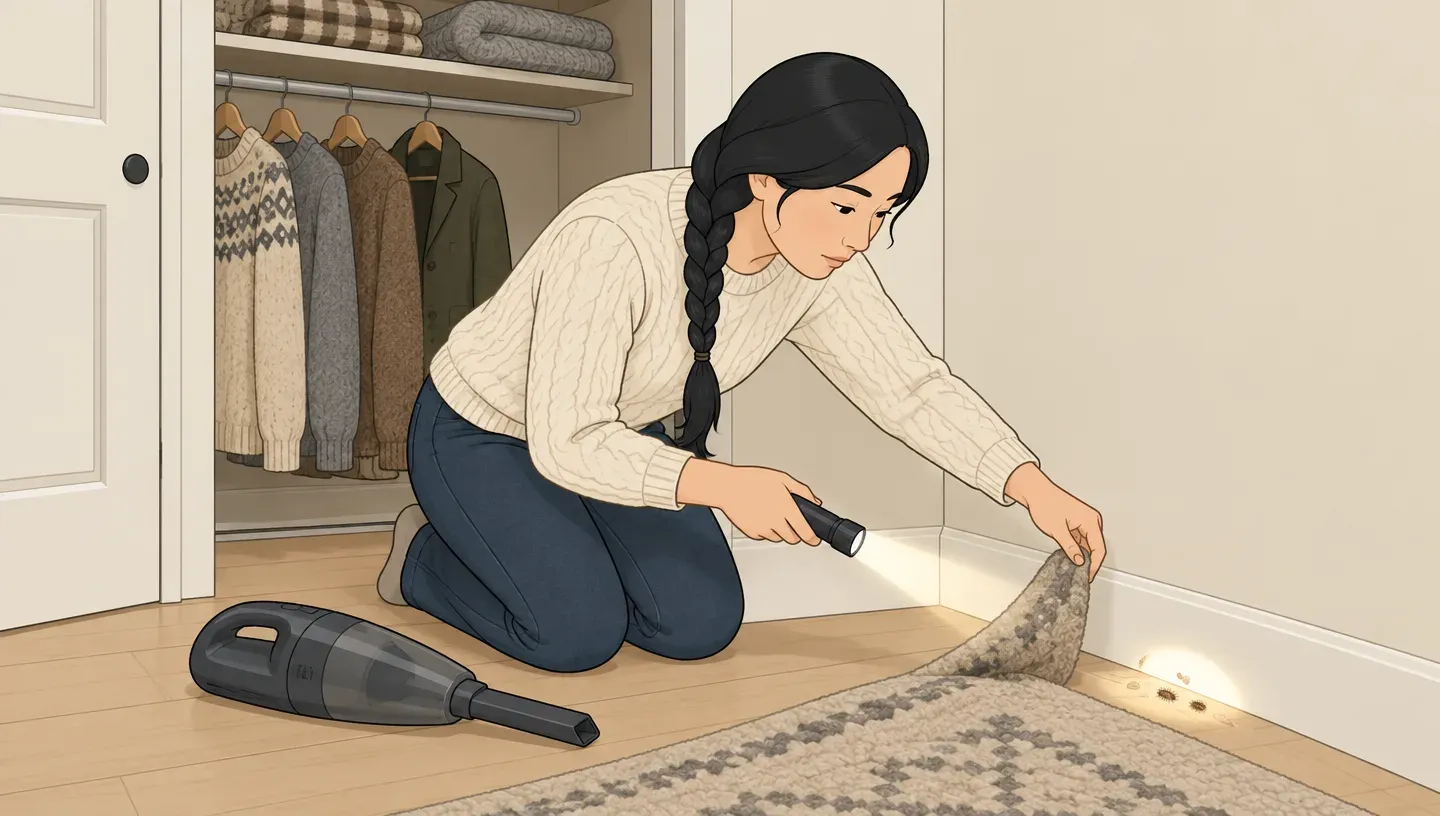
Illustration: a flashlight check along a closet baseboard below stored wool sweaters.
Carpet beetle larvae are fuzzy, slow, tan-to-brown grubs about 1/8 to 1/4 inch long, and they’re the stage that eats wool, fur, feathers and lint. Finding them means beetles are breeding indoors. Vacuum where they feed, hot-wash or freeze what they touched, and recheck: no new larvae or shed skins means it worked.
Cost: about $13 in supplies. Difficulty: moderate. Call a pro if larvae are inside a hair- or feather-stuffed mattress, pillow or sofa, or they keep turning up after you’ve cleaned every closet, rug edge and vent you can reach.
This page covers what a larva looks like, the three common types, look-alikes, where they hide and what to do next. For the adults, see what carpet beetles look like. We haven’t tested anything ourselves; it rests on UC IPM, University of Kentucky, Rutgers and other extension guidance plus list prices.
Carpet Beetle Larvae vs. Look-Alikes at a Glance
| What you see | Size | Usually where | Most likely |
|---|---|---|---|
| Hairy tan-to-brown grub, bristly shed skins, no silk | 1/8 to 1/4 inch | Closets, rug edges, baseboards | Carpet beetle larva |
| Same, but shiny, carrot-shaped, with a long tail brush | Longer, up to ½ inch | Also flour, cereal and grain | Black carpet beetle larva |
| Creamy-white caterpillar, silk tubes or webbing | Up to ½ inch | Stored wool | Clothes moth larva |
| Tiny translucent or whitish-yellow bug | 1.5 to 4.5 mm | Mattress seams | Bed bug nymph |
| Hairy speck with hair fans at the rear, many legs | About 1 mm | — | Duff millipede, harmless |
Sources: University of Kentucky, UC IPM, EPA and Colorado State.
What Do Carpet Beetle Larvae Look Like?
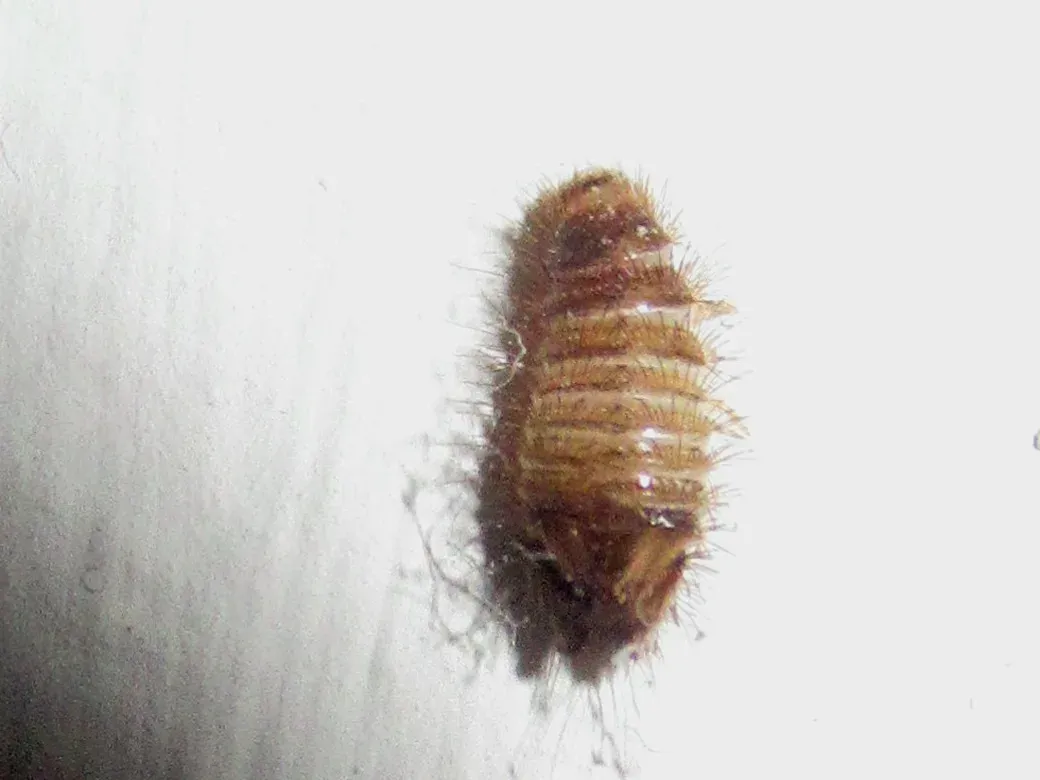
A varied carpet beetle larva on a kitchen wall. Photo by David Short (CC BY 2.0), via Wikimedia Commons.
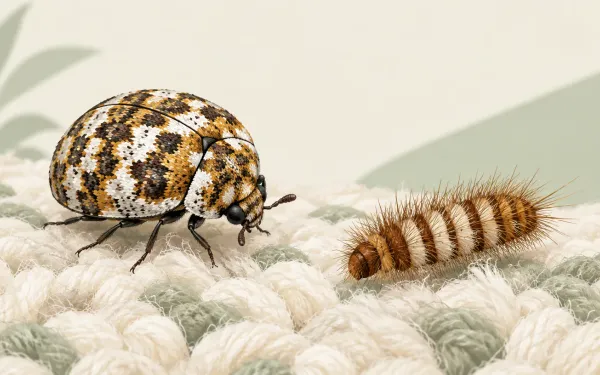
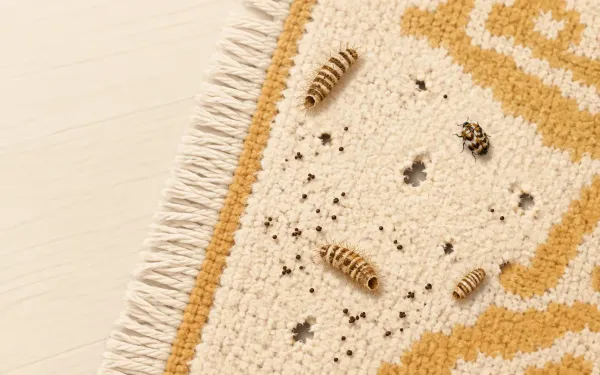
A carpet beetle larva, also called a carpet bug larva or carpet beetle worm, is a small, hairy grub that crawls slowly and hides from light. The University of Kentucky describes them as 1/8 to 1/4 inch long, tan to brownish and densely covered with hairs or bristles, often with a tuft at the tail. They leave bristly shed skins and pellets the size of a grain of salt.
A “baby carpet beetle” is this larva. Eggs hatch in one to two weeks, and each larva molts 8 to 17 times (Rutgers), so skins of several sizes pile up in one spot. A white one is likely a young furniture carpet beetle larva, which darkens to chestnut brown (UC IPM).
Black, Varied and Furniture Larvae: The Shape Tells Them Apart
UC IPM describes the three common household types:
- Varied carpet beetle larvae: striped light and dark brown, wider at the rear than the head, with hair tufts they raise into a round plume when disturbed.
- Furniture carpet beetle larvae: white at first, then dark red or chestnut brown, wider at the head than the rear.
- Black carpet beetle larvae: shiny, light brown to almost black, tapering to a tail tuft of long hairs.
Full-grown black carpet beetle larvae reach 5/16 inch (UC IPM) to about ½ inch (Rutgers, Ohio State), so a carrot-shaped larva longer than the others, with a tail brush, is one.
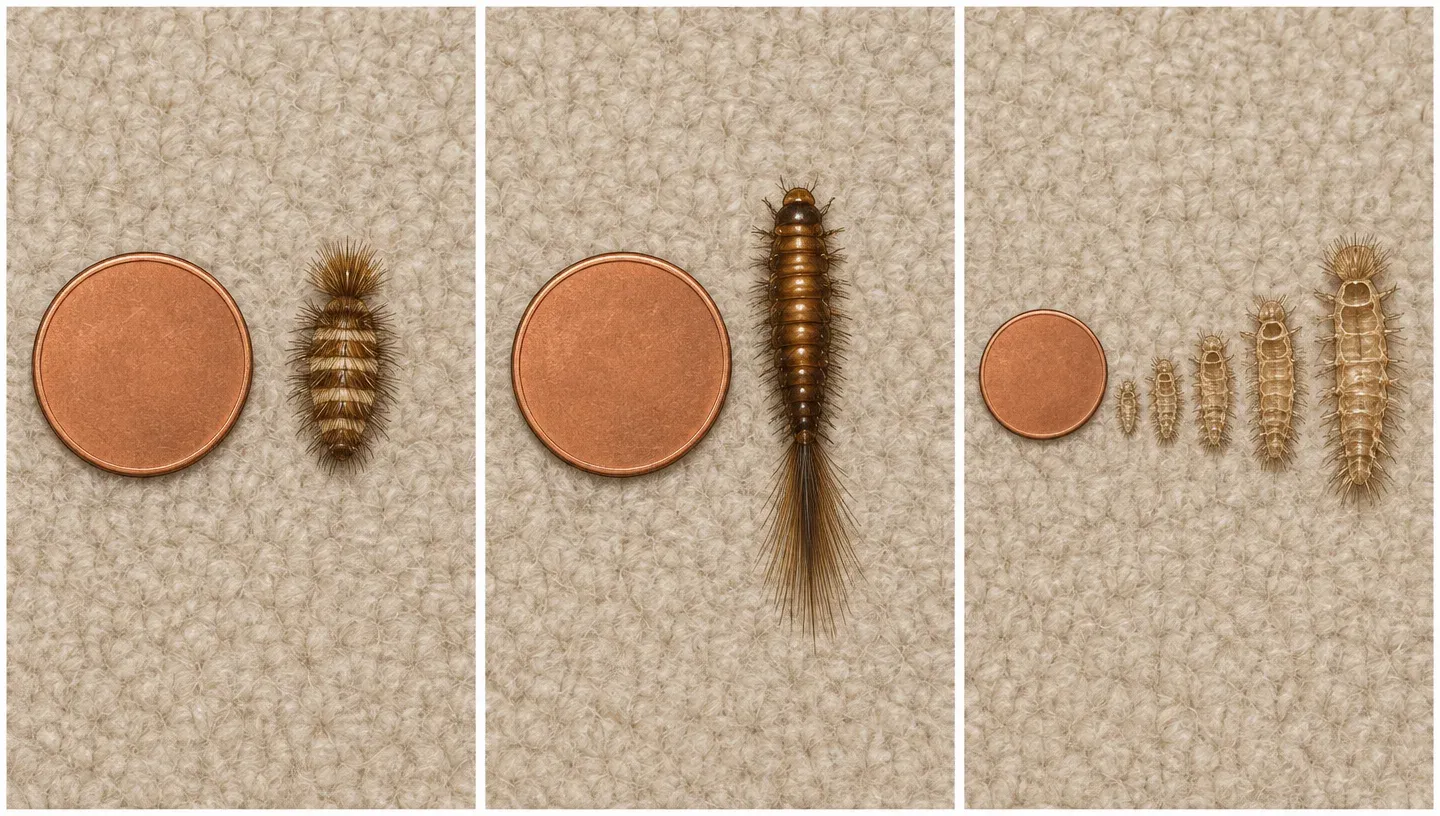
Illustration: a varied and a black carpet beetle larva, and shed skins in increasing sizes, beside a plain coin.
Carpet Beetle Larvae vs. Clothes Moth Larvae: Look for Silk
Silk is the quickest tell: carpet beetle larvae don’t spin it. Webbing or cases mean it’s time to get rid of clothes moths instead.
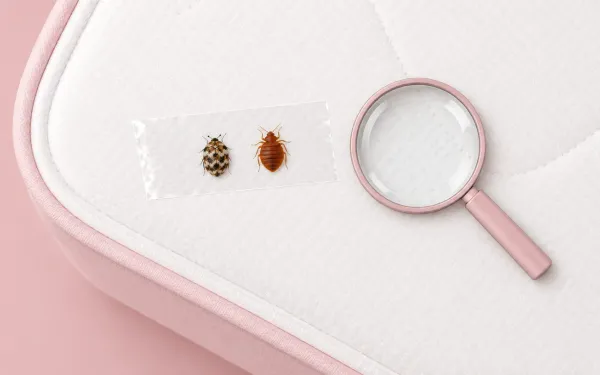
Bed bugs have no larvae, only blood-feeding nymphs; compare carpet beetles vs. bed bugs if you’re torn. Other small indoor grubs are in our bug eggs and larvae guide.
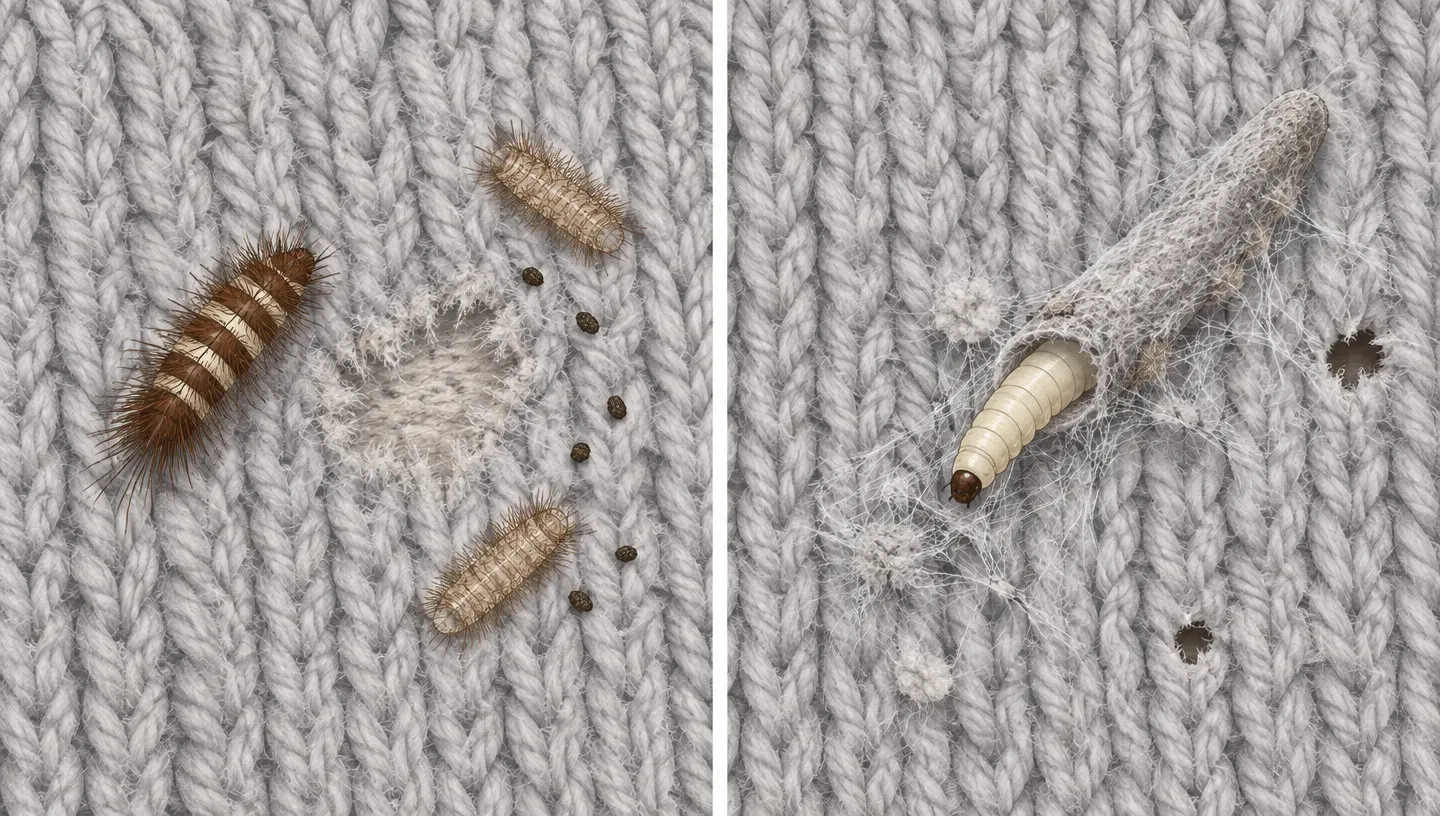
Illustration: a carpet beetle larva with skins and pellets (left) and a clothes moth larva in a silk tube (right).
Why the Larvae Do the Damage: They Digest Keratin
Adult carpet beetles eat pollen and don’t touch fabric. The larvae digest keratin, the protein in wool, fur, felt, silk, feathers and leather (University of Kentucky), and live on lint, pet hair and dead insects. Cotton and synthetics are seldom attacked unless blended with wool or soiled with food or body oils.
They stay larvae a long time: 70–94 days for the furniture carpet beetle, 166–330 days for the black and 220–630 days for the varied (UC IPM). The damage is usually one grazed patch rather than scattered holes; see signs of carpet beetles or match it in holes in clothes.
Where Do Carpet Beetle Larvae Hide?
In dark cracks, crevices and folds, most often in closets, drawers and upholstered furniture (University of Florida). With a flashlight, work through the University of Kentucky’s list:
- Baseboards and rug edges, where lint and pet hair collect; rug edges and undersides are infested more often than open floor.
- Stored wool: seams, folds, cuffs and collars of sweaters, coats and blankets stored for months.
- Under heavy furniture, inside upholstered pieces, and in floor vents that collect lint.
- Attics, basements and light fixtures, where bird nests and dead insects collect.
- Stored food: cereal, pet food and birdseed. A hairy larva in pet food or near a dead mouse may be a larder beetle, a cousin that prefers meat.
Kentucky says you must find every infested item, so keep going after the first. Renting? Ask your landlord in writing before lifting carpet off the tack strip.
Why Are Carpet Beetle Larvae on Walls or the Ceiling?
A larva on a wall or ceiling is usually a wanderer. Ohio State says larvae crawl from room to room and live behind baseboards, moldings and in air ducts, and a larva ready to pupate may leave its food (UC IPM). So carpet beetle larvae on walls mean they’re feeding somewhere in the house, not necessarily in that room. Check the nearest rug edges, closets, vents and the gap under baseboards first.
Are Carpet Beetle Larvae Harmful? To Wool, and Sometimes Skin
To wool, fur and down, yes. Carpet beetles don’t bite, but a review in the dermatology journal Cutis says larval hairs can cause itchy bumps mistaken for bites; see a doctor about a rash that doesn’t clear.
Larvae usually mean an infestation. UC IPM says a few adult beetles aren’t cause for alarm; act when you find larvae developing in fabrics. Eggs and larvae also hitchhike on secondhand clothing and upholstered furniture (Oklahoma State).
How to Confirm Carpet Beetle Larvae
- Tape one to white paper and compare it with the table: hairy, slow, no silk.
- Look for shed skins and droppings. The skins are hollow, bristly and striped, in several sizes as the larva molts (see the to-scale picture above); the droppings are pellets like grains of salt, in the same spot.
- Check nearby wool for one grazed patch rather than scattered holes.
- Recheck cleaned spots in a few weeks; new skins mean they’re still feeding.
What to Do Next
Vacuum the spot, then baseboards, carpet edges, closet floors and vents, and dispose of the bag promptly (UC IPM). Hot-wash and dry anything washable; Kentucky says hot laundering, dry cleaning or dryer heat kills eggs and larvae. Spray only cracks you can’t clean, with a product whose label lists carpet beetles, never clothing or bedding. The full plan is in how to get rid of carpet beetles.
Freeze what you can’t wash, sealed in a plastic bag. The rules differ: 2 weeks below 18°F (UC IPM), 1 week at 0°F or 72 hours at -20°F (Kentucky), or 3 days below 0°F (Colorado State). Two weeks at 0°F or colder meets the first two (our math). Let the bag warm about 24 hours before opening so condensation doesn’t form on the item.
| Item | Typical cost |
|---|---|
| Two-gallon freezer bags, 10 | $5.29 |
| Indoor insect spray labeled for carpet beetles, 24 oz | $7.49 |
| DIY total | About $13 |
| Pro carpet beetle treatment (price guide) | $150–$450 |
DIY: Target list prices, October 1, 2026, before tax; assumes you own a vacuum, washer and freezer. Price-guide range: HomeAdvisor, checked October 1, 2026. Only a handful of shared quotes exist: 6 that homeowners posted on Reddit ranged $250–$1,800. Call a pro when larvae are inside a mattress, pillow or sofa stuffed with hair or feathers: UC IPM recommends fumigating it, which only licensed operators can do.
- Tape a larva to white paper for ID.
- Vacuum baseboards, rug edges, closets and vents, then empty it outside.
- Hot-wash and dry everything washable it touched.
- Freeze wool you can’t wash, two weeks at 0°F.
- Clean wool before storing it in sealed bins.
- Recheck cleaned spots through next spring.
Common questions
Colorado State says most household species spend close to a year as larvae, ranging from 3–4 months to nearly two years.
No. They chew animal fibers, not skin. A rash with larvae nearby is usually from touching their bristly hairs (Cutis), not a bite.
They can feed on a wool blanket, a down comforter or a hair- or feather-stuffed mattress or pillow. Hot-wash and dry the bedding; more in carpet beetles in bed.
Sources and further reading · 12
- UC IPM: Carpet Beetles (Pest Notes 7436)
- University of Kentucky Entomology: Carpet Beetles (ENTFACT-601) and Clothes Moths (ENTFACT-609)
- Rutgers NJAES: Carpet Beetles (FS1181)
- Colorado State University Extension: Dermestid Beetles
- University of Florida IFAS: Carpet Beetles
- Ohio State University Extension: Carpet Beetles (HYG-2103)
- University of Arkansas Extension: Carpet Beetles (PDF)
- Oklahoma State University Extension: Dermestid Carpet Beetles
- Utah State University Extension: Carpet Beetles (PDF)
- EPA: Bed Bugs Appearance and Life Cycle
- Cutis: What’s Eating You? Carpet Beetles (Dermestidae)
- Costs: HomeAdvisor: Carpet Beetle Extermination Cost; Target list prices for Ziploc two-gallon freezer bags and Ortho Home Defense Insect Killer for Indoor & Perimeter, whose label lists carpet beetles.