Can Mice Climb Walls? How High Mice and Rats Can Jump

Illustration: a mouse climbing the rough corner of a brick wall toward a gap under the eaves.
Yes, mice can climb walls. House mice run up any rough vertical surface, such as brick, wood or stucco, travel along wires and ropes, and jump about a foot onto a flat surface (UC IPM). Slick, smooth finishes stop them. Rats climb too, and roof rats often get in at the roofline, so seal high gaps, not just low ones.
Call a pro if rodents reach your roof along overhead power or phone lines; the ICWDM warns that guards on those lines can fray the insulation and cause short circuits.
This guide covers which surfaces mice and rats can climb, how high they jump, the signs they’re climbing in your home, and how to cut off their routes. We haven’t tested this ourselves; it rests on UC IPM, Nebraska Extension and Internet Center for Wildlife Damage Management (ICWDM) guidance, including a rodent-proofing handbook the ICWDM hosts.
Mice vs. Rats: Climbing at a Glance
| House mice | Roof rats | Norway rats | |
|---|---|---|---|
| Climbs rough walls | Yes, any rough vertical surface | Yes, very agile climbers | Yes, most are good climbers |
| Where you’ll notice them | Tops of cabinets, ceilings, attics | Attics, trees, utility lines | Lower floors, basements |
| Jump up | About 10–12 inches, up to 18 | Rats: up to 36 inches | Rats: up to 36 inches |
| Other limits | Jumps a 3-foot gap, survives a 9-foot drop | Rats: 48 inches across, a 50-foot drop | Rats: 48 inches across, a 50-foot drop |
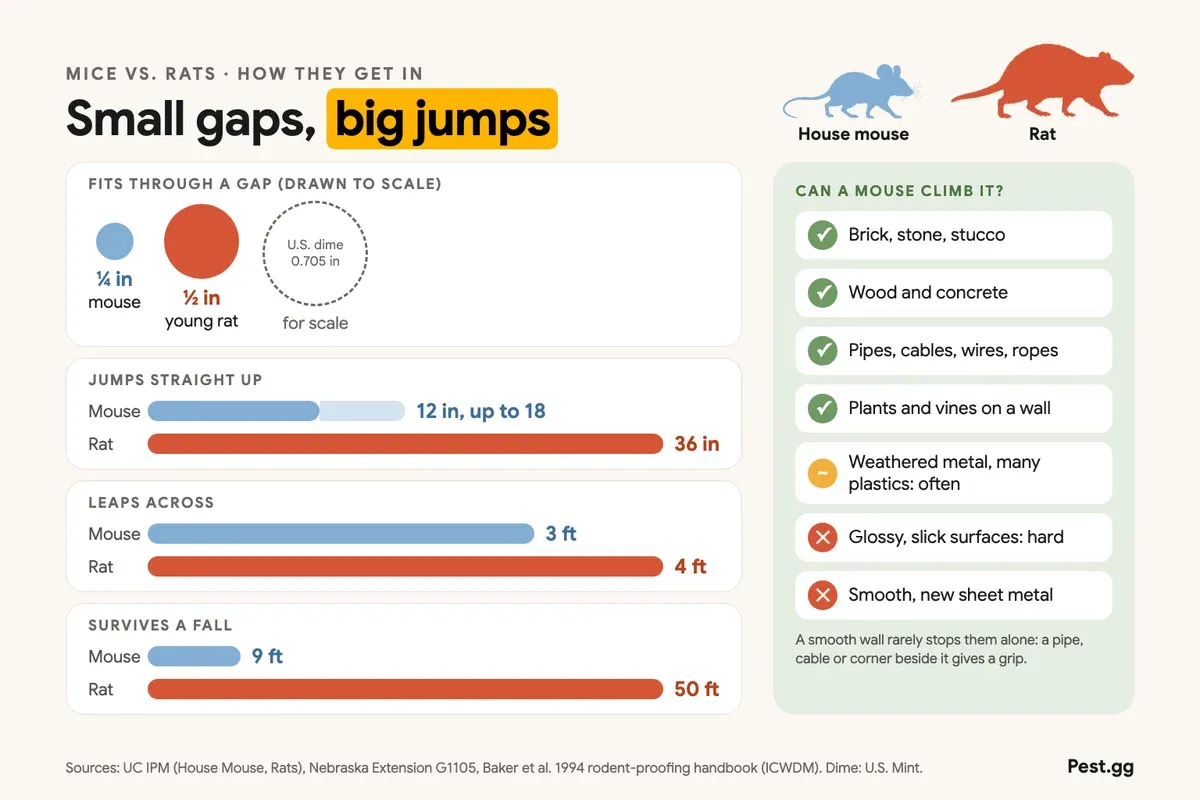
Infographic: how small a gap and how high a jump, mice vs. rats. Sources: UC IPM, Nebraska Extension, ICWDM-hosted rodent-proofing handbook.
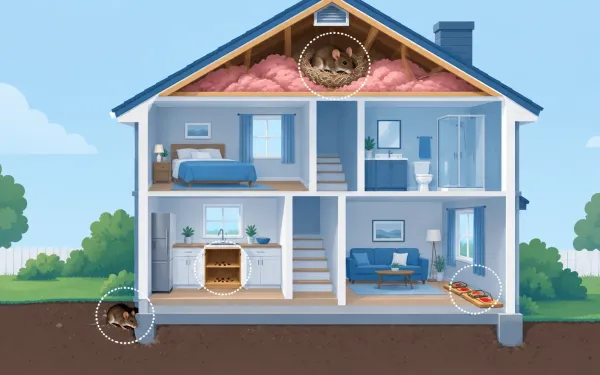
That’s why droppings turn up on top of kitchen cabinets, why you hear scratching in the ceiling, and why a mouse can get in through a gap under the eaves as easily as one by the foundation.
What Surfaces Can Mice Climb?
Grip is what matters: a mouse needs something its claws can catch on.
| Surface | Can a mouse climb it? |
|---|---|
| Brick, stone, stucco | Yes, rough enough to grip |
| Wood and concrete | Yes, unless it has a slick finish |
| Pipes, cables, wires, ropes | Yes, including along them sideways |
| Plants and vines on a wall | Yes, and they lead to the roof |
| Weathered sheet metal, many plastics | Often yes |
| Smooth, new sheet metal | No; it’s used as a barrier |
| Glossy, slick surfaces | Hard to climb |
Mice also run horizontally along wire cables and ropes, according to UC IPM. That’s how they cross from a fence or a tree to a house, and why plants growing next to or up a building should be thinned or removed.
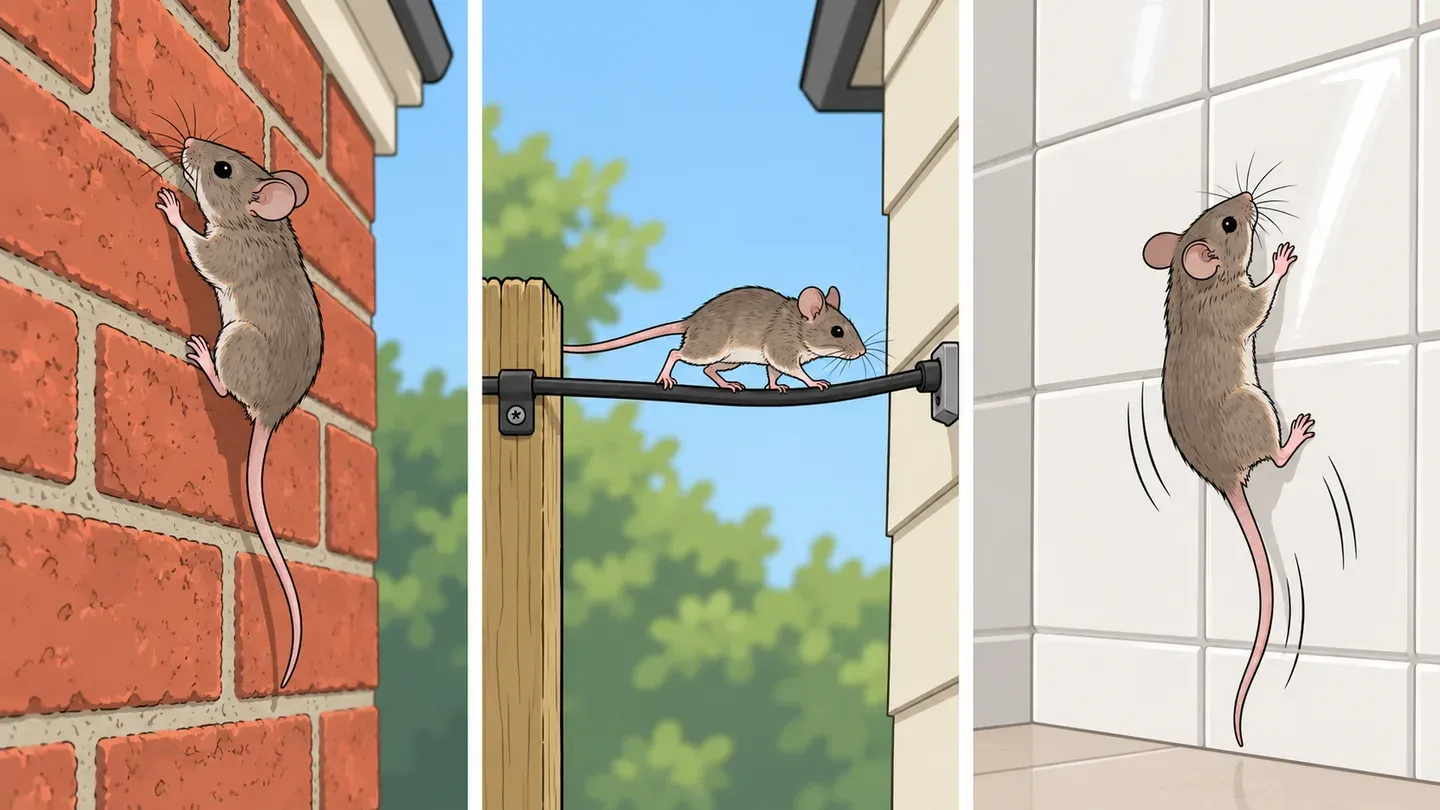
Illustration: a mouse gripping a brick wall, running along a utility cable, and slipping on glossy tile.
Smooth Walls: Can a Mouse Hold On?
Not for long on its own. A mouse needs something its claws can catch, and a smooth surface gives it nothing: smooth, new sheet metal is slick enough that the rodent-proofing handbook uses a band of it as a climbing barrier. Glossy tile and slick painted surfaces are hard going too (ICWDM). The catch is that a smooth wall rarely stands alone: a pipe, cable, corner or door frame beside it gives a mouse the grip the wall doesn’t.
How Do Mice Climb Walls?
A mouse climbs by catching its claws on tiny bumps, cracks and mortar lines, so the rougher the surface, the easier the climb. On a wall too smooth to grip, it uses whatever runs beside it: a pipe, a cable, a corner or a door frame. Rats work the same way on a bigger scale; the ICWDM-hosted handbook describes them bracing between a wall and an attached pipe and climbing up inside wall voids.
Can Mice Climb Siding, Metal or Plastic?
Often, yes. The handbook chapter on rodent-proof construction says rats and mice can climb almost any rough vertical surface, including wood, brick, concrete, weathered sheet metal and many plastic products. Smooth, new sheet metal is different: the same chapter uses a smooth metal band on walls as a climbing barrier.
With siding, check the seams and corners. The chapter names the joint between siding and corner trim as one of the ways rats and mice get into a house.
How High Can a Mouse Jump?
About a foot, and sometimes more. UC IPM says house mice jump up to 12 inches from the floor onto a flat surface; other extension guides say about 10 inches, and the rodent-proofing handbook puts the top at 18 inches. Nebraska Extension adds that a mouse can jump across a 3-foot gap and survive a 9-foot drop.
So a countertop is reachable if there’s a chair, a shelf or a hanging towel along the way, and a mouse that falls off a shelf usually just runs off.
Can Rats Climb Walls?
Yes, and roof rats are the better climbers of the two species you’re likely to meet. They use their tails for balance on overhead utility lines, run along fences at night, and nest in trees and attics before climbing down to food (ICWDM).
Norway rats are heavier and usually stay on lower floors, but most are good climbers too, and they get into buildings by climbing, jumping, gnawing and swimming. They’re the stronger swimmers; roof rats are the better climbers.
How High Can Rats Climb?
As high as the surface lets them. On rough brick, siding seams, a vine or a pipe, a rat can climb all the way to the roof, which is how roof rats end up in attics (ICWDM). What stops them is a gap in grip: smooth metal, a rat guard on a utility line, or branches cut back from the roof (UC IPM).
Rats also climb pipes. The ICWDM-hosted handbook says they can climb the outside of vertical pipes up to 3 inches across and climb inside pipes and wall gaps 1½ to 4 inches wide. Activity high in the house usually means roof rats or mice; getting rid of rats in your house covers both rat species.
Can Mice Climb Stairs and Furniture?
Yes. Stairs, carpeted steps, upholstered furniture, wooden bed frames and curtains all have plenty of grip, and curtains that reach the floor give a mouse an easy route to a windowsill or shelf.
Bedding that touches the floor or a bed pushed against the wall works like a ladder. If one is already in your room, pull the bed off the wall and set traps along the bedroom walls.
Upstairs, a mouse more often travels inside walls and along pipes than up the stairs. Nebraska Extension notes mice keep their whiskers against walls to guide them, which is why they follow the edges of rooms.
How to Confirm Mice Are Climbing in Your Home
Check high places for droppings: on top of cabinets, on shelves, on the tops of door frames and in the attic. Size tells you the animal; see mouse poop vs. rat poop.
Look for rub marks: dark, greasy smudges where mice climb the same spot repeatedly. The ICWDM shows a smudge line left by mice climbing concrete to reach a hole.
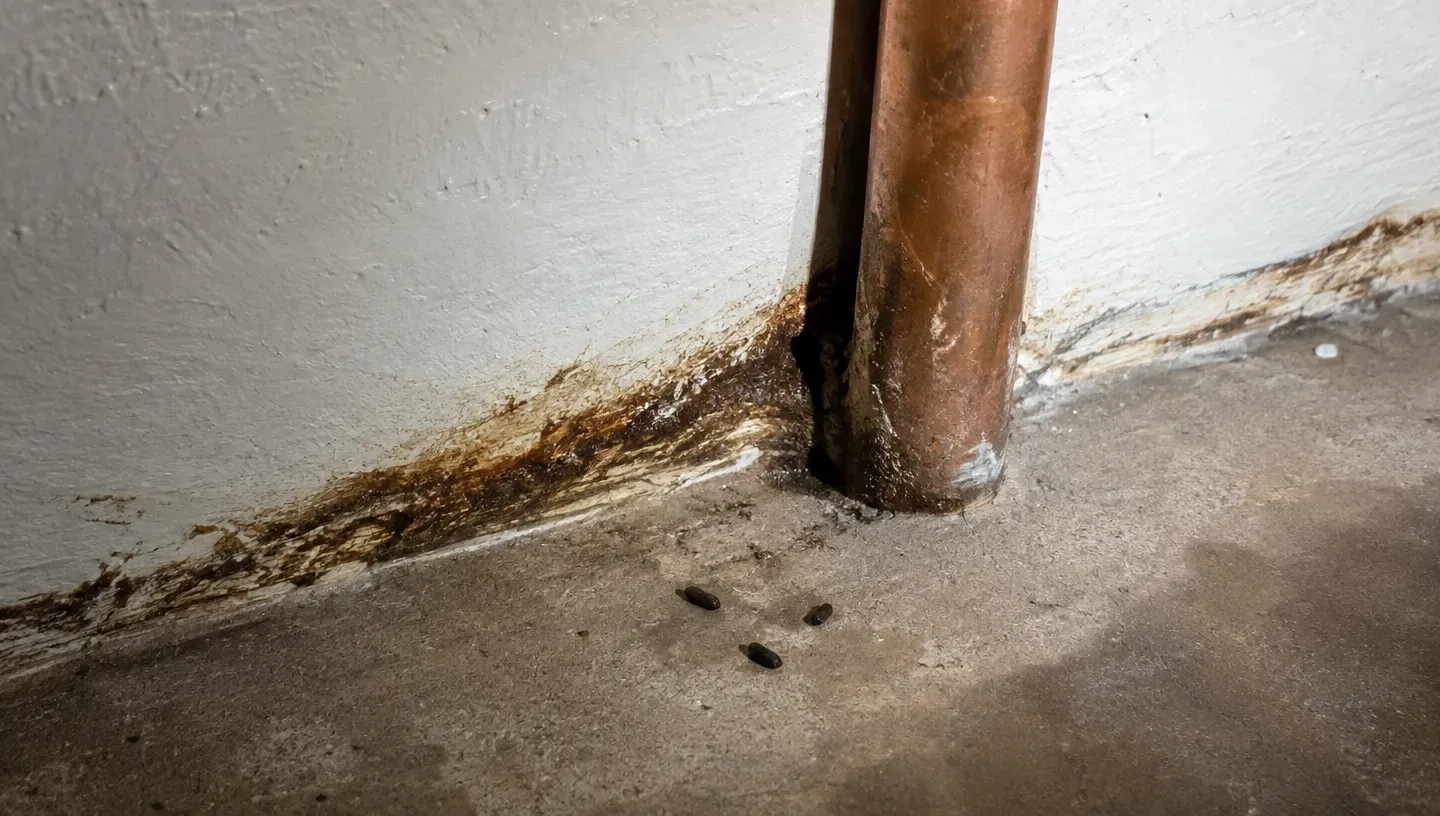
A dark, greasy rub mark where mice run along the wall to a gap around a pipe, with droppings below.
Listen overhead. Gnawing, climbing in walls and running across the upper surface of ceilings are common signs of mice, and on drop ceilings their movements can be loud. Hearing it in the attic? Trap along the joists and the eaves.
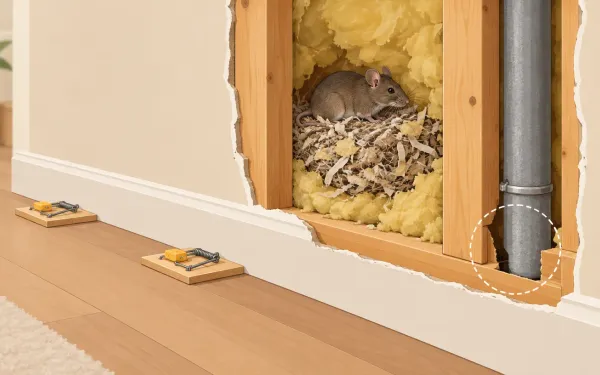
Find where they come out. If the sounds come from inside a wall, look under the sink, behind the refrigerator and along the baseboards; mice in walls has the trapping plan.
What to Do Next
A climbing mouse can reach openings you’d never think to check, so look up as well as down when you hunt for entry points. Mice squeeze through openings about ¼ inch across (UC IPM), and the gaps mice use to get in include vents, pipe and cable entries, the eaves and the roofline, not just the foundation.
Rat proofing a house works the same way for both rodents: close the gaps and break the climbing routes. Guards stop climbers, but only if they sit high enough. On a downspout or pipe that rats climb, a cone-shaped metal guard works; on a wall, a smooth sheet-metal band 14 to 18 inches wide does the same job, as long as it sits at least 30 inches above anything a rodent can jump from (ICWDM handbook). Don’t fit guards to power or phone lines yourself: they can fray the insulation and cause short circuits.
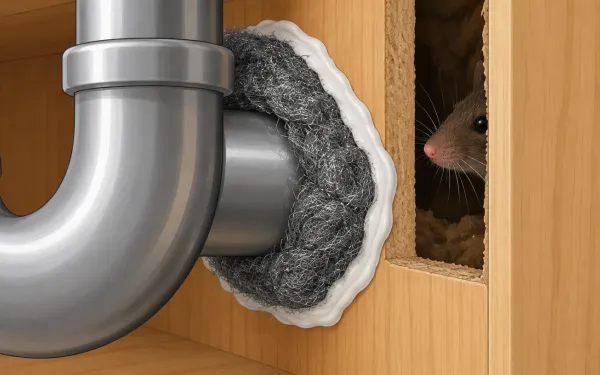
- Seal openings high and low with ¼-inch wire mesh or stainless steel or copper wool, as the ICWDM recommends.
- Thin shrubs and remove vines growing up the walls.
- Cut back tree limbs within 3 to 6 feet of the roof, as UC IPM advises for rats.
- Keep bedding and curtains off the floor.
- Take away food sources: store pet food, birdseed and pantry food in sealed containers, so a mouse that does climb in finds nothing to stay for.
- Set traps against the walls where you find droppings; see how to set a mouse trap.
- Follow the full plan in how to get rid of mice.
Renting? Don’t cut trees, fit guards or seal outside walls yourself; send your landlord photos and ask in writing. You can still trap inside your unit.
Common questions
Yes. Carpeted and wooden stairs both give plenty of grip, though a mouse more often moves between floors inside walls and along pipes.
Yes, straight up any rough vertical surface such as brick, wood, concrete or stucco (UC IPM). A smooth surface such as new sheet metal or glossy tile stops them, unless a pipe, cable or corner beside it gives them a grip.
Yes. Rats climb rough walls, pipes and vines the same way mice do, and roof rats can climb all the way to the roofline (ICWDM). They can also climb inside pipes and wall gaps 1½ to 4 inches wide.
Yes. Fabric is easy to grip, and curtains that reach the floor lead a mouse to a windowsill or shelf. Hem them just off the floor if mice are around.
They can, if bedding touches the floor or the bed is pushed against the wall. Keep bedding off the floor and the bed a little away from the wall.
Up to about 36 inches straight up from a flat surface and 48 inches across, according to the ICWDM-hosted handbook. A guard or a sealed gap needs to sit well above anything a rat can jump from.
They can. UC IPM notes that house mice jump over obstacles, and says pairs of traps set 1 to 2 inches apart catch more of them.
Sources and further reading · 7
- UC IPM: House Mouse Pest Notes — climbing, jumping, gap sizes and trap spacing.
- UC IPM: Rats — roof rats vs Norway rats, and cutting back tree limbs.
- University of Nebraska–Lincoln Extension: Controlling House Mice (G1105) — climbing, jumping, drops and gap sizes.
- ICWDM: House Mouse Damage Prevention and Control and House Mice — surfaces, sealing materials and signs.
- ICWDM: Norway Rats and Roof Rats — how each species climbs; smooth and slick surfaces; signs of climbing and sounds.
- Baker, Bodman & Timm (1994): Rodent-Proof Construction and Exclusion Methods (ICWDM) — climbing surfaces, jump heights, pipe climbing, metal bands and guards.
- ICWDM: Roof Rat Prevention and Control — rat guards on utility lines.