How to Get Rid of Pantry Moths for Good, Without Sprays
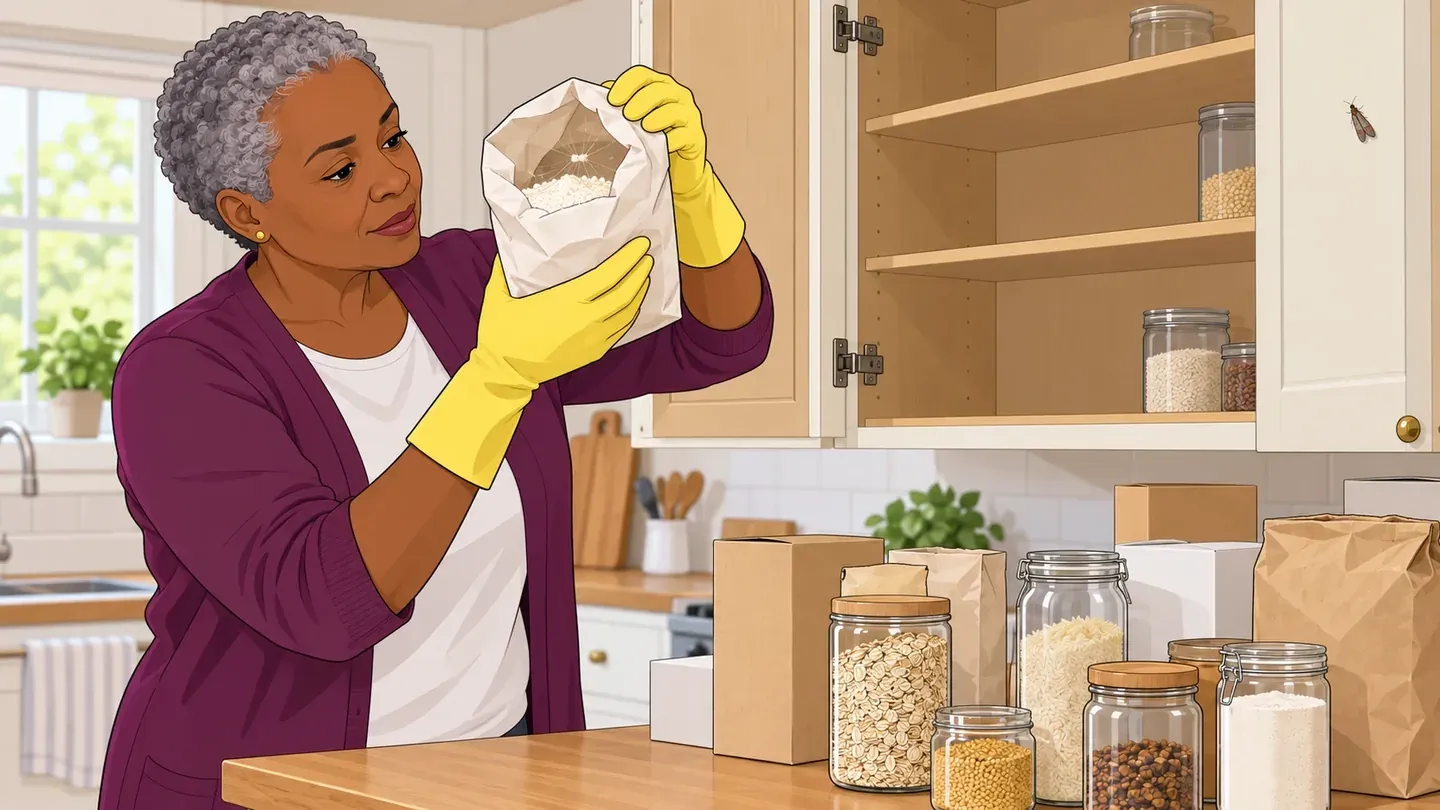
Illustration: a half-emptied pantry, with jars and boxes lined up on the counter and a bag of flour being checked for webbing.
To get rid of pantry moths, find every infested package and throw it out in a sealed bag, freeze anything you suspect, vacuum and wash the shelves, then store dry food in jars or containers with tight lids. Use pheromone traps to check your work: if they stay empty for weeks, you’ve found the source.
Cost: about $26 in supplies. Difficulty: easy. Call a pro if you have thrown out every infested package and sealed your dry goods, but moths or larvae still turn up after six to eight weeks.
It usually starts with one small moth flying out of a kitchen cabinet. Swatting adults won’t remove pantry moths, because the problem is caterpillars living in your food. As University of Kentucky entomologists put it, infested food must be found and destroyed. This guide covers Indian meal moths in kitchens, pet food and birdseed. It won’t promise a spray or a trap that ends them: traps only catch males, and a single missed package can restart things within a month or two.
What Works and What Doesn’t Against Pantry Moths
| Method | Works? | Cost | Main limitation |
|---|---|---|---|
| Finding and tossing infested food | Yes, the core fix | Free | One missed package restarts it |
| Freezing suspect food | Yes | Freezer space | Only for food you plan to keep |
| Vacuuming and washing shelves | Yes, gets wandering larvae | Free | Cocoons hide in corners and pin holes |
| Jars with tight lids | Yes, prevents reinfestation | $16.49 for 12 | Larvae chew through bags |
| Pheromone traps | To monitor, not control | $9.99 for 2 | Catch males only |
| Insecticide sprays, mothballs | No | — | Not for use near food |
Pantry Moths or Clothes Moths?
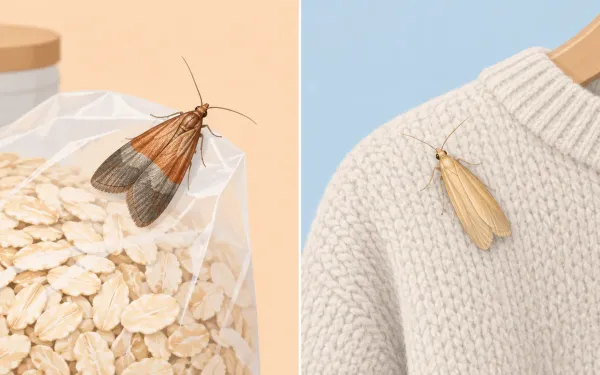
The moth in your kitchen is most likely the Indian meal moth, the species behind “pantry moths,” “food moths” and “grain moths.” The National Pesticide Information Center (NPIC) calls it the most common pantry moth. The steps below get rid of food moths and grain moths alike, since those names usually mean the same insect. Check before you buy traps, though, because clothes moth and pantry moth traps aren’t interchangeable.
| What you see | Most likely |
|---|---|
| Moth about ½ inch long, wings gray near the body and coppery brown on the outer two-thirds | Indian meal moth |
| Cream or pinkish caterpillars and silk webbing in food | Pantry moth larvae |
| Smaller gold moth fluttering in dark closets | Webbing clothes moth |
| Holes in wool, fur or carpet | Clothes moth larvae |
UC IPM notes a resting clothes moth is about ¼ inch long, half the length of most food moths, which is one quick way to tell pantry moths from clothes moths. If the damage is in wool, fur or carpet rather than food, you’re dealing with clothes moths, and the pantry steps below won’t reach them. Getting rid of clothes moths means washing or dry cleaning the damaged items, vacuuming closets and rug edges, and using traps made for clothes moths.
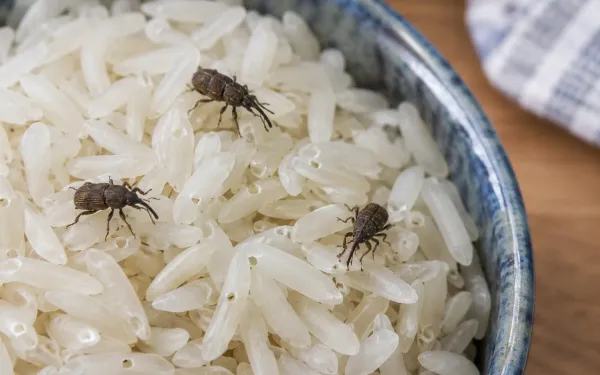
Tiny beetles instead? The same cleanout works, but Indian meal moth traps won’t attract beetles; see how to get rid of drugstore beetles, or how to get rid of weevils for beetles with a long snout in rice and grain. A dark beetle with a pale band across its back, in pet food or dried meat, is likely a larder beetle. Small dark droppings instead of webbing point to rodents; rat poop vs. mouse poop shows how to tell mouse from rat.
Step 1: Find Where the Pantry Moths Are Coming From
UC IPM says pantry pests usually come home in an infested package, often one damaged at the store or opened and forgotten. Empty the pantry and check each item, opened packages first, for:
- Webbing in package folds, or clumps of food stuck together with silk
- Caterpillars (Indian meal moth larvae) on the food, under lids or in box seams
- Tiny holes in bags or boxes
These foods are the usual suspects:
- Flour, cornmeal, cereal, rice and other grains
- Dried fruit, nuts, chocolate, candy and powdered milk
- Spices such as chili powder or paprika
- Dry pet food and birdseed
- Dried flower arrangements, dried pepper wreaths and decorative Indian corn
Home infestations are often traced to birdseed and dry pet food, so check the garage and the laundry room too.
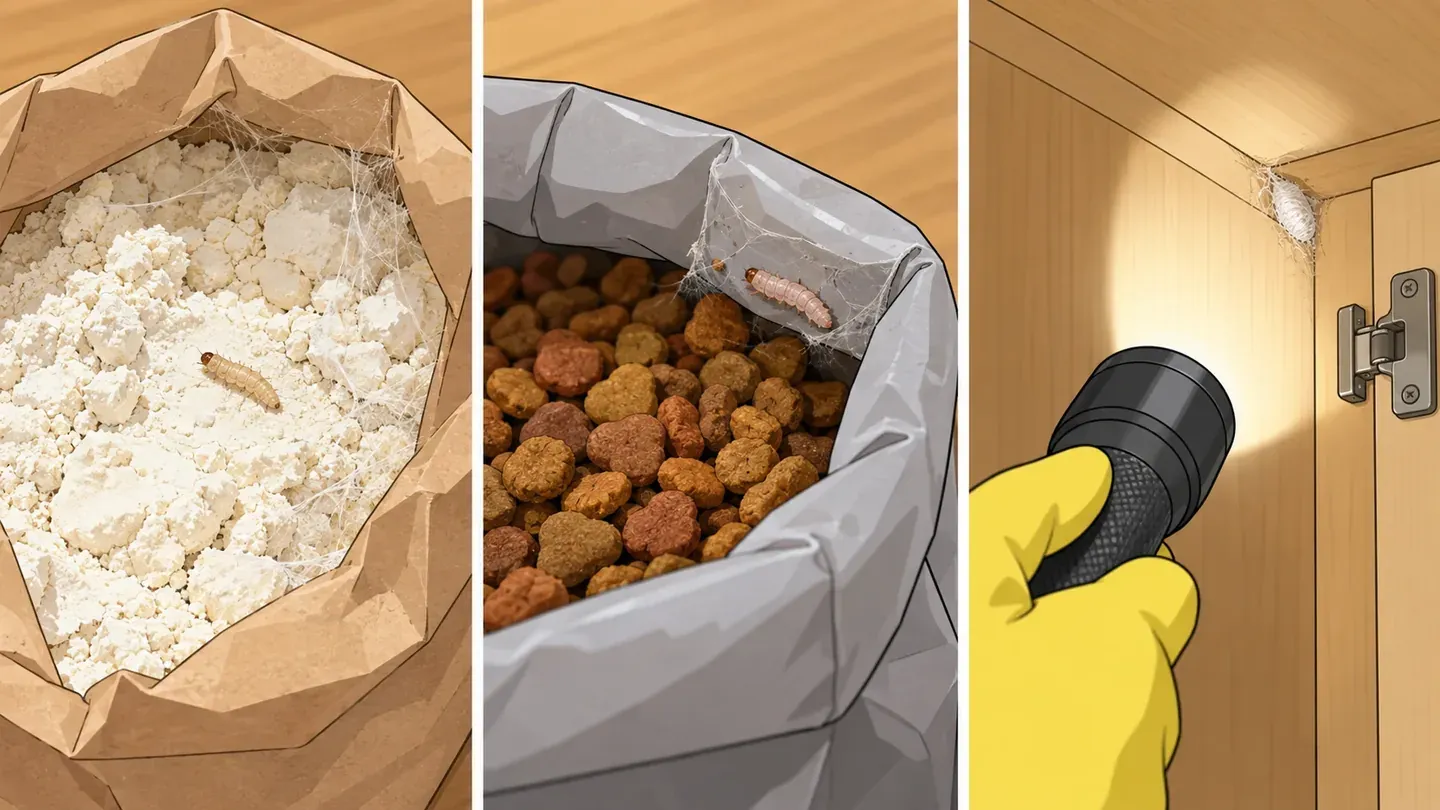
Illustration: webbing in flour, a caterpillar in pet food, and a cocoon far from the food.
Step 2: Throw Out or Freeze Infested Food
UC IPM’s advice: throw away any food with signs of infestation. Seal it in a bag and take it out of the house right away.
For food that looks clean but sat nearby, cold or heat kills eggs and larvae. The sources don’t agree on the numbers:
| Method | What the sources say |
|---|---|
| Freezer | A week (NPIC). 0°F for 4 days in a freezer that doesn’t self-defrost, for items like birdseed and dried flowers (University of Kentucky). Two or three days (Colorado State). |
| Oven | 155°F for about 20 minutes with the door propped open, for the same kinds of items (University of Kentucky). 120–140°F for 20 minutes, though heat may damage the item (Colorado State). |
A full week in the freezer covers all three. Freezing doesn’t remove webbing, so anything with visible webbing still goes in the trash.
Step 3: Vacuum and Wash the Pantry Shelves
- Vacuum the tops and undersides of the shelves, using a crevice attachment in cracks and corners.
- Wash with soap and warm water to remove spilled food, eggs and cocoons.
- Look away from the food. UC IPM says mature larvae often travel far from the food to pupate. Check the upper corners of kitchen cabinets, door hinges and the gap under the ceiling for silk cocoons, and vacuum them up.
Step 4: Store Dry Food in Airtight Containers
This step keeps the problem from coming back. Plastic bags aren’t enough: NPIC notes pantry moth larvae can chew through plastic and zip-top bags.
- Use glass jars or thick plastic containers with tight lids for flour, rice, pasta and cereal.
- Keep pet food and birdseed in a lidded bin, not the open bag.
- Freeze rarely used flours, grains and spices to keep infestations from starting.
UC IPM advises keeping susceptible food sealed, refrigerated or frozen for at least several months after the cleanout.
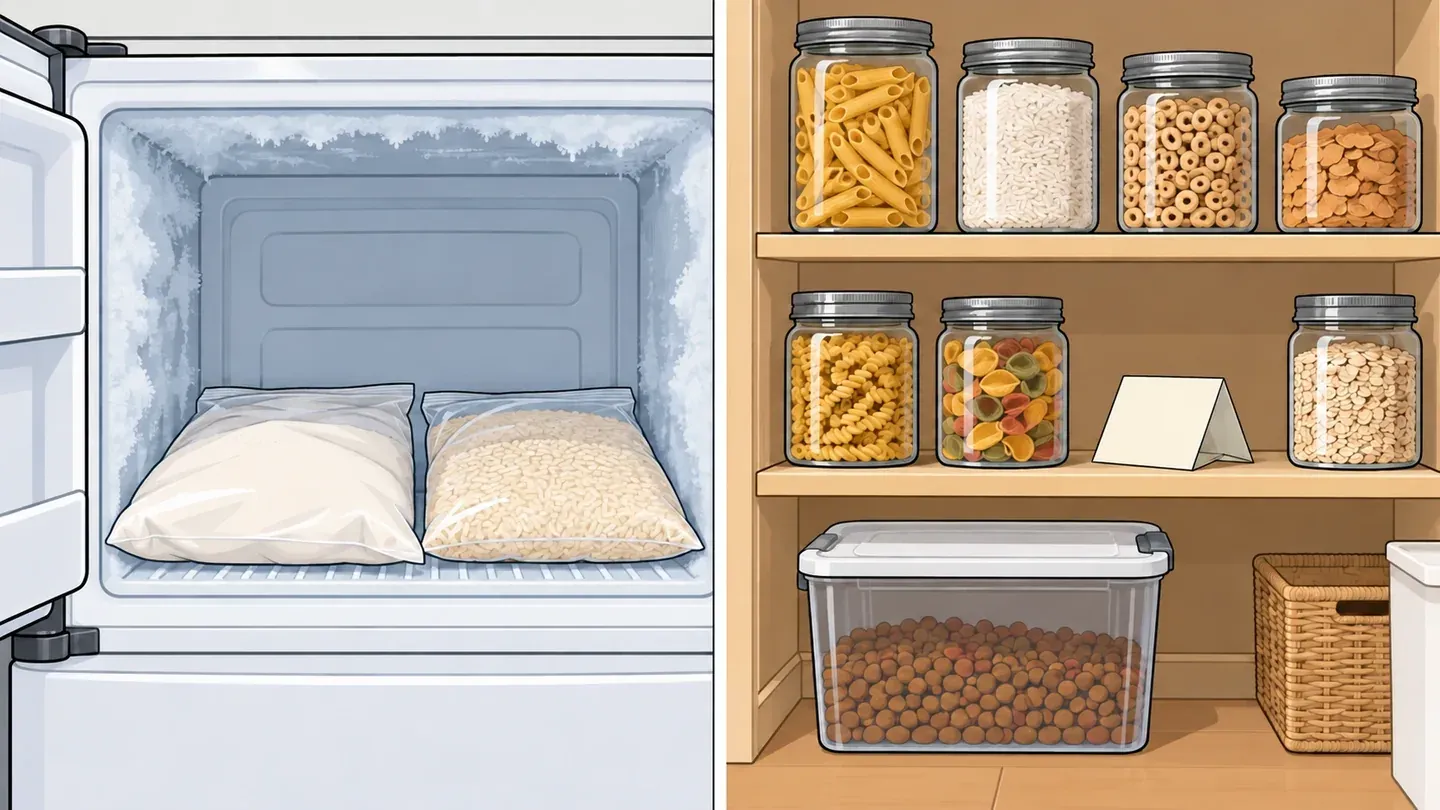
Illustration: bags of flour and rice lying flat in a freezer (left), and clean shelves with glass jars, a lidded pet food bin and a sticky trap (right).
Step 5: Use Pheromone Traps to Monitor, Not to Control
Pantry moth traps are sticky cards with a pheromone lure. UC IPM explains the lure attracts adult males, not females, though catching males before they mate may cut egg-laying. On their own, the traps are a monitoring tool and unlikely to reduce numbers. Some packaging claims to catch both sexes; either way, traps don’t touch the caterpillars in your food.
- Buy the right kind: traps labeled for Indian meal moths. Clothes moth traps won’t attract them.
- Place them where the infestation was and check them weekly.
- Don’t crowd them. TERRO, a common brand, recommends one trap per room and says its lures last up to 3 months.
- Keep them up afterward. Pantry pests can live for many weeks without food.
Step 6: Clean Again in 2–3 Weeks
Do a second, quicker pass two to three weeks after the first. UC IPM says pantry moth eggs hatch within a few days, so eggs or cocoons you missed in cracks and shelf corners will have become visible caterpillars or webbing by then. Empty the shelves again, vacuum the corners and shelf-pin holes, and check every container and trap. If you find nothing, keep the traps up through a full life cycle.
Do You Need to Spray for Pantry Moths?
No. UC IPM says insecticides are not recommended for pantry pests, and that spraying on or near food may harm your family more than the pests would. Sprays are also ineffective here, and risky on food, prep surfaces or utensils.
Keep mothballs out of the kitchen too. NPIC says they are pesticides for clothes moths and other fabric pests and shouldn’t be used around food or food preparation areas. More in do mothballs keep mice away?
Why Do Pantry Moths Keep Coming Back?
If you can’t get rid of pantry moths even after a full cleanout, you’re not alone: on Reddit, the complaint comes up again and again. Usually it’s one of these:
- A missed source: pet food in the garage, birdseed, an old jar of paprika, a dried flower arrangement.
- Larvae that already left the food. Cocoons in cabinet corners can still hatch after the food is gone.
- Food back in bags or boxes. Larvae can chew through plastic bags.
- A new infested package from the store.
A few moths after a thorough cleanout don’t mean it failed. New larvae in stored food do.
How Long Does It Take? The Pantry Moth Life Cycle
The cleanout is the quick part; confirming it worked takes longer. In warm weather, Indian meal moths take about six to eight weeks from egg to adult, according to UC IPM; another extension guide puts the shortest cycle at 25 days. A female can lay hundreds of eggs.
So one missed package can restart things within a month or two. Keep traps up and food sealed at least that long. If traps stay empty through a full cycle and no new larvae appear, you’ve most likely found the source.
How to Prevent Pantry Moths
- Check packages before they go on the shelf, especially damaged ones.
- Freeze new grain products. Clemson Extension calls freezing them for 3 days at 0°F after purchase a good habit.
- Use older food first and clean up spills regularly.
Which Plan Fits Your Situation
| Your situation | Start with | Then |
|---|---|---|
| A few moths, food not yet checked | Empty and inspect the pantry | Toss or freeze anything with webbing |
| Caterpillars on walls or ceiling | Vacuum them and any cocoons | Find the food they left |
| Clean pantry, moths still flying | Pet food, birdseed, dried decorations | Second cleanout in 2–3 weeks |
| Damage in wool, not food | Clothes moths | Clothes moth traps, not pantry traps |
| Tiny beetles, not moths | The same cleanout | No pheromone traps for beetles |
| Moths 6–8 weeks after a full cleanout | Another source search | A pro who won’t spray food shelves |
What It Might Still Cost
| Item | Typical cost |
|---|---|
| Pheromone traps, 2 with lures | $9.99 |
| 12 quart glass jars with lids | $16.49 |
| DIY total | About $26 |
| Pro pantry moth treatment | $150–$200 |
| Pro Indian meal moth treatment | About $250 |
DIY: U.S. list prices from the trap maker and Target on October 1, 2026, before tax and shipping, plus a vacuum, soap and freezer space you likely have. Pro: Fixr (January 2025) and Today’s Homeowner (March 2025).
Before You Start: A Quick Checklist
- Clear a counter and a trash bag before you empty the shelves.
- Open every package, opened ones first, and look in the folds.
- Check the garage and laundry room for pet food and birdseed.
- Freeze anything you suspect but want to keep.
- Vacuum corners, shelf-pin holes and the cabinet ceiling.
- Move dry food into jars with tight lids, not bags.
- Mark your calendar for a second cleanout in 2–3 weeks.
When to Call a Pro
None of the extension guides above call for professional treatment; their method is the removal, cleaning and sealed storage described here. Consider a pro if:
- New moths or larvae keep turning up six to eight weeks after you threw out every infested item and sealed your dry goods.
- You can’t find any food source, even after checking pet food, birdseed and decorations.
Since UC IPM doesn’t recommend insecticides for pantry pests, be wary of a quote built around spraying food shelves. Our guide to what an exterminator does lists what to ask.
Common questions
There’s no good evidence they do. None of the university guides cited here recommend bay leaves; what they rely on is sealed containers, checking packages and throwing out infested food. A bay leaf in an open bag of flour won’t protect it.
If there are moths in your pantry, the “worms” are most likely their caterpillars. The University of Kentucky lists caterpillars crawling up walls or across ceilings as a usual first sign of pantry pests: mature larvae move quite a distance from the food to pupate. Vacuum them and any cocoons, then find the infested food (Step 1).
The Bottom Line
Pantry moths live in food, so the fix is a cleanout, not a spray. Find and toss every infested package, freeze what you suspect, vacuum the shelves and move dry food into jars with tight lids. Clean again in two to three weeks and keep traps up through a full life cycle. Empty traps and no new larvae mean you found the source.
Sources and further reading · 7
- UC IPM: Pantry Pests and Clothes Moths
- University of Kentucky: Stored Product Pests in the Pantry (ENTFACT-612)
- Colorado State University: Indian Meal Moth
- NPIC: Pantry Moths and Mothballs: Regulation and Proper Uses
- Clemson Extension HGIC: Indian Meal Moth
- TERRO: Pantry Moth Traps (manufacturer)
- Cost guides: Fixr and Today’s Homeowner