How to Catch a Rat: Set, Bait and Place Rat Traps
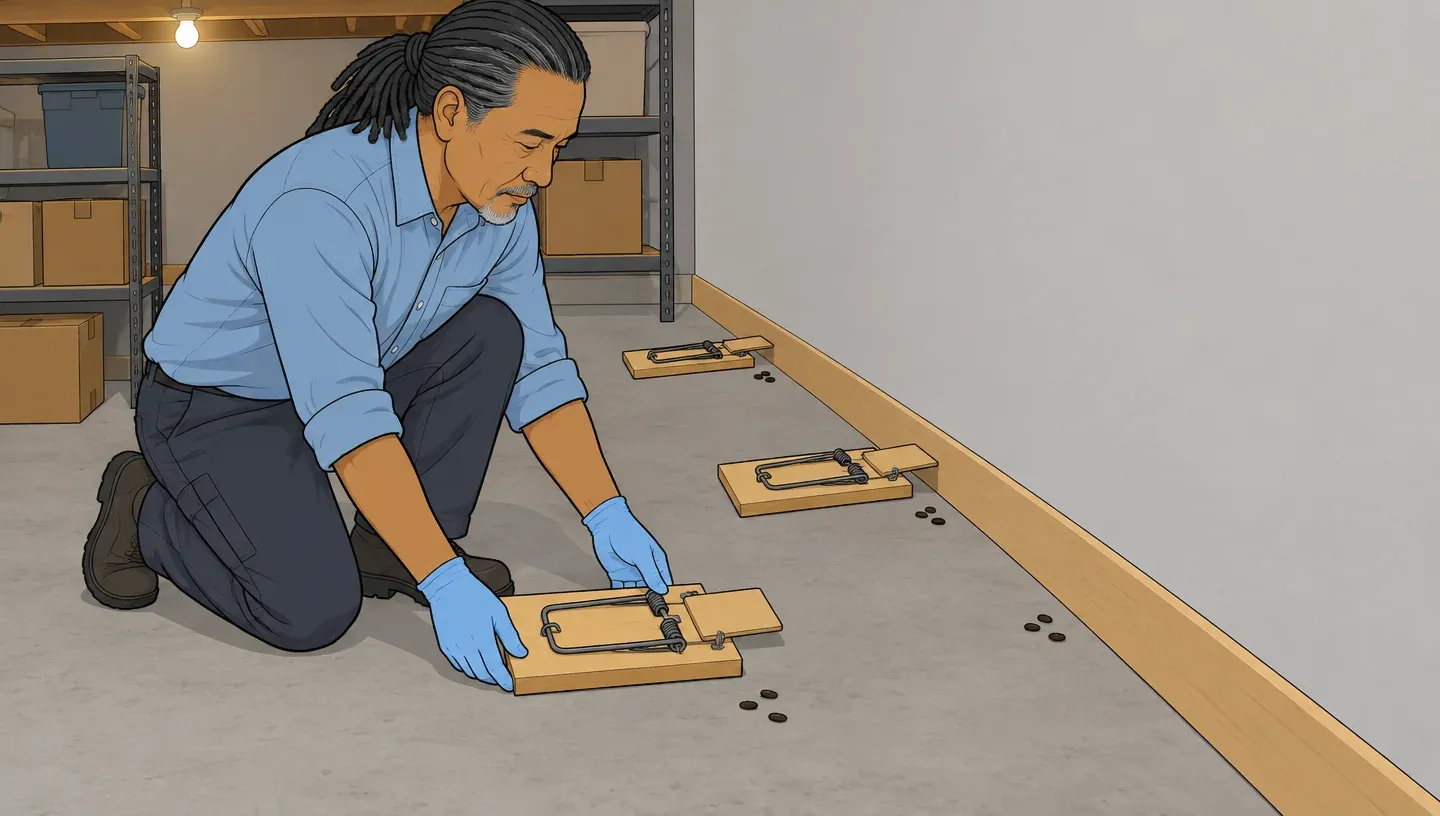
Illustration: a rat-size snap trap set at a right angle to the wall, trigger end against the baseboard, with more traps down the same wall.
To catch a rat, use rat-size snap traps, not mouse traps. Bait each with a pea-sized amount and place them at right angles to the wall where you find droppings. Leave them baited but not set for a couple of days, then set them all the same night. Skip glue boards and poison. A week without catches or new signs means you’re done.
Cost: about $22–43 in supplies. Difficulty: moderate. Call a pro if you can’t reach or clear the spot where the rats are active, or new droppings and gnawing continue after at least 15 days of trapping and re-baiting.
This guide covers choosing traps, placement, pre-baiting, setting, safe disposal and what to do about a trap-shy rat. We haven’t tested these traps ourselves; this rests on CDC, University of California, ICWDM and New York State health department guidance, the trap maker’s instructions and October 2026 list prices. Trapping is half the job; sealing holes is the other half of the plan to get rid of rats in your house.
Saw a rat tonight? Don’t try to corner it. Put food and pet food in sealed containers tonight, buy about 6 rat-size snap traps tomorrow and lay them out baited but not set, then set them all the same night a couple of days later.
What Works and What Doesn’t for Catching Rats
| Method | Works? | Cost | Main limitation |
|---|---|---|---|
| Wide-pedal rat snap trap | Yes, the best pick | $3.59 each | Needs pre-baiting; keep from kids and pets |
| Narrow-trigger rat snap trap | Yes, fewer catches | Varies | Add a 2-inch cardboard square to the trigger |
| Electronic trap | Yes | Considerably more | Still needs pre-baiting |
| Bucket trap | Can catch rats | Homemade | Drowning hazard for toddlers; slow and messy |
| Glue boards, live cage traps | No (CDC) | — | Frightened rats urinate in them |
| Poison | Skip for DIY | — | Slow, and toxic to people and pets |
| Mouse traps | No | — | Won’t hold a rat |
Snap Traps for Rats: Which Trap to Buy
Buy rat-size snap traps with a big, flat trigger pedal, not a narrow one: wide-pedal traps caught almost twice as many rats in research cited by the ICWDM. University of California experts call snap traps the safest, most effective and cheapest option; a wooden wide-pedal trap lists at $3.59.
How Many Rat Traps Do You Need?
Start with 6 for one room with signs; a heavily infested home may need a dozen or more. Line them up about 2 to 3 feet apart along the wall with the most droppings, the maker’s suggested spacing, and give each room with signs its own traps.
Step 1: Find Where the Rats Travel
Placement may matter more than the trap. The best spots show droppings, gnaw marks or greasy rub marks between shelter and food.
- Kitchen: behind the stove and refrigerator, and at the back of cabinets and drawers.
- Basement or ground floor: usually Norway rats, which burrow. Set traps close to walls, behind objects and in dark corners.
- Attic, or noises overhead: usually roof rats, which climb. Try ledges, pipes, beams and rafters near the activity, plus the floor.
- A few feet along the run, not right at a hole. Rats more often refuse a trap set directly in front of their hole.
Not sure it’s a rat? Mouse-size droppings need mouse traps, so first tell rat poop from mouse poop, or see our mouse vs. rat guide.
Step 2: Place Rat Traps Along the Wall
Rats run along walls for safety (CDC), so put the traps where they’ll cross the trigger, and leave them in these spots through pre-baiting and setting.
Set a “T”, trigger end nearly touching the wall. Parallel to the wall? Use pairs with triggers facing away from each other, so rats coming from either direction hit one.
Fasten them down. A fastened trap focuses the force of the snap and isn’t carried off. Nail traps to beams or wire them to pipes; renters can wire or tie them and should tell the landlord about the rats in writing.
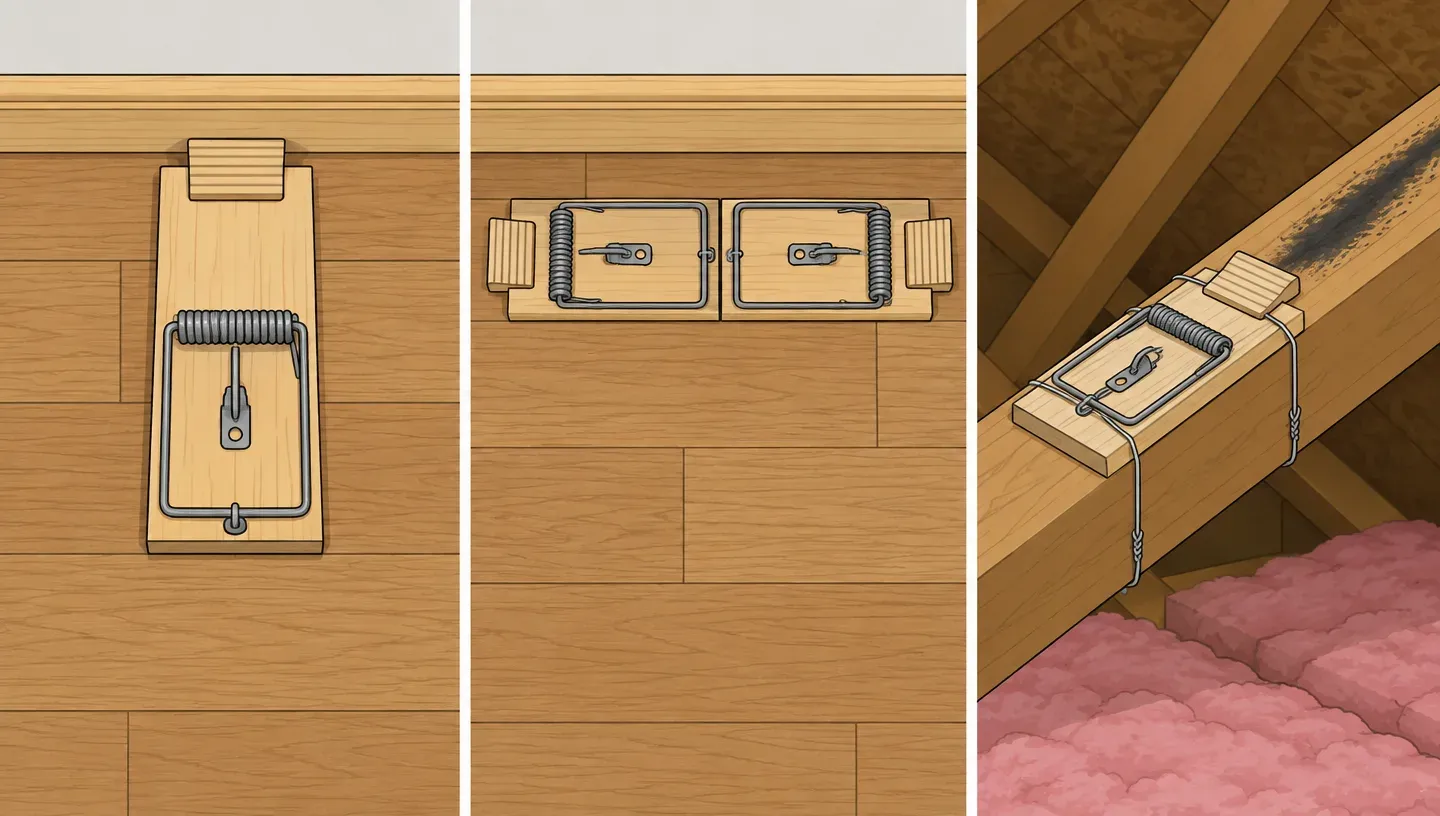
Illustration: a trap at a right angle to the wall (left), a parallel pair with triggers facing outward (center), and a trap wired to a rafter for roof rats (right).
Kids and pets in the house? Set traps inside boxes or stations, or behind a barrier such as a board leaned against the wall (University of California). Outdoors, set them only at night, under a weighted milk crate, to spare birds.
Step 3: Bait the Traps and Leave Them Unset
Bait a pea-sized amount, tied on. Nuts, dried fruit, bacon or dry pet food make good rat trap bait; tie dry bait to the trigger with thread or fine wire so the rat has to tug. Peanut butter works too, except where visitors with peanut allergies might touch the traps.
Pre-bait for a couple of days. Leave traps baited but not set until the bait has been taken several times. Rats fear new objects; skip this and you may catch only young rats, not the breeding adults.
Bait gone from every trap each morning? You don’t have enough traps. Double the number, and again if needed, until some bait is left overnight. Then set them all on the same night, because a rat that springs a trap and escapes becomes very hard to catch.
Step 4: How to Set a Rat Trap
On setting night, set each trap and put it back in the exact same spot. Keep fingers clear of the striking area whenever you set or handle the trap, the maker warns.
Free the arm bar. On a new wooden trap, pull out the staple holding the long thin wire and let it hang over the back end.
Hold the kill bar back. Top up the bait, pull back the U-shaped kill bar and hold it down with your thumb.
Hook and release. Lay the arm bar over the kill bar, hook its tip under the pedal, then slowly lift your thumb. If the trap has Firm and Sensitive notches, use Sensitive: harder to set, but it trips with light contact.
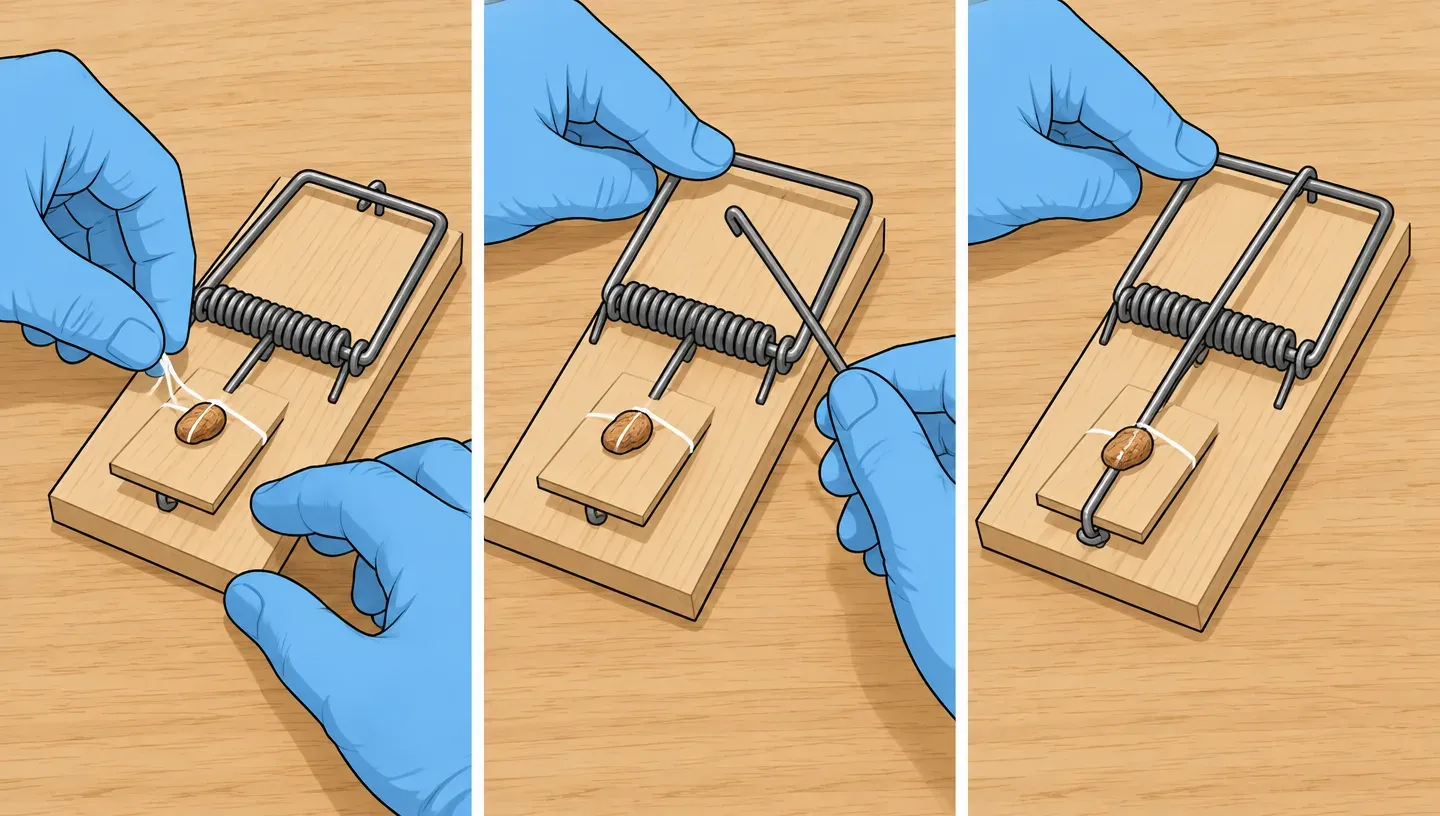
Illustration: tie the bait on, hold the kill bar back with your thumb, then hook the arm bar under the pedal.
Bait licked clean, no catch? Use the sensitive setting, tie dry bait on and clean residue off the pedal.
Step 5: Check Traps Daily and Dispose of Rats Safely
Check traps every morning and remove dead rats right away, the CDC’s way:
Soak first. With rubber or plastic gloves on, spray the rat and the area with disinfectant, or a fresh mix of 1 part bleach to 9 parts water, and let it soak 5 minutes.
Double-bag it. Put the rat in a plastic bag with the trap, knot it, seal that inside a second bag and put it in a covered garbage can. Wash gloved hands, remove the gloves and wash again. Some cities don’t allow carcasses in household trash; your local health department can tell you.
Reusing a trap? Soak it in disinfectant for 5 minutes, then rinse and dry it. Clean droppings the same wet way (how to clean mouse droppings).
Caught but still alive? Don’t touch it, and don’t release it; a pest or wildlife control operator can handle it.
How to Catch a Trap-Shy Rat
A rat that steals bait, walks around traps or ignores them for a week is reacting to something new in its path (rat neophobia).
Pre-bait longer. Leave every trap baited but unset for 3 to 4 nights, until the bait is taken each night, then set them all at once.
Change the bait to what the rat is already eating, such as dry pet food or bacon, tied to the trigger.
Move traps a few feet, not across the room, and add one on the other side of the obstacle it walks around. Still nothing after two weeks? Look for a second food source you missed.
Does a Bucket Rat Trap Work?
It can, but none of the extension or CDC guidance we checked recommends it. Buckets with even a little liquid are a drowning risk for toddlers (Consumer Product Safety Commission), and a trap-shy rat avoids a bucket too. If you try one, keep it in a locked shed.
How to Kill a Rat: Traps vs. Poison
Traps are faster: a rat-size snap trap springs shut on contact, while anticoagulant poisons must be eaten daily for 6 to 10 days (New York State Department of Health). Every rodenticide is toxic to people and pets (rat poison around pets); if a pro uses poison, it belongs in tamper-resistant rat bait stations.
Which Plan Fits Your Situation
| Your situation | Start with | Then |
|---|---|---|
| Renting | 6 traps, wired or tied, not nailed | Written note to your landlord |
| Kids or pets | Traps behind a barrier or in boxes | Morning check before anyone is up |
| Noises overhead (roof rats) | Traps on beams and rafters | A pro if you can’t reach the attic safely |
| Bait gone from every trap | Double the traps, still unset | Set all the same night |
What It Might Still Cost
| Item | Typical cost |
|---|---|
| 1 wooden rat snap trap | $3.59 |
| 6–12 rat snap traps | $22–43 |
| Pro trap-and-seal job, 53 shared quotes (middle half) | $1,400–$3,000 |
| Pro visit, price-guide range (usually no sealing) | $150–$655 |
| Pro inspection only | $100–$200 |
DIY: list price, October 1, 2026, before tax. Pro: the middle half of 53 trap-and-seal quotes homeowners shared on Reddit (see the quote table). Price-guide range: This Old House for mice (April 2026) and HomeAdvisor for rats (June 2026); it usually covers a trap-and-bait visit, with sealing extra. Even HomeAdvisor suggests setting your own traps for a minor infestation. Add copper mesh, gloves and bleach, and a full DIY rat kit runs about $65–87.
Before You Start: A Quick Checklist
- Buy rat-size, wide-pedal snap traps, about 6 per room with signs.
- Seal food and pet food in containers tonight.
- Find droppings and rub marks to pick trap spots.
- Leave traps baited but unset for a couple of days.
- Set every trap on the same night.
- Keep gloves and disinfectant ready for the first catch.
When to Call a Pro
- You can’t safely reach or clear the attic, roof or crawl space where the rats are active.
- New droppings or gnawing continue after at least 15 days of trapping and re-baiting (CDC).
- You can’t find where they get in. Ask how many visits the price covers and whether sealing is included.
Common questions
No. The CDC says mice and rats need different snap traps.
Expect a few days at least; cautious rats may avoid new traps for days or even weeks. The CDC’s finish line is a full week with no catches and no new signs.
Sources and further reading · 7
- U.S. Consumer Product Safety Commission: Large Buckets Are Drowning Hazards for Young Children.
- CDC: How to Trap Up to Remove Rodents and How to Clean Up After Rodents.
- University of California pest experts (UC IPM): Pest Notes: Rats.
- University of California Agriculture and Natural Resources (UC ANR): Rats and Mice: How to Manage Using Snap Traps (Niamh Quinn).
- Internet Center for Wildlife Damage Management (ICWDM): Norway Rat and Roof Rat Prevention and Control.
- New York State Department of Health: Controlling the Rat.
- Victor: Easy Set Rat Trap (M205) instructions.