Will Mice Leave on Their Own? Why Cold Keeps Them In
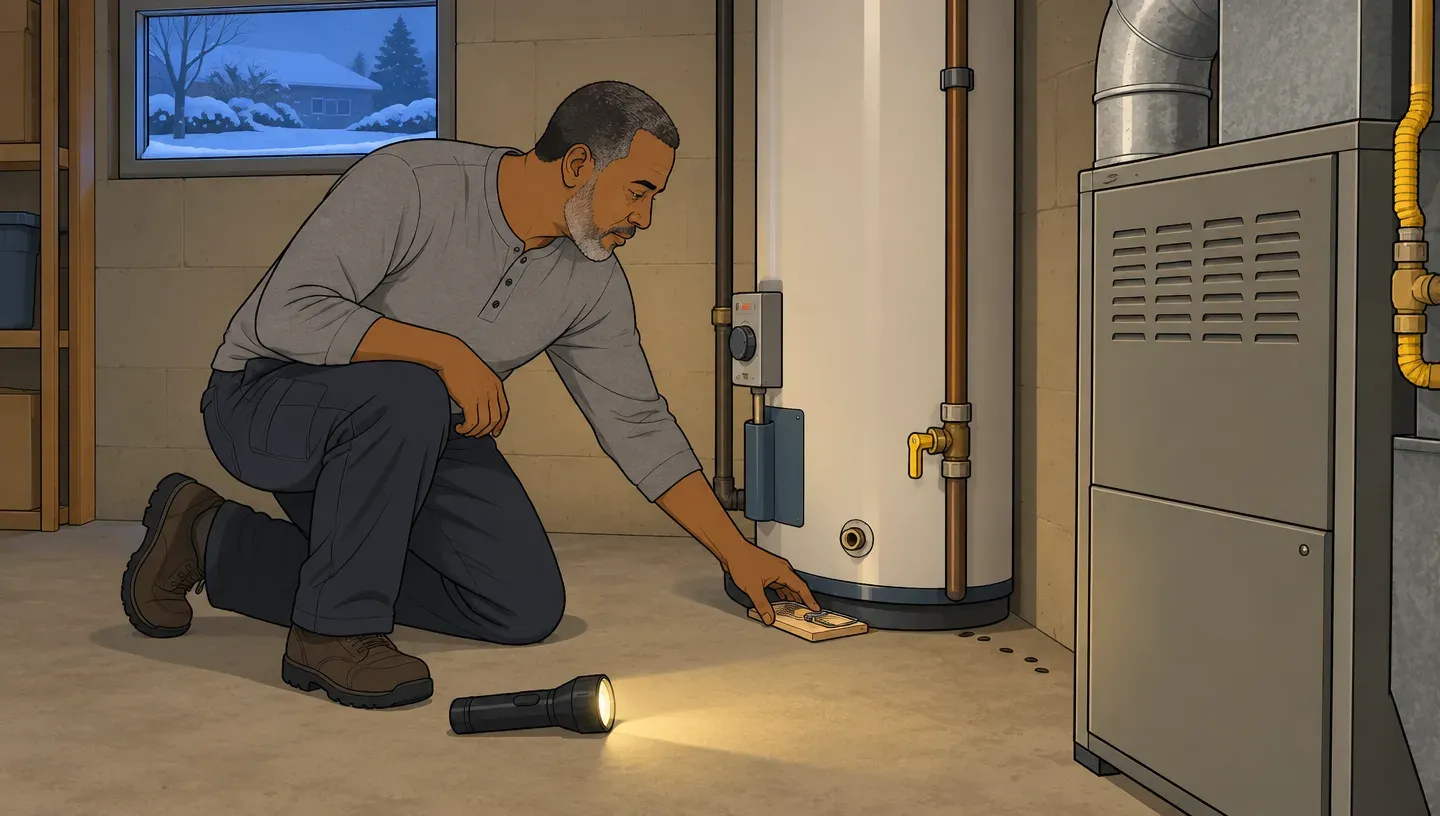
Illustration: a snap trap set along the wall beside the water heater, one of the warm spots mice favor in winter.
Will mice leave on their own? Rarely. A house mouse with food and shelter stays within about 30 feet of its nest and breeds year-round, so waiting only adds mice (UC IPM); see how long mice live and how fast they breed. Set snap traps along the walls and keep going until a full week passes with no catches and no new droppings. Skip glue traps and repellents.
Cost: about $57–71 in supplies. Difficulty: moderate. Call a pro if you’ve trapped for at least 15 days and still find new droppings, or the gaps mice use are high on the roofline where you can’t work safely.
A quiet spell isn’t proof they left: one renter on Reddit described four months of mice, three months “gone,” then four more. This guide covers why mice seem to vanish, what waiting costs, how the seasons change things, and rats. We haven’t tested this ourselves; it rests on UC IPM, Nebraska Extension, ICWDM and CDC guidance plus store list prices.
Will Mice Leave on Their Own?
Not while your home gives them what they need. If the nest is behind the stove or inside a nearby wall, a mouse has no reason to move. House mice don’t need to drink water and can live in tiny spaces on little food.
They also multiply. One female can have 5 to 10 litters a year of about 5 or 6 pups, and her young can breed at 5 to 6 weeks old (UC IPM). It’s easier to control mice before they settle in, the CDC notes, so waiting works against you.
Will mice leave if there is no food? Cleaning up helps but won’t evict them: Nebraska Extension says sanitation alone almost never gets rid of mice, though poor sanitation lets more thrive.
Why Do Mice Suddenly Disappear in the House?
Usually they haven’t left. Check these in order:
| What changed | What it may mean | How to check |
|---|---|---|
| No sightings for weeks | Mice are active mostly between dusk and dawn | Look for fresh droppings, not mice |
| You got a cat or dog | A predator makes mice more secretive, so they seem fewer | Same: fresh droppings and gnawing |
| Someone used poison | Poisoned mice often die inside the building | A dead-mouse smell a few days later |
| Cold weather | They moved closer to fridges, water heaters and furnaces, favorite den sites | Shine a flashlight behind them |
| Nothing new for a week | They may really be gone | A flour patch overnight, then the CDC’s one-week rule |
The CDC’s rule: one week with no catches and no new droppings, urine spots or gnawing. Seeing no mice isn’t enough.
How to Make Mice Leave for Good: Trap, Then Seal
Trap first, not seal first, or you lock mice inside. Put food and pet food in lidded containers, and set snap traps along walls where you’ve found signs, baited end touching the wall, no more than about 10 feet apart (UC IPM). A 12-pack (about $14) is enough to start in one room; Nebraska Extension’s rough guide for a new infestation across a 1,500-square-foot house is two dozen.
Skip glue and live traps: the CDC says they scare mice into urinating, which raises your chance of getting sick. With kids or pets, put traps behind the stove and fridge or on ledges. Spray droppings with disinfectant rather than sweeping them (how to clean mouse droppings).
After one clean week, pack each gap with copper mesh or steel wool, then caulk over it. Foam, rubber and wood alone won’t stop mice, and copper mesh doesn’t rust, Nebraska Extension notes. The CDC’s list of gaps starts behind appliances and around pipes under sinks, washing machines, water heaters and furnaces; how mice get in the house covers the rest, and the full plan is in how to get rid of mice. Renting? Tell your landlord in writing before anyone seals outside walls or the foundation.
What Waiting Costs You
The risk comes from handling droppings, urine and nests, and it grows the longer mice stay:
- Germs. The CDC says rodent diseases spread through droppings, urine, saliva and bites, and through air or food contaminated with their waste.
- LCM virus. UC IPM estimates that 5% of U.S. house mice carry it. Most healthy people who catch it have no or only mild symptoms, the CDC says, but it can be serious during pregnancy or for people with weak immune systems. Never handle mice or nests bare-handed.
- Allergies. House mouse urine is a major allergen and has been linked to early-onset asthma in sensitive children, UC IPM adds.
- Wiring. Mice nesting in large appliances can chew wiring and insulation, causing short circuits that are fire hazards.
| Item | Typical cost |
|---|---|
| 12 wooden mouse snap traps (start here) | $13.74 |
| 20 feet of copper mesh for sealing | $28.80 |
| 50 nitrile gloves | $8.49 |
| Bleach, 81 ounces | $6.39 |
| Full DIY kit, with 12 to 24 traps | About $57–71 |
| Pro trap-and-seal job, 53 shared quotes (middle half) | $1,400–$3,000 |
| Pro visit, price-guide range (usually no sealing) | $150–$655 |
| Pro attic insulation cleanup, if upsold | $7,500–$14,000 |
Start with just the traps; buy sealing and cleanup supplies once the catches stop. DIY: U.S. list prices from Victor, DoMyOwn and Target, September 30, 2026. Pro: the middle half of 53 trap-and-seal quotes homeowners shared on Reddit (see the quote table). Price-guide range: This Old House for mice (April 2026) and HomeAdvisor for rats (June 2026); it usually covers a trap-and-bait visit, with sealing extra. Attic cleanup: the middle half of 35 shared quotes that included new insulation. Ask for sealing to be itemized in any quote.
Do Mice Like the Cold? No, Cold Brings Them In
Cold is what brings them inside. The Internet Center for Wildlife Damage Management (ICWDM) says mice are most likely to move into buildings as temperatures drop in the fall, and they nest next to heat such as water heaters, gas pilot lights and appliance motors. They stay active all winter.
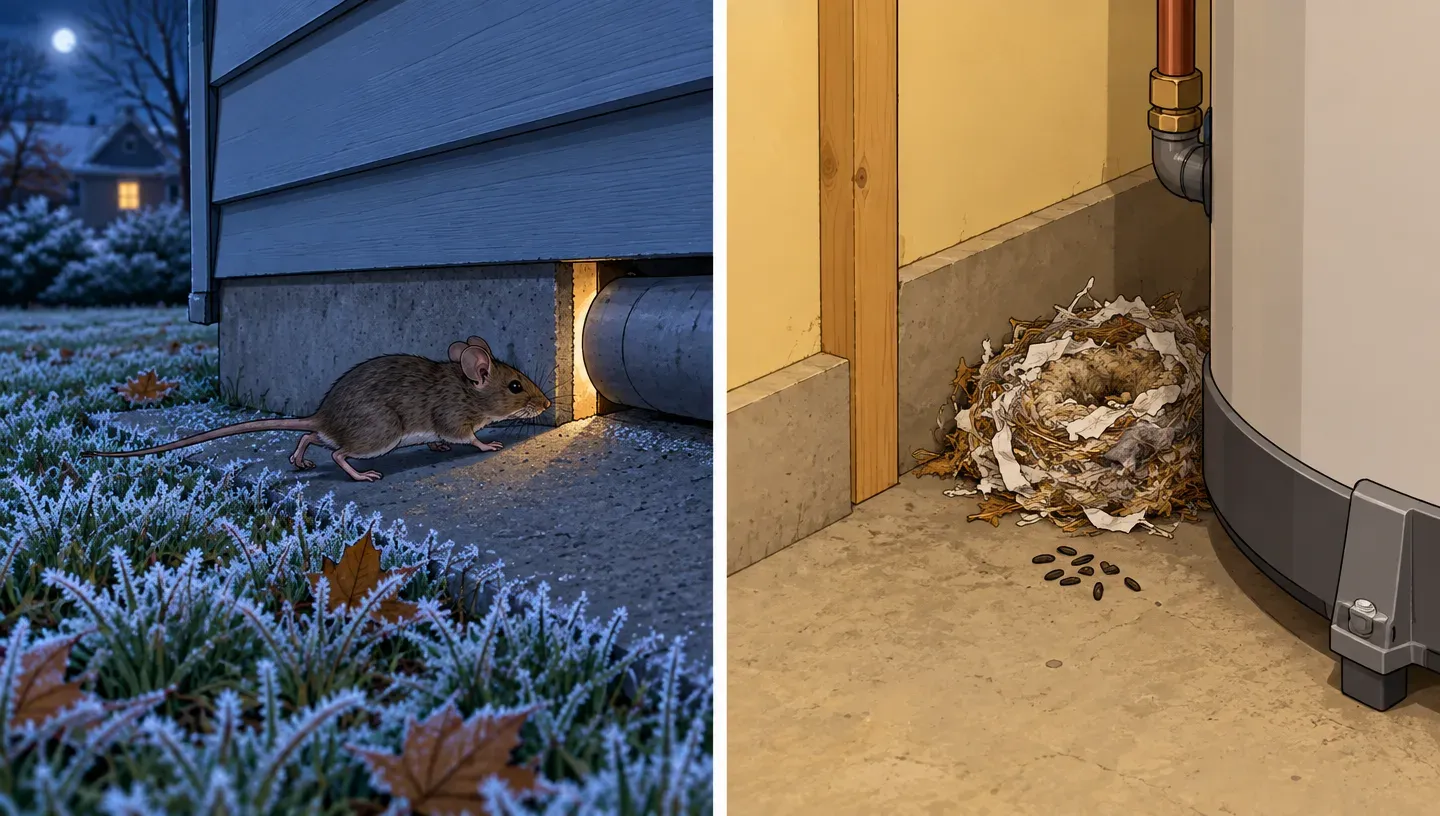
Illustration: on a cold night, warm air leaking from a gap leads a mouse inside, where it nests beside the water heater.
Indoor mice don’t take summers or springs off either: house mice breed year-round indoors when food is steady, so warm weather doesn’t send them out (UC IPM).
When to Mouse-Proof: Late Summer, Before the Cold
UC IPM calls exclusion the most successful and permanent form of house mouse control, and it’s easiest before the cold. Start with the season you’re in.
| Season | What to do |
|---|---|
| Late summer | Seal gaps ¼ inch or wider, about the width of a pencil. Thin or remove plants touching the house. |
| Fall | Leave a few set snap traps along walls as monitors. Fall is the highest-risk time for rodents getting in. |
| Winter | Check behind the fridge, water heater and furnace for fresh droppings. |
| Spring | Look for new signs. Keep garbage in lidded cans and pick up fallen fruit. |
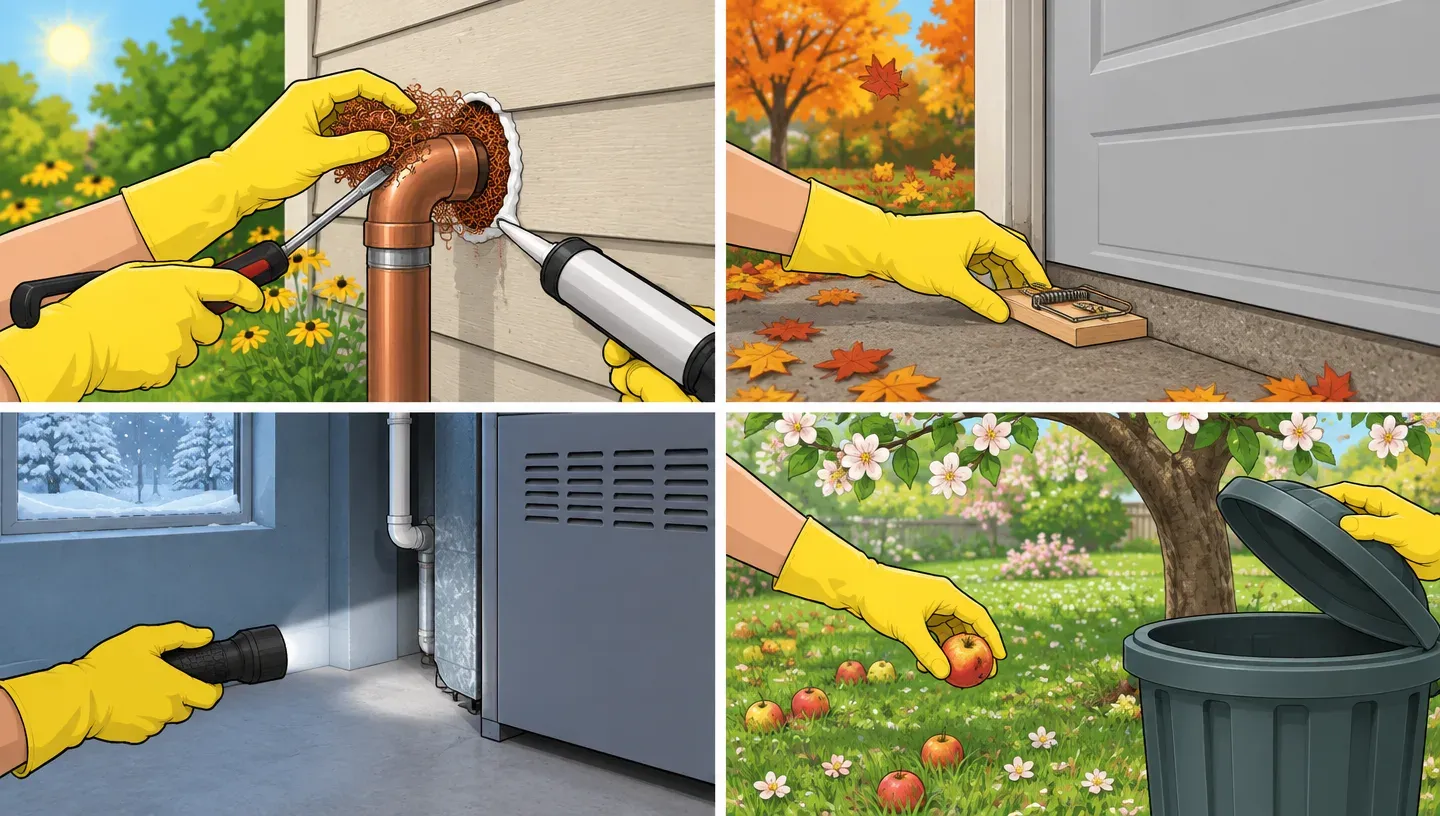
Illustration: late summer sealing, a fall monitor trap, a winter check behind the furnace and a spring cleanup under the fruit tree.
Where Do Rats Go in the Winter?
Not far. UC IPM says rats stay active all year. Norway rats burrow along foundations and under woodpiles and, once inside, usually stay in the basement or on the ground floor; roof rats favor attics, wall voids and cabinets. Cold slows them rather than driving them off: Norway rat breeding peaks in spring and fall and can stop in winter in harsh climates.
Rats won’t necessarily leave if there’s no food, either. Norway rats forage 100 to 500 feet from their nests, so a rat can keep nesting at your place while eating next door, and rats need water every day, so fix drips. The method is in how to get rid of rats in the house.
What to Do Next
- Store food and pet food in lidded containers tonight.
- Set snap traps along the walls where you find droppings.
- Check traps every morning with gloves on.
- Keep trapping at least 15 days, until a week passes with no new signs.
- Seal gaps with copper mesh and caulk once the catches stop.
- Leave monitor traps out each fall.
Going with poison instead? UC IPM says to use tamper-proof bait stations out of reach of children, pets and wildlife; all rodenticides are toxic.
Common questions
Don’t count on it. UC IPM says dogs and cats rarely control rodent populations; a cat mostly makes mice hide.
Unlikely. ICWDM says smell and taste repellents are seldom a practical solution to a mouse infestation, and UC IPM finds little evidence that sound, magnetic or vibration devices drive established mice out. More in mouse repellents.
Far enough to beat catch-and-release. UC IPM says house mice moved as far as half a mile from their home range can find their way back to the nest.
Probably not, and there may be more. Our guide to what one mouse means explains how to check.
The same steps as for mice. UC IPM lists sanitation, exclusion and population control as the elements of successful rat control.
Sources and further reading · 6
- UC IPM: House Mouse and Rats.
- ICWDM: House Mouse Biology, House Mice, Norway Rat Biology and House Mice: Damage Prevention and Control Methods (PDF).
- Nebraska Extension: Controlling House Mice (G1105).
- CDC: Controlling Wild Rodent Infestations, Trap Up, LCM, Seal Up and Clean Up.
- Illinois Department of Public Health: Rats.
- National Park Service: Hantavirus Kit and Fact Sheet (PDF).