Spider Egg Sac: What It Looks Like and What to Do With It
A spider egg sac is a small ball or teardrop of silk, usually white, cream, tan or brown and about ¼ to ½ inch across, tucked in a web or a sheltered corner. Indoors you’ll most often find one in a cobweb in a garage, basement or window corner. Each holds dozens to hundreds of eggs. To get rid of one, vacuum it up and throw the vacuum bag or contents away sealed; don’t crush it by hand.
Difficulty: easy. Call a pro if you find egg sacs or spiders you think are black widows or brown recluses in places you use every day, such as closets, bedding or a child’s room.
This guide covers what spider eggs look like by species, how many are inside, how long they take to hatch, and how to remove them. We haven’t tested anything ourselves; it rests on Penn State, UC IPM, NC State, University of Kentucky and Oregon State Extension guidance. For other eggs and larvae you might find, see bug eggs and larvae.
What Do Spider Eggs Look Like?
You rarely see the eggs themselves. Spiders wrap them in silk, so what you find is the sac: a round, oval or teardrop-shaped case with a papery or fluffy surface. Some spiders hang the sac in their web or tuck it into a retreat; others carry it with them (NC State).
Egg Sacs of Common House Spiders by Species
| Spider | Egg sac | Eggs inside | Where you’ll find it |
|---|---|---|---|
| Common house spider | Brown, oval, tough papery cover, 6 to 9 mm across (Penn State) | 140 to 380 per sac, 12 or more sacs in a lifetime (Penn State) | In cobwebs in wall corners, floor joists and windows |
| Black widow | Mostly round, about ½ inch, creamy yellow to light tan, tough and papery (UC IPM) | 250 to 750 (NC State); 200 to 800, up to nine sacs (Penn State) | In the web, in dark sheltered spots such as woodpiles, sheds and garages |
| Brown recluse | Off-white silk, about ⅓ inch across (University of Kentucky) | About 40 to 50 per sac, up to 5 sacs in a lifetime | Along joists, sills and rafters in garages, attics, basements and crawl spaces |
| Wolf spider | Large round sac carried by the mother (Oregon State) | Not given | On the mother, attached to her spinnerets |
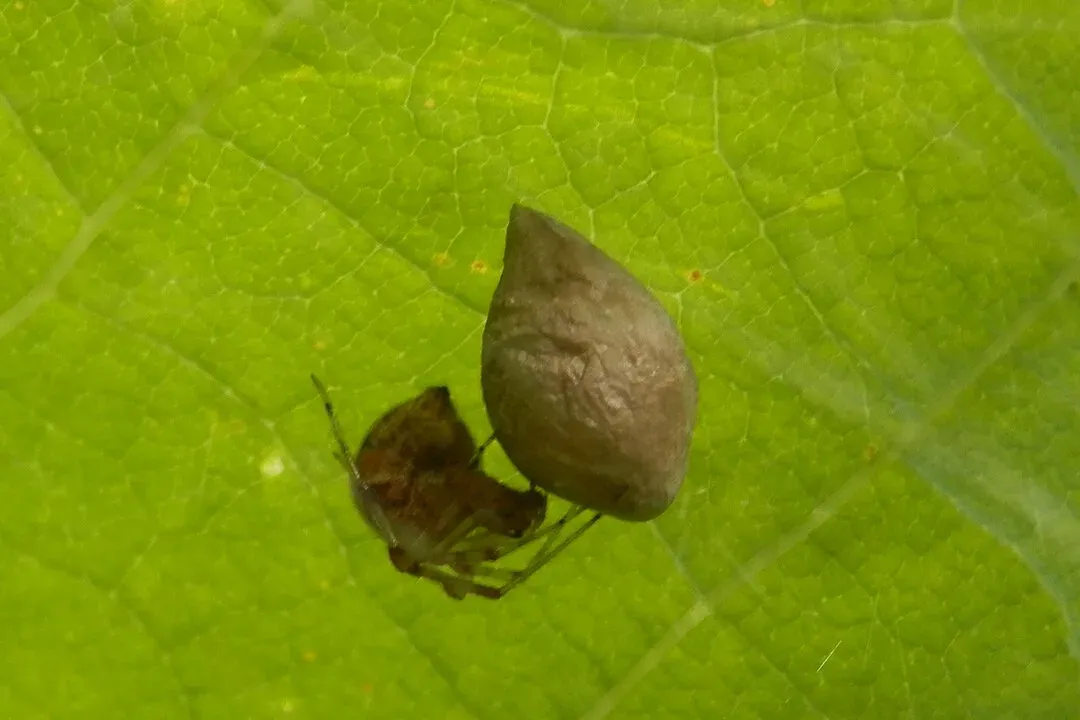
A common house spider with its brown egg sac. Photo: Ryan Hodnett (CC BY-SA 4.0), cropped, via Wikimedia Commons.
The common house spider is the one you’re most likely to meet indoors. Its sacs hang in the same tangled cobweb as the spider, often several at a time.
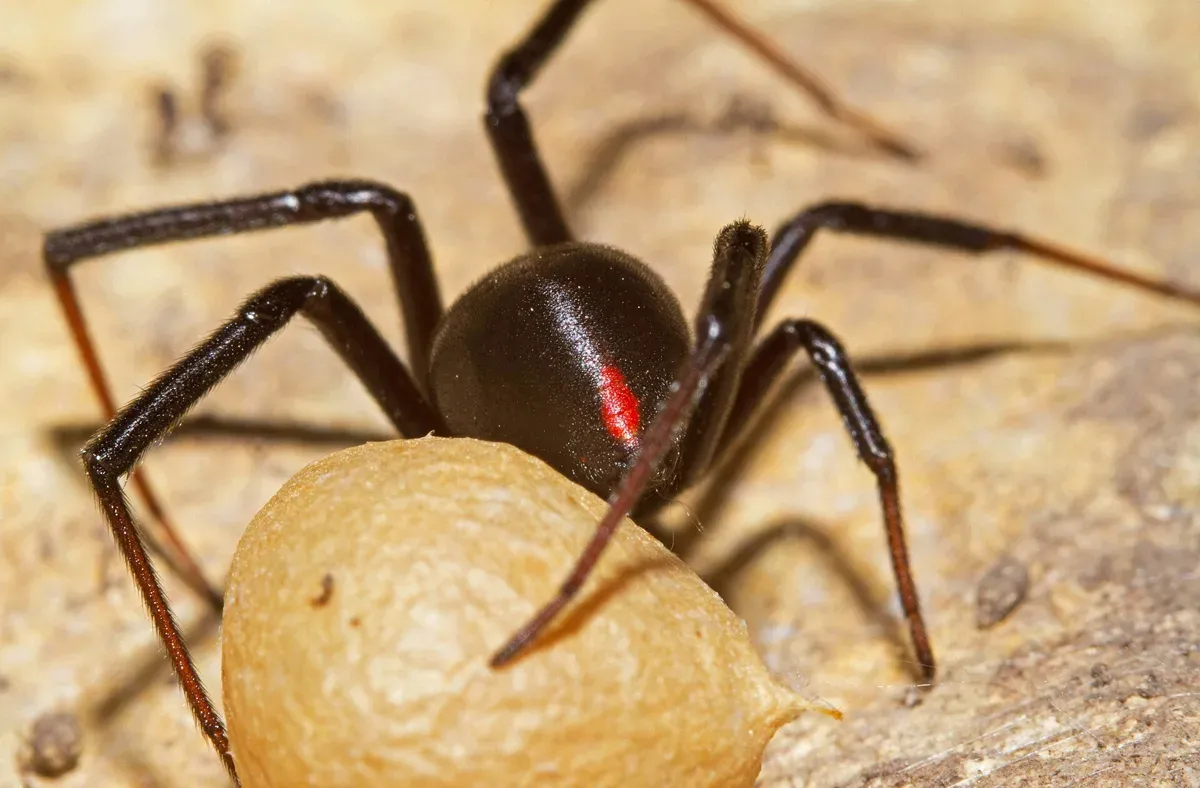
A black widow beside her tan egg sac. Photo: Alejandro Santillana, Insects Unlocked, University of Texas at Austin (public domain), cropped, via Wikimedia Commons.
A black widow sac is bigger and paler than a house spider’s, and the web around it is an irregular tangle low to the ground. Leave the spider alone and use gloves and a vacuum.
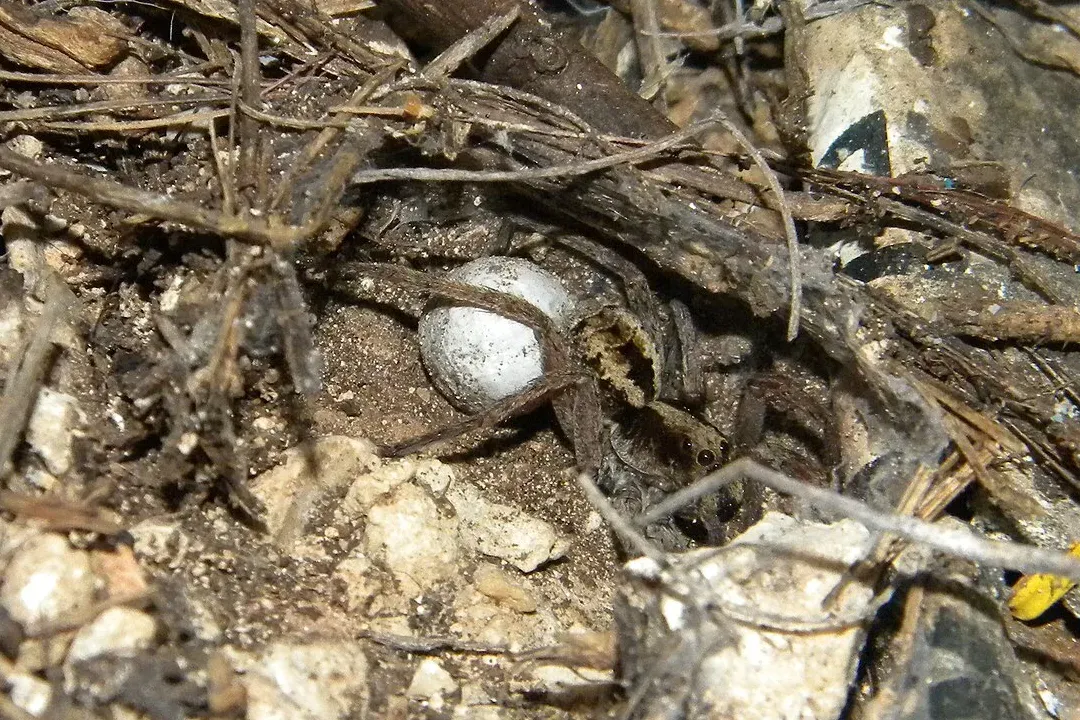
A wolf spider carrying her egg sac. Photo: Maximilian Paradiz (CC BY 2.0), cropped, via Wikimedia Commons.
Wolf spider mothers carry the sac around with them, and when the spiderlings hatch they climb onto her back and ride around until partially grown (Oregon State). If you see a large hairy spider covered in tiny ones, that’s what it is.
How Many Spiders Are in an Egg Sac?
Dozens to hundreds, depending on the species: about 40 to 50 in a brown recluse sac (University of Kentucky), 140 to 380 in a common house spider sac (Penn State) and 250 to 750 in a black widow sac (NC State).
How Long Do Spider Eggs Take to Hatch?
It depends on the species and the temperature. Black widow eggs hatch in two to four weeks, depending on temperature (NC State); Penn State puts it at about eight days, after which the young stay in the case for about nine more.
How to Get Rid of a Spider Egg Sac Safely
Step 1: Put on gloves. Especially if the spider could be a black widow or brown recluse.
Step 2: Vacuum it up. Use the hose with a crevice tool to take the sac, the web and any spider in one pass. UC IPM calls vacuuming an effective way to control spiders, and NC State suggests vacuuming along baseboards, in corners and under and behind furniture.
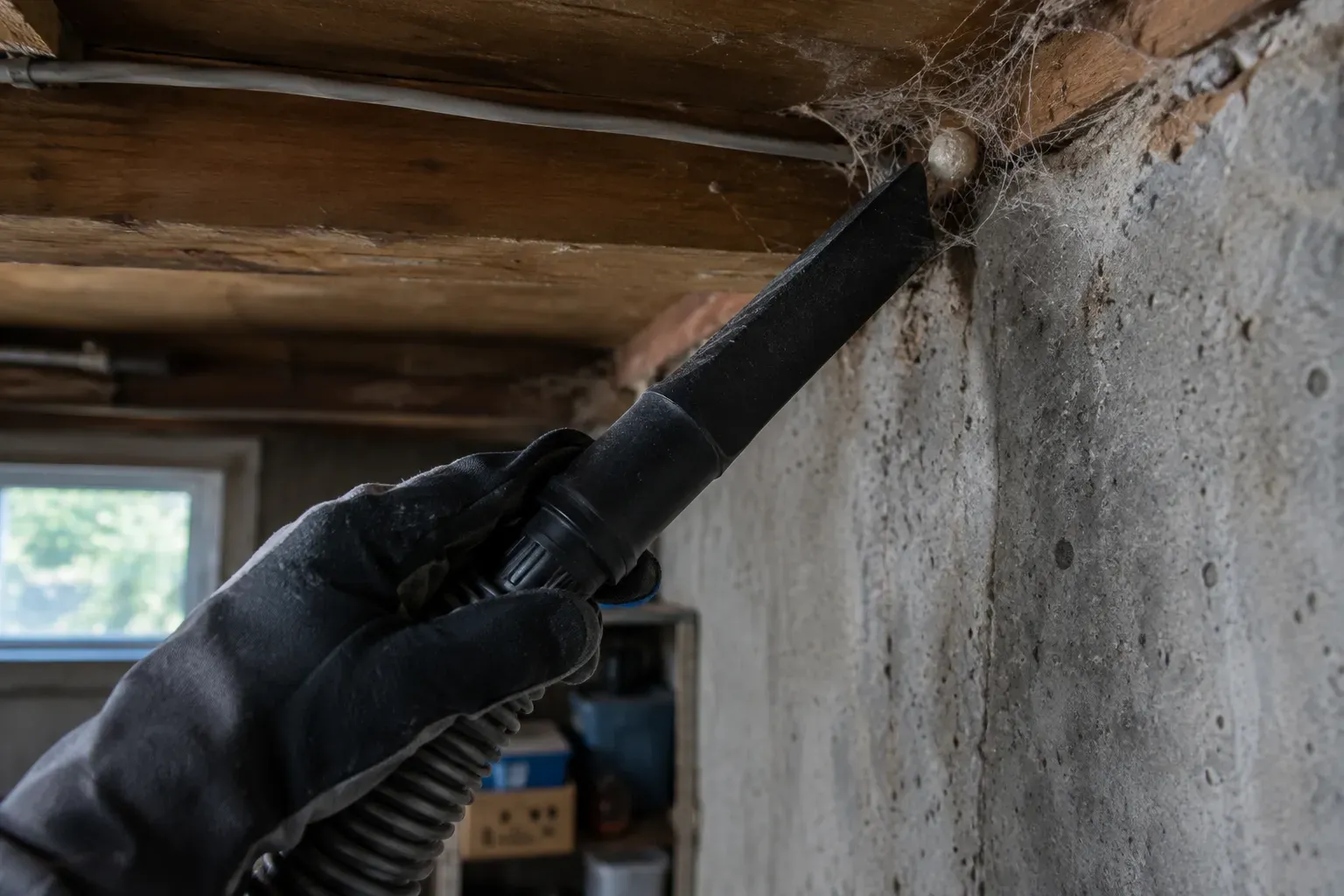
Illustration: vacuuming a cobweb and egg sac out of a basement corner.
Step 3: Throw the contents away sealed. Empty the canister or remove the bag into a plastic bag, tie it shut and put it in the outdoor trash.
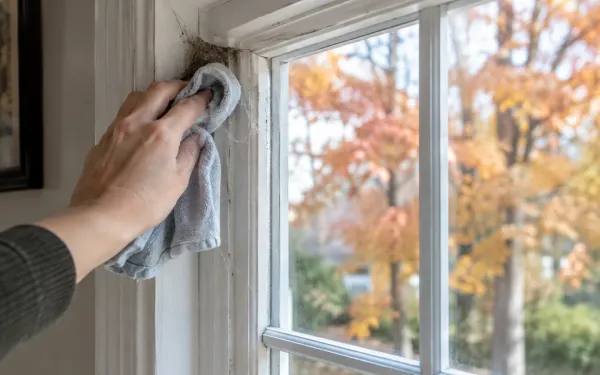
Step 4: Clear the places spiders build. Knock down webs regularly, reduce clutter in garages and basements, and seal cracks around windows and doors. How to get rid of spiders has the full plan.
Don’t pick a sac off by hand or try to crush it: vacuuming takes the sac, the web and the spider together without touching them. Sprays aren’t needed for a single sac.
When to Call a Pro
If you find egg sacs or spiders you think are black widows or brown recluses in places you use every day, such as closets, bedding or a child’s room. Look-alikes are common, so compare with the black widow and brown recluse pages first, and see the hobo spider page for another spider often mistaken for a dangerous one.
Common questions
Indoors, yes: vacuum it up and throw the contents away sealed. Outdoors, in a garden or woodpile, you can leave it: nearly all common spiders are harmless and eat other insects.
Yes. Common house spiders build their webs in the corners of walls, floor joists and windows (Penn State), and brown recluse egg sacs turn up along joists, sills and rafters in garages, attics, basements and crawl spaces (University of Kentucky).
The eggs are hidden inside a silk sac. What you see is a small ball or teardrop of silk, white, cream, tan or brown, about ¼ to ½ inch across, usually in a web or a sheltered corner.
From about 40 in a brown recluse sac to several hundred in a common house spider or black widow sac.
The Bottom Line
A spider egg sac is a small silk ball in a web or corner. Indoors, vacuum it up with the web and spider, seal the contents in a bag and throw it out, then clear webs and clutter so spiders have fewer places to build.
Sources and further reading · 6
- Penn State Extension: Common House Spider: egg sac color, size, eggs per sac, web sites.
- Penn State Extension: Southern Black Widow Spider: egg sacs per female, eggs per sac, hatching.
- UC IPM: Spiders (Pest Notes 7442): black widow egg sacs, vacuuming.
- NC State Extension: Spiders in and Around Homes: black widow eggs and hatching, carrying egg sacs, vacuuming.
- University of Kentucky Entomology: Brown Recluse Spider (ENTFACT-631): egg sacs and where they’re found.
- Oregon State University Extension: How to Identify a Wolf Spider: egg sacs and spiderlings.