Does Baking Soda Kill Roaches? What the Evidence Shows
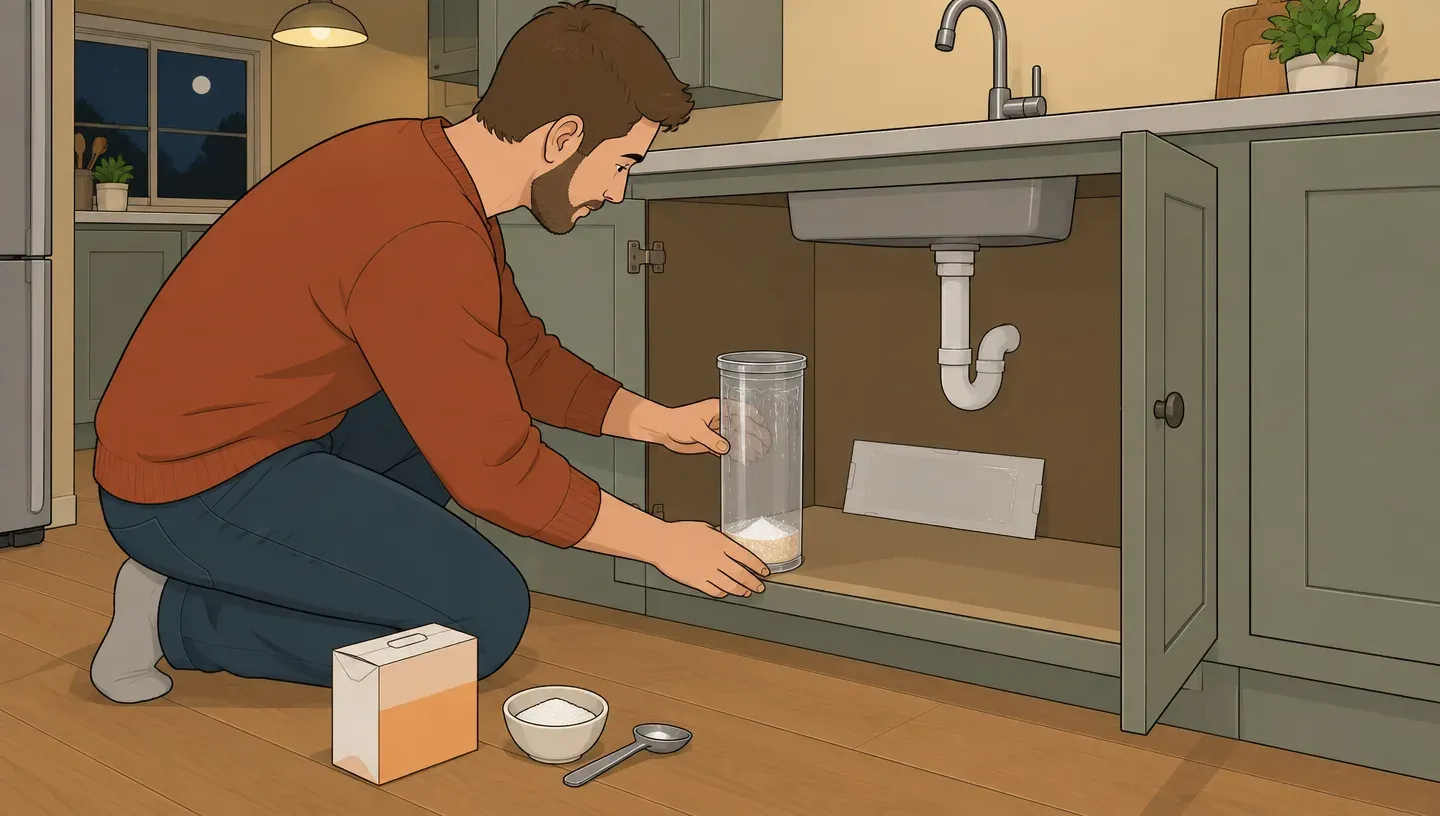
Illustration: a clear jar trap with a white baking soda and sugar mix, set beside a sticky trap at the back of the cabinet under the kitchen sink.
Does baking soda kill roaches? Sometimes, in a sugar mix they eat inside a trap, but not enough to end an infestation. Extension experts say it does little, and no study has counted roaches in a home before and after. A $9 tube of gel bait works better; skip open piles of baking soda and the vinegar mix.
Cost: about $54 in supplies. Difficulty: moderate. Call a pro if your sticky traps still catch roaches after two rounds of gel baiting, roaches have spread beyond the kitchen and bathroom, or they keep coming in from a neighboring apartment.
This guide compares baking soda with boric acid, diatomaceous earth and gel bait, explains the one study behind the hype, and shows how to test the pantry version if you still want to. We haven’t tested baking soda ourselves; this rests on a 2025 trap study, Virginia Tech, University of Kentucky and UC IPM guidance, Poison Control, veterinary pharmacists and list prices. The full plan to get rid of roaches covers cleanup and follow-up.
How We Compared Baking Soda and the Alternatives
We rated each option on five things:
- Evidence on roaches: field study, lab study, extension advice or none.
- Reach: whether it gets to roaches hiding in cracks, not just the ones that wander out.
- Spread: whether it kills roaches that never touched it.
- Safety around kids and pets: what happens if a child or pet eats it.
- Price: U.S. list prices checked October 1, 2026.
Sources are listed at the end.
Does Baking Soda Kill Roaches? What the Sources Say
Sometimes, inside a trap. A 2025 study in The Journal of Basic and Applied Zoology found more dead roaches in traps baited with baking soda plus sugar or peanut butter than in traps with the food alone.
Whether it shrinks an infestation is a different question. Virginia Tech’s insect identification lab writes that borax, baking soda and baking powder “do little to reduce cockroach populations,” and that people confuse them with boric acid. Home websites repeat the equal-parts recipe and call it “deadly” without citing a test.
Baking Soda vs. Other Roach Killers at a Glance
| Option | Evidence on roaches | Price | Main limitation |
|---|---|---|---|
| Baking soda + sugar in a jar | One small trap study | $1.69 a pound | No proof it shrinks an infestation |
| Open pile of baking soda | None | $1.69 a pound | Only reaches roaches that come out to it |
| Boric acid dust | The most common active ingredient in roach dusts | $18.50 a pound | Must be a barely visible film, kept dry |
| Diatomaceous earth | Dries insects out (NPIC) | Varies | Works only where it stays dry |
| Gel bait | Can match professional results (Kentucky) | $8.99 a tube | Sprays nearby stop roaches eating it |
List prices from Target, DoMyOwn and HomeandGardenSupply, October 1, 2026, before tax.
What the Baking Soda and Sugar Study Found
Researchers in Ghana set tall plastic jar traps, greased inside so roaches couldn’t climb out, in a dorm bedroom and two homes for 30 days. Some held 1 tablespoon of sugar; others held the same sugar mixed with 1 tablespoon of baking soda. Share of trapped roaches found dead:
| Room | Sugar + baking soda vs. sugar alone |
|---|---|
| Dorm bedroom | 85% vs. 36% |
| Home storeroom | 54% vs. 31% |
| Home kitchen | 66% vs. 20% |
Peanut butter traps showed the same pattern. Baking soda raised the death rate among roaches already stuck in the jar, but the trap did a lot of the work: 20–36% died with sugar alone. Nobody counted the roaches in the home before and after, and the authors note that baking soda’s effect on insects “is not well-supported by scientific studies.”
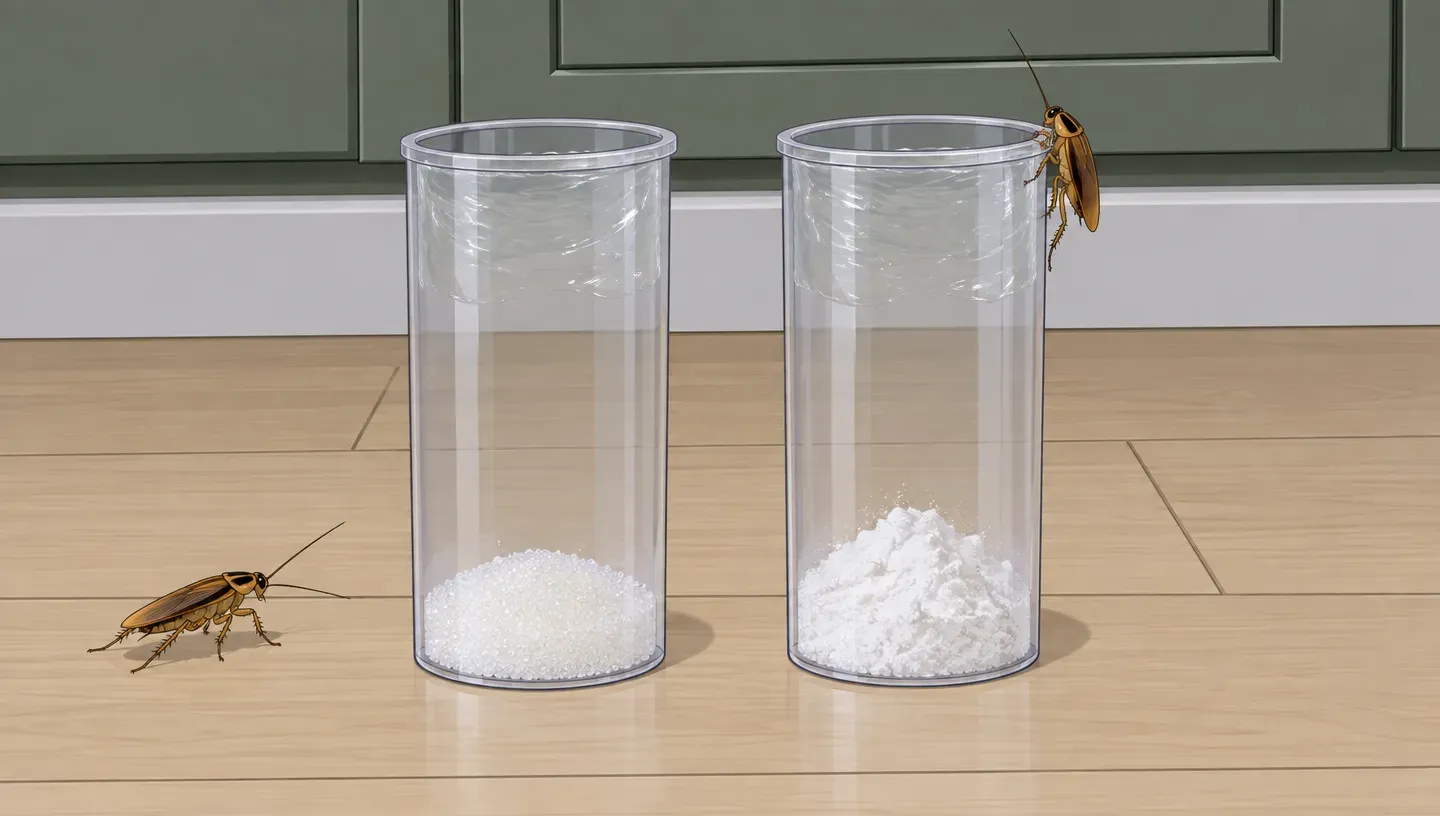
Illustration: jar traps with sugar alone (left) and sugar mixed with baking soda (right), their inside walls coated with petroleum jelly.
How Does Baking Soda Kill Roaches?
The popular explanation: baking soda reacts with acid in the roach’s gut and the gas kills it. Nobody has measured this, and no study has timed how fast it works.
The bigger gap is the hidden roaches. Gel bait spreads: the University of Kentucky notes that roaches that never touched the bait can die from traces in the spit and droppings of those that did. Nothing shows baking soda spreads that way.
Baking Soda and Sugar in a Jar: A Small Effect, If You Copy the Study
If you still want to try the pantry version, copy the setup that produced results, not the open piles most recipes suggest.
Step 1: Mix 1 tablespoon of baking soda with 1 tablespoon of sugar or peanut butter.
Step 2: Use a tall, greased container. A clean plastic container about 9 inches tall, like the study’s, with a thin coat of petroleum jelly on the inside walls.
Step 3: Set it where roaches travel, such as under the sink or behind the fridge, out of reach of kids and pets.
Step 4: Put sticky traps beside it and count every few days. Falling counts mean something is working; steady counts mean switch to gel bait.
Best for: curiosity, alongside sticky traps.
Main limitation: it kills roaches that fall in, with no evidence it clears a home.
Open Piles of Baking Soda: Skip Them
An open pile on a paper towel only reaches roaches that come out to it; many stay in the cracks where gel bait goes. Sweetened, it also tempts children and pets.
Best for: nothing.
Main limitation: no test behind it, and it sits in the open.
Boric Acid: The Powder People Mean to Use
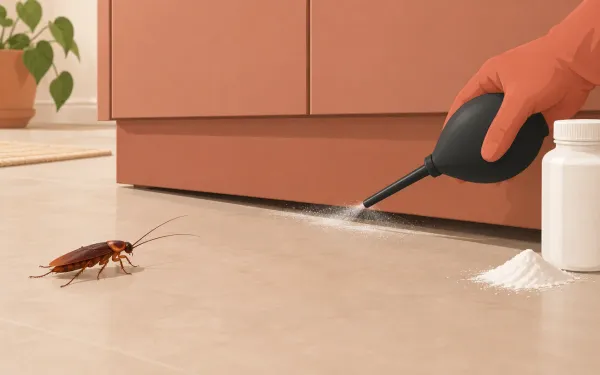
Much online talk mixes baking soda up with boric acid, an insecticide sold as roach powder. Roaches walk through it and swallow it while cleaning themselves, and in a 2004 lab study, 0.5–2% boric acid in sugar water gave “rapid and effective kill” of German cockroaches. The sugar idea isn’t the problem; the active ingredient is. Boric acid for roaches goes on as a barely visible film blown into cracks.
Best for: dry cracks and voids, alongside bait.
Main limitation: heavy piles repel roaches, and it must stay out of reach.
Diatomaceous Earth: Only Where It Stays Dry
Diatomaceous earth is a dust made of fossilized algae. It dries insects out by absorbing the oils and fats from their outer shell (NPIC), so it works only where it stays dry.
Best for: dry voids, if you already have it.
Main limitation: useless in a damp sink cabinet.
Gel Bait: What Works Better Than Baking Soda
The University of Kentucky says most householders get better results with baits than with other insecticides, that used correctly they can match professional extermination, and that they pose minimal hazard to children or pets.
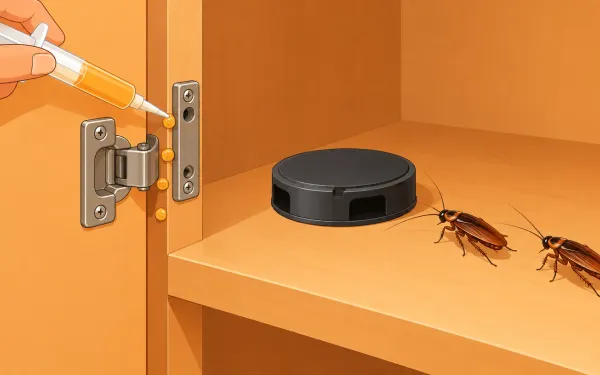
Buy one tube and check the label for a proven active ingredient: fipronil, indoxacarb, abamectin, dinotefuran or hydramethylnon. Put many small dabs in cabinet hinge gaps, under the sink and behind the fridge; one sink cabinet alone may need more than a dozen. Don’t spray nearby: Virginia Tech warns aerosols and liquids can repel roaches from bait. Dot size and refills are in the roach gel bait guide.
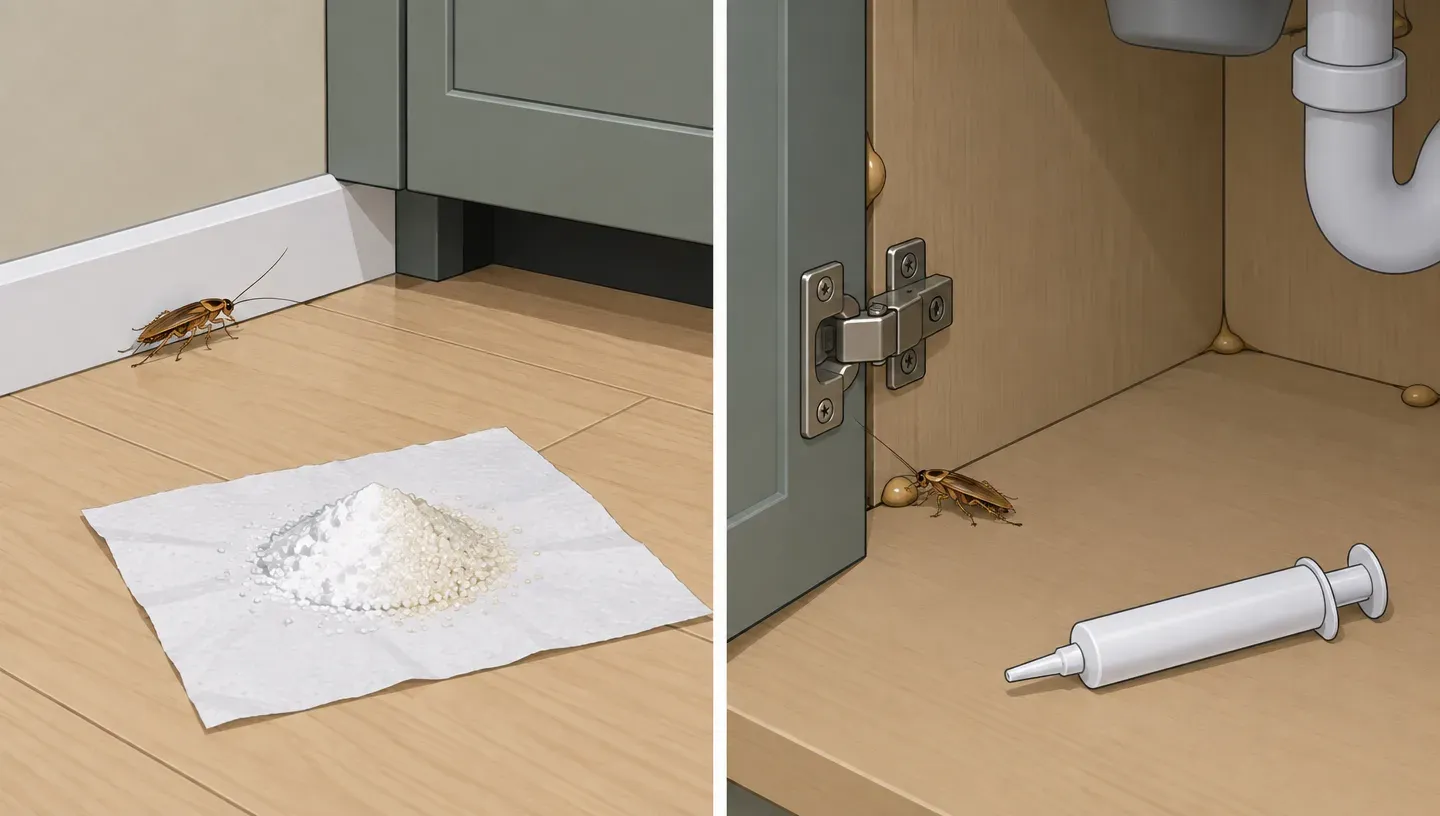
Illustration: baking soda and sugar on a paper towel in the open (left), and dots of gel bait in a cabinet hinge gap where a roach is feeding (right).
Best for: any roach infestation in a kitchen or bathroom.
Main limitation: expect 7 days or more before you see fewer roaches (UC IPM).
Is Baking Soda Safe Around Kids and Pets?
Not completely. Poison Control says swallowing too much can cause serious toxicity, and the gas it forms can build pressure in the stomach. Its bad taste may keep most children from eating much, but sugar or peanut butter hides that, so treat the mix like any other bait. If a child swallows some, call Poison Control at 1-800-222-1222.
For pets, the American College of Veterinary Pharmacists puts the toxic dose at 10–20 grams per kilogram of body weight. For a 10-pound cat, that’s around 45 grams, less than three tablespoons (our math). Vomiting is usually the first sign, within 3 hours; call your vet if a pet gets into it.
Which Option Fits Your Situation
| Situation | What to use | Why |
|---|---|---|
| Saw a roach tonight | Sticky traps along walls and under the sink | The spots that catch the most show where bait goes tomorrow. |
| Small striped roaches in the kitchen | Gel bait and a steady plan | German cockroaches breed indoors; see the German roach plan. |
| Cat, dog or toddler at home | Gel deep in cracks; no sweetened baking soda | Sugar hides baking soda’s taste; bait is minimal hazard placed well. |
| You want to try baking soda | The jar setup, with sticky traps beside it | Trap counts tell you whether to switch. |
| You already sprayed | Gel in cracks you didn’t spray | Spray residue repels roaches from bait. |
| Roaches come from next door | Bait, plus a written note to the landlord | Include your trap counts. |
What It Might Still Cost
| Item | Price |
|---|---|
| Baking soda, 1 lb | $1.69 |
| Roach gel bait, one 2.1 oz tube | $8.99 |
| Sticky traps, 25 boards | $21.99 |
| Boric acid roach powder, 1 lb | $18.50 |
| Full DIY kit: 4 tubes of gel bait, 25 sticky traps, caulk for gaps | About $54 |
| Pro cockroach visit, 25 shared quotes (middle half) | $200–$400 |
| Pro cockroach treatment, price-guide range | $100–$600 a round |
| Pro full treatment with follow-ups, 10 shared quotes (middle half) | $450–$1,500 |
DIY: list prices from Target, DoMyOwn and HomeandGardenSupply, October 1, 2026, before tax and shipping. Pro: the middle half of 25 single-visit and 10 full-treatment quotes homeowners shared on Reddit. Price-guide range and annual plans: This Old House (March 2026).
To start, one tube plus the sticky traps comes to about $31 (our math); the $54 kit is the full supply list for a whole-home plan. Baking soda saves about $7 over a tube of bait, but you may spend weeks on a mix with thin evidence while roaches keep breeding. Sticky roach traps show progress but won’t clear an infestation alone.
Before You Try Baking Soda: A Quick Checklist
- Set sticky traps first, under the sink and behind appliances.
- Buy one tube of gel bait with a listed active ingredient.
- Dab gel in hinge gaps and corners, not in the open.
- Keep sprays away from the bait.
- Use a tall greased jar, not an open pile, if you test baking soda.
- Keep any sweet mix out of reach of kids and pets.
- Count trap catches every few days and switch if they hold steady.
When to Call a Pro
Call a pro if sticky traps still catch roaches after two rounds of gel baiting, roaches spread beyond the kitchen and bathroom, or they keep arriving from a neighboring unit. What an exterminator does explains what to expect from the visit.
Common questions
No source shows that it does. Poison Control notes that baking soda needs an acid to release carbon dioxide bubbles, so the mix fizzes in the bowl long before any roach eats it. Vinegar’s smell has no home test as a repellent either (what smells roaches hate).
No study tested it. The idea that roaches can’t burp, so gas builds up and kills them, is the same unmeasured gut-gas theory, worded differently.
Baking powder is baking soda with a dry acid added. It’s on the same Virginia Tech list of remedies that do little.
No. UC IPM says even a good bait program may take 7 days or longer, partly because females carrying egg cases barely feed. Start gel bait today and track it with sticky traps.
The Bottom Line
Baking soda can finish off a roach stuck in a greased jar, but nothing shows it clears a home. Spend the extra $7 on a tube of gel bait, dab it where roaches hide, and let sticky traps tell you it’s working.
Sources and further reading · 8
- Aboagye et al. (2025), “Non-insecticidal control of domestic and peri-domestic species of cockroach,” The Journal of Basic and Applied Zoology 86:28
- Virginia Cooperative Extension: Cockroaches Found in Living Spaces (ENTO-528NP)
- University of Kentucky: Cockroach Elimination in Homes and Apartments (ENTFACT-614)
- UC IPM: Cockroaches (Pest Notes 7467)
- Gore and Schal (2004), boric acid-sugar solutions as German cockroach baits, Journal of Economic Entomology
- Poison Control: My Child Got Into the Baking Soda
- American College of Veterinary Pharmacists: Baking Soda
- This Old House: Roach Exterminator Cost