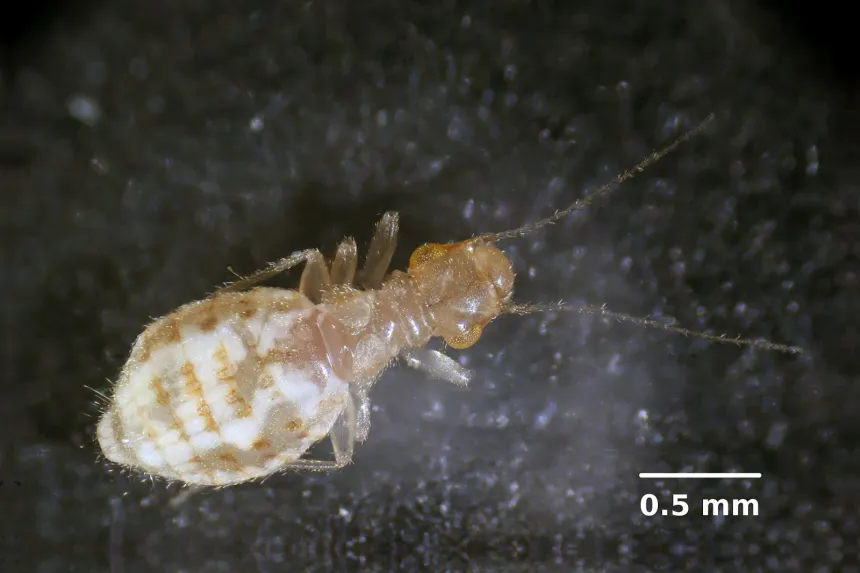
- Scientific name
- Psocoptera (order)
- Also called
- psocids, paperlice
- Size
- About 1/32–1/16 in
- Color
- Pale gray, cream or translucent
- Found in
- Damp books and papers, cardboard, pantry shelves, window sills
- Harmful?
- No. Don't bite; can contaminate stored food
- Active
- Year-round where humidity is high, worst in summer
Booklice are tiny, pale insects that feed on the microscopic mold growing on damp paper, cardboard and stored food. They’re harmless: they don’t bite, don’t spread disease and usually cause little damage, but seeing them means the humidity is too high. The one thing to do: dry the room out, because without at least 60% humidity they can’t survive.
This page covers how to identify booklice, tell them from look-alikes and why they turn up in books and pantries. It rests on University of Maryland Extension and University of Nebraska–Lincoln guidance (published by Utah State).
How to Identify Booklice: Tiny, Pale and Wingless
- Tiny: about 1/32 to 1/16 inch (1 to 2 mm), barely visible.
- Almost colorless, gray or light brown, soft-bodied, with a relatively large head. The shape loosely resembles a head louse, which is where the name comes from, but they aren’t lice.
- Wingless in the common indoor species; they move in quick, jerky runs.
- In groups, especially where something smells moldy.
Groups of small whitish insects in a damp spot, particularly with mold present, point to booklice (University of Nebraska–Lincoln).
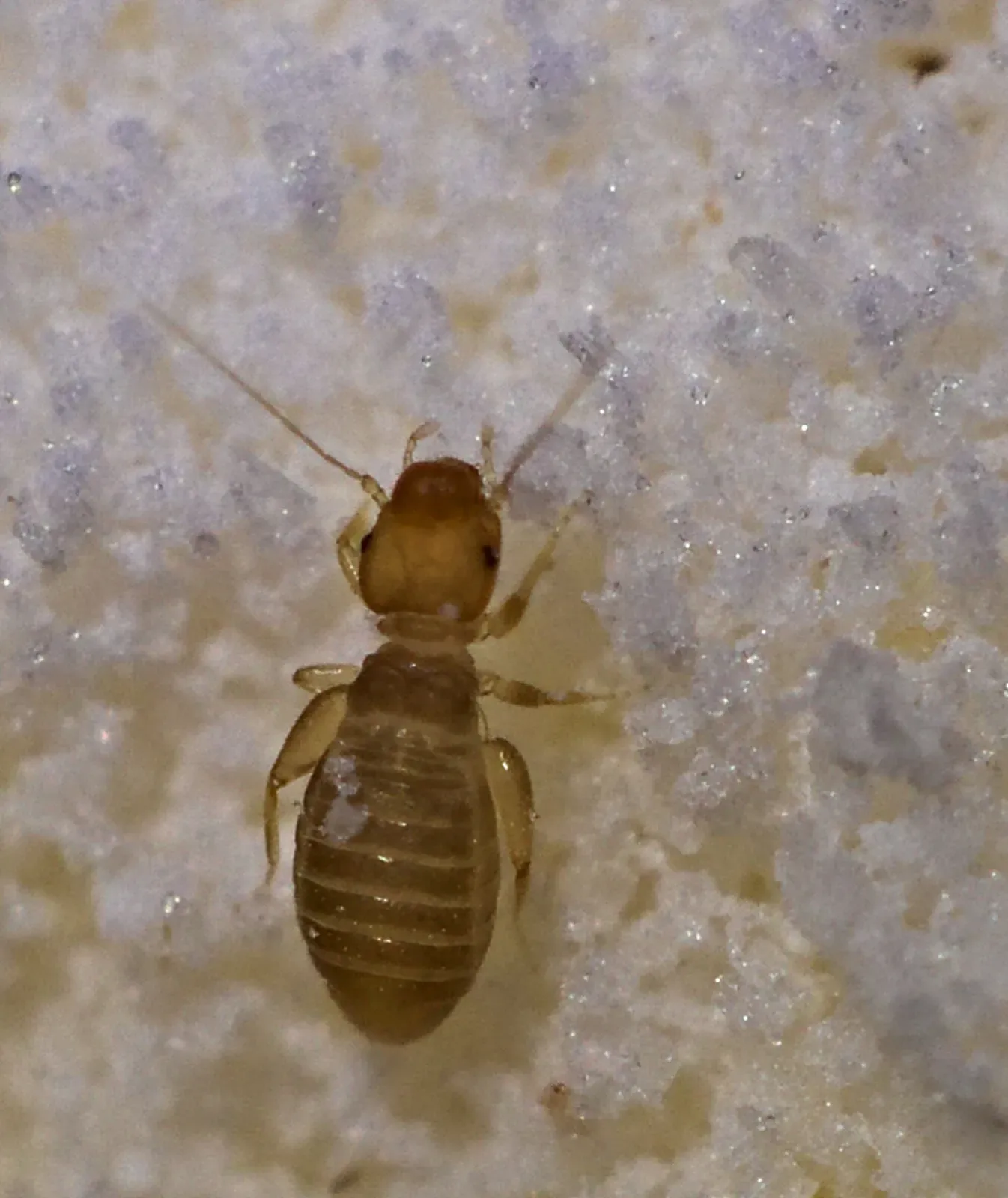
A booklouse in a bag of flour, where damp, slightly moldy food draws them. Photo: Andreas Eichler (CC BY-SA 4.0), via Wikimedia Commons.
Booklice vs. Look-Alikes: Size, Tails and Jumping
| Insect | How it differs | How to tell |
|---|---|---|
| Booklice | 1–2 mm, pale, soft, wingless | Groups on damp paper, boxes and shelves |
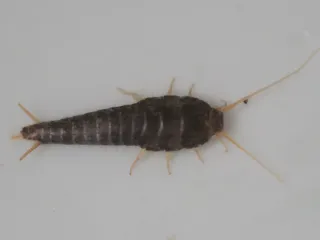
| Silverfish | About 1/2 in, silvery scales, carrot-shaped | Three long tail bristles |
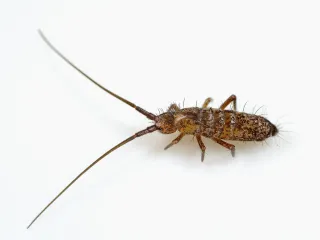
| Springtail | Similar size; gray, white, black or bluish | Jumps when disturbed |
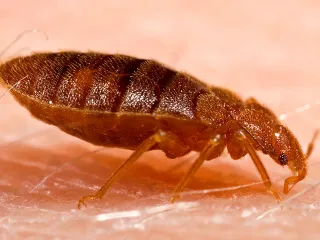
| Bed bug nymph | Flatter; pale, turning red after feeding | In mattress seams, not on paper |
Booklice are much smaller than silverfish and lack the three long bristles at the tail end (University of Nebraska–Lincoln).
Why Booklice Show Up: Damp Air and Mold
They need warm, moist conditions where mold and mildew grow, with humidity of at least 60%. They prefer damp, warm, undisturbed spots and are most numerous in houses in spring and summer (University of Maryland). They often arrive in boxes stored in damp basements or attics, can wander in from outdoors, and once they find food they stay close to it. Outdoors, their relatives live under tree bark feeding on mold.
Mold is the main food, but not the only one. A booklouse may also feed on starchy materials (University of Maryland), such as the starch sizing in book bindings and along the edges of pages (Utah State). That’s why old books, paper and cardboard boxes in a damp room are where they gather first.
Where You’ll Find Booklice: Books, Boxes and Pantries
- Old books, papers and documents in damp rooms
- Cardboard boxes in basements and garages
- Pantry shelves, flour, cereal and pet food in humid kitchens
- Window sills with condensation, and new homes where plaster is still drying
- Houseplants, where they likely feed on the sooty mold that grows on aphid honeydew
Are Booklice Harmful? No, but They Point to Moisture
No. They don’t bite and don’t spread disease, and they cause little direct damage because they feed chiefly on mold. They can eat the starch sizing in book bindings and along page edges, and they can contaminate stored food. The bigger issue is the moisture: left alone, it can bring termites, carpenter ants and wood rot (University of Nebraska–Lincoln).
How to Confirm It’s Booklice
- Look closely with a magnifier: tiny, pale, soft and wingless, about 1 to 2 mm.
- Check for tails and jumping: three long bristles mean silverfish; a jump means springtails.
- Sniff and look for mold on the paper, cardboard or shelf where they gather.
- Set a sticky trap nearby to catch a few for a closer look.
What to Do: Dry It Out, Toss the Moldy Stuff
Lower the humidity: fix leaking pipes, ventilate closed rooms and run a dehumidifier in rooms that stay damp. Throwing out moldy cardboard and food is often the simplest fix; air out or dry books and store paper in sealed plastic bins. Books you want to keep can go in a plastic bag in the freezer for a week. Pesticides shouldn’t be necessary; vacuum up the ones you see. For other pests, browse all pest guides.
Often confused with
Sources
- Booklice (University of Maryland Extension)
- Silverfish, Firebrats and Booklice (Utah State University Extension)
Last reviewed Oct 10, 2026.