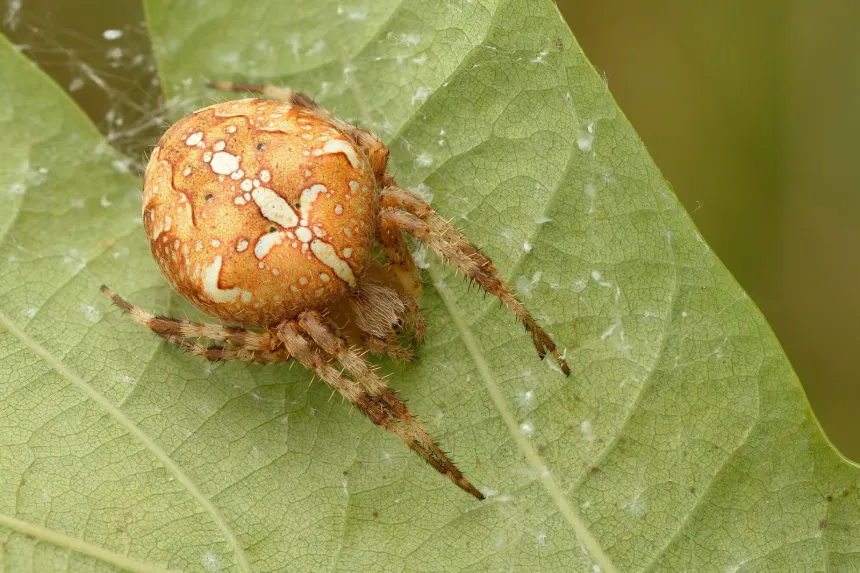
- Scientific name
- Araneidae (family)
- Also called
- garden spider, barn spider, cross spider, writing spider
- Size
- Body about 1/4 in to over 1 in for large garden spiders
- Color
- Varies; many brown or gray, some bright yellow and black
- Found in
- Gardens, porches, eaves, outdoor lights, shrubs
- Harmful?
- No
- Active
- Late summer and fall
Orb weavers are the spiders behind the round, wheel-shaped webs on porches, between shrubs and around outdoor lights. They’re harmless: reluctant to bite, with a minor bite, and they catch large numbers of flying insects. The one thing to do: leave them where they’re not in the way, or brush the web down and let them move on.
This page covers how to identify an orb weaver and its web, which ones you’ll see, and how to keep webs off the porch. It rests on University of Kentucky and UC IPM guidance.
How to Identify an Orb Weaver: The Wheel-Shaped Web
- The web: a flat, round web with spokes and a spiral, usually rebuilt every day or night.
- Large, round abdomen, often wider than the front body.
- Colors vary: many are brown or gray, some are bright yellow and black, others have a white cross pattern.
- Size: from about 1/4 inch to over an inch in big garden spiders.
The spider rests at the center of the web or hides in a shelter near its edge, waiting for prey. Orb weavers have poor eyesight and find prey by feeling vibrations in the web; they have trouble walking on anything but silk (University of Kentucky, UC IPM). Young spiders often spin very symmetrical webs, while adults may add a design that helps identify the species. There are about 200 species in North America.
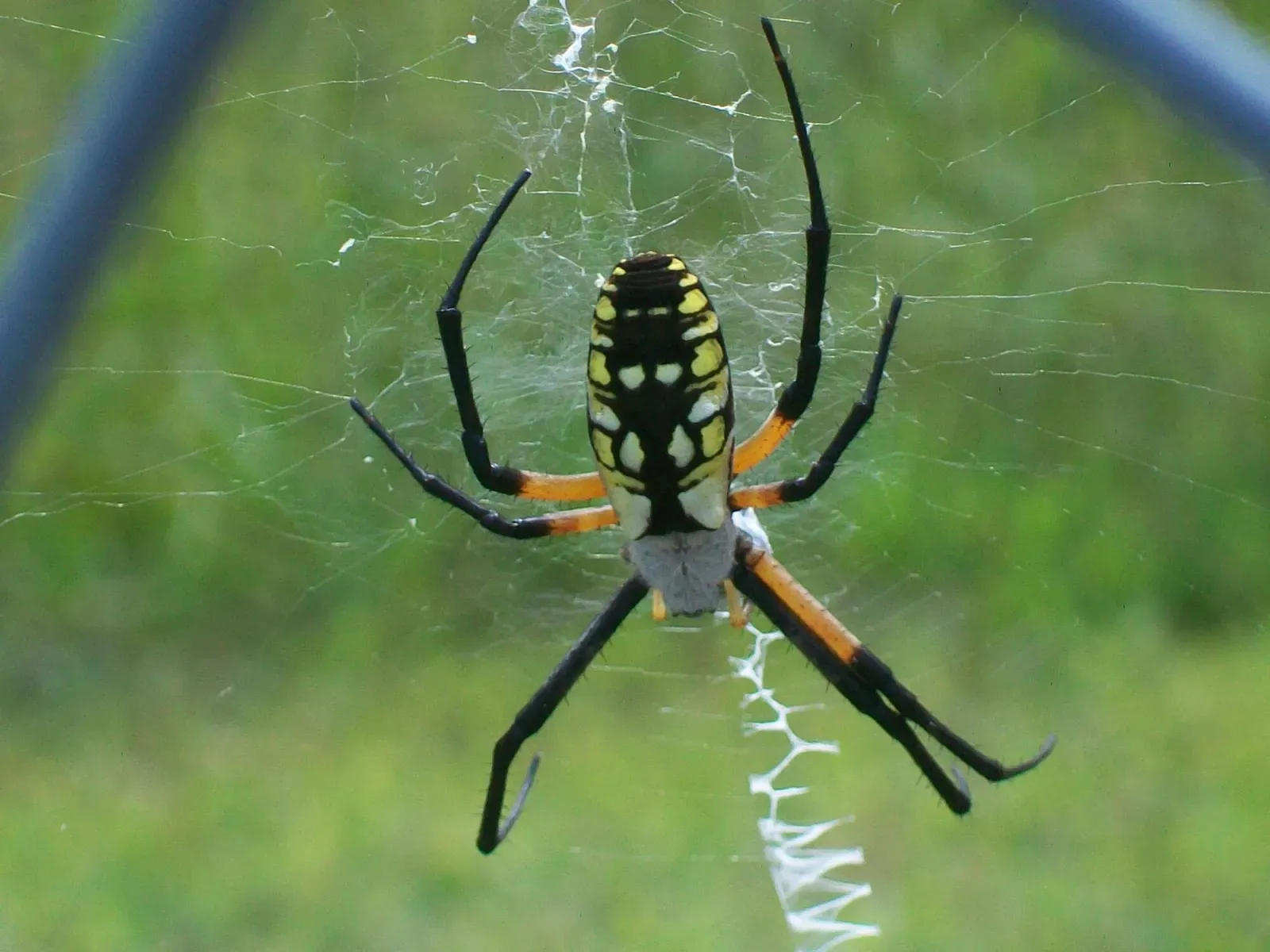
A black and yellow garden spider in its web, the way you’ll see orb weavers in late summer. Photo: AmaryllisGardener (CC BY-SA 3.0), via Wikimedia Commons.
Common Orb Weavers: Garden Spiders and Their Relatives
- Black and yellow garden spider: large and striking; builds in open, sunny spots in gardens and tall grass.
- Marbled spider: yellow-orange abdomen with brown to purple markings; prefers wooded areas between trees and shrubs.
- Spiny-bellied spiders: small orb weavers with thorn-like points on the abdomen.
Orb Weaver vs. Look-Alikes: Check the Web
| Spider | Web | How to tell |
|---|---|---|
| Orb weaver | Neat round web with spokes and a spiral | Sits in the center or at the edge |
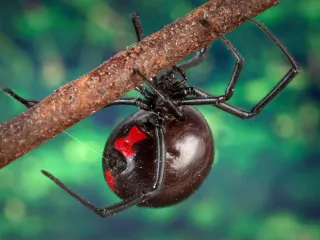
| Black widow | Irregular, tough, sticky cobweb | Hangs upside down showing a red hourglass |
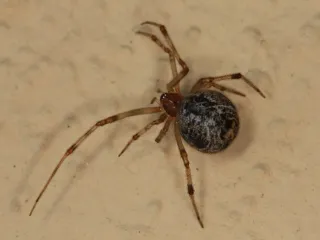
| Common house spider | Tangled cobweb in corners | Small, round, mottled brown |
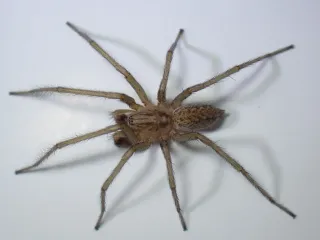
| Funnel weaver | Flat sheet narrowing into a tube | Waits in the tube; see hobo spider |
When You’ll See Them: Late Summer and Fall
Orb weavers grow all summer, so the biggest spiders and webs appear in late summer and fall. Webs are rebuilt often, so knocking one down rarely bothers the spider for long. Outdoors they’re also prey: mud daubers stock their nests with paralyzed spiders.
Where You’ll Find Them: Outside, Near Lights
- Gardens, shrubs and tall flowers
- Porch corners, eaves, decks and railings
- Near outdoor lights that attract moths and other insects
They rarely come indoors but often live on or near the outer walls of buildings (University of Kentucky).
Are Orb Weavers Harmful? No
They’re reluctant to bite, and a bite is minor. The University of Kentucky notes that most spiders don’t attempt to bite at all, and many have fangs that can’t pierce skin. UC IPM says most spiders are beneficial predators of insects and most can’t harm people. Orb weavers feed on whatever flies, falls or blows into the web, so a porch web next to a light is catching the moths and other insects the light draws in.
How to Confirm It’s an Orb Weaver
- Look at the web: round, flat, with spokes and a spiral.
- Find the spider at the hub or in a retreat at the edge.
- Check the setting: outdoors, on a porch, in a garden or by a light.
- Note the season: the largest orb webs show up in late summer and fall, after a summer of growth.
What to Do: Leave It or Move It
Leave them where they’re not in the way. To move one, knock the web down with a broom; they’ll often rebuild elsewhere. A broom or vacuum also takes down egg sacs, which matters because each sac can hold hundreds of young spiders. Tight window screens and door sweeps keep the occasional wanderer out (University of Kentucky). Yellow or sodium-vapor bulbs at outside doors draw fewer night-flying insects, so fewer spiders set up next to them (University of Kentucky). For other pests, browse all pest guides.
Often confused with
Sources
- Common Spiders Found Around Homes and Buildings (University of Kentucky Entomology, EF622)
- Spiders (UC IPM)
Last reviewed Oct 4, 2026.